Showing posts with label winter. Show all posts

Saturday, October 25, 2025

hive preparation for winter


beekeeping,bee,winter,bee cozy,bee space,bee nest,winter cluster,air flow,

Refer to Derek’s 2024 paper in the Journal of Thermal Biology, Are man-made hives valid thermal surrogates for natural honey bee nests? Derek reports that “bee space above combs increases heat loss by up to ∼70%; hives, compared to tree nests, require at least 150% the density of honey bees to arrest convection across the brood area.”

In a hive, brood heat typically circulates by (1) rising between frames, (2) striking the inner cover, (3) spreading sideways, and (4) descending through the cold bee space.

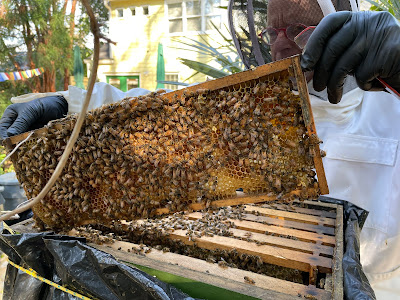
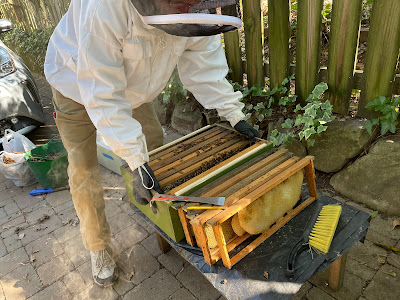
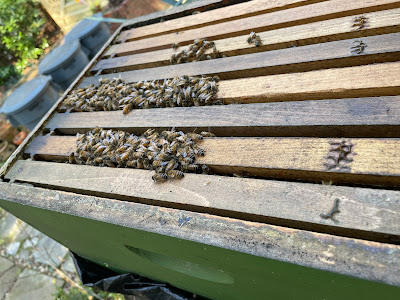
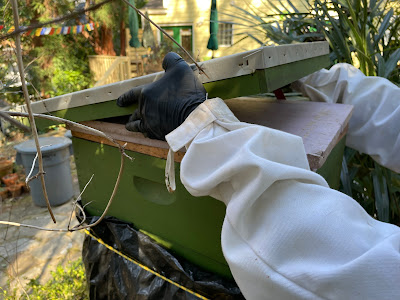
To improve insulation, I added an external Bee Cozy (R-value 8) and took internal measures to limit brood heat circulation by blocking the bee space above the combs. I used letter-sized plastic sheets (the type made for overhead projectors), placing one spliced and trimmed sheet directly on the top bars beneath each hive’s inner cover.

Wednesday, December 25, 2024

learning from natural honey bee nests

beekeeping,bee,winter,bee cozy,winter cluster,bee nest,bee space,air flow,ventilation,
It’s winter and I’m thinking about my bees in these recent cool temperatures; my curiosity turned to Google Scholar and searching for the beekeeper and engineer - Derek Mitchell. Here I found Derek’s 2024 paper in the Journal of Thermal Biology - Are man-made hives valid thermal surrogates for natural honey bee nests.  This is a highly technical read with an exotic mix of scientific units, but I found take-home nuggets useful to my hobby beekeeping. My goal is not to keep bees in a tree, but to modify my wintering of bees in a thin-walled wood box by learning what bees have, on their own, achieved living in tree cavities.
Man-made hive Tree nest
Top ventilation Beekeeper’s  choice None 
Wall properties Thin low R-value Thick high R-value
Comb to wall surface Continuous bee space separation Comb attached to the wall with a few small gaps
Comb to roof surface Continuous bee space separation Comb maximally attached to tree cavity roof
Comb to bottom surface Continuous bee space separation made more complex with multiple boxes One continuous separation
Vertical comb length Single frame height whether using one or multiple boxes  Continuous
Made with HTML Tables

Using 16 variables adjusted to experimental observation, Derek used computational fluid dynamics (CFD) modeling and compared the convective air flow and metabolic impact to bees in a standard British National Hive (one box of 35 Liters) versus a synthetic tree nest (45 liters).

Derek writes, “bee space above combs increases heat loss by up to ∼70%; hives, compared to tree nests, require at least 150% the density of honey bees to arrest convection across the brood area.”

Derek recommends blocking the bee space above the combs in a man-made hive, which I interpreted as adding a clear plastic sheet resting directly on the top bar frame. I have a box of letter-sized plastic sheets designed for overhead projector presentations - it seems perfect for the task. Stay tuned for how this works out for me as I am over-wintering two hives with a different number of boxes. One hive has two medium boxes, and the other hive has one deep box. I spliced sheets together with tape and trimmed the extended sheet to fit inside my eight-frame box. Each hive received one trimmed plastic sheet beneath its inner cover resting directly on the top bar frame. No doubt the bees will glue the plastic to the top bar frame and this will require some vigorous spring cleanup effort. 🤣

Perhaps you want to give this small modification a try and use different materials (e.g., wood, thick acrylic, or coroplast).

Saturday, April 6, 2024

tulip poplar windfall, other spring flowers and phenology '24

beekeeping,tulip poplar,white clover,winter,National Phenology Network,climate,chinese wysteria,amur honeysuckle,spiderwort,dandelion,

Click on the image and notice that ants have discovered the tulip poplar flower. These ants are not thought of as pollinators just clever at finding sweets.

Based on my Atlanta backyard observations and record keeping, I found this year's first Tulip Popular flower windfall right on time (day 97) - see my table below.  I'm curious how my first tulip poplar windfall observations correlate with other spring surrogates?  The National Phenology Network leaf out model is another way to determine if spring is early, on time, or late.

Spring Leaf Index Anomaly Map uses the first leaf out of cloned lilac and honeysuckle cultivars as these woody plants are among the first to leaf out or bloom and are common across much of the country.  The model also uses temperature and weather events beginning January 1 of each year.  The current spring is compared with a 1991-2020 average. The map shows that the 2024 Georgia Piedmont region's first leaf out day of the year is similar to the 30-year average - spring is on time in the Georgia Piedmont region and surrounding regions show that spring is a few days early.

Other Atlanta nectar sources at this time (not shown):


1st Windfall day of year
April 10, 2011 100
March 27, 2012 87
April 19, 2013 109
April 12, 2015 102
April 15, 2017 105
April 5, 2018 95
April 11, 2019 101
April 7, 2021 97
April 6, 2022 96
March 24, 2023 83
April 6, 2024 97
median 97
Made with HTML Tables

Monday, February 19, 2024

does the cluster provide insulation?

I discovered 2 interesting articles by Derek Mitchell (PhD Candidate in Mechanical Engineering at the University of Leeds), one is intended for a general honey bee audience, the other a hard-core engineering-science article.  This blog post contains 2 images from those articles.

 Facts about bees wintering in thin-wall wood hives:

  • bees move from the hive edges towards the center of the hive to form a cluster
  • as temperatures fall, the cluster shrinks - see the image from Derek's article
  • the cluster core is hot compared to the cluster periphery.  
  • bees in the core consume honey and keep bees in the periphery warm.
  • in extreme winter temperatures, bees on the periphery risk death by hypothermia
  • the cluster periphery is denser than the core

beekeeping,bee,winter,winter cluster,bee cozy,

Derek writes, "Since the early twentieth century, the outer layer (mantle) of honeybees (Apis mellifera) in the winter cluster has been said to insulate the cluster core."  

A shrinking cluster increases density, reduces porosity, and increases heat loss. Here I'm using porosity to describe the amount of empty (air) space, or porosity = empty space ÷ total space.  Typically a thermal insulator reduces heat loss by trapping air and is therefore low in density.  The higher density cluster periphery is not a thermal insulator - has never been a insulator.  Beekeepers need not stress bees in extremely cold temperatures when insulation is readily available. 

  • take a quick look in beekeeping catalogs and you'll discover flexible hive wraps - flexible wraps roll-up for easy storage and reusable next winter
  • solid foam board insulation for home improvement is available for purchase or free as building waste
Bees have evolved to live in trees (a nest with extremely thick wood walls) that provide real insulation - see the image from Derek's article. To those protecting popular opinion, to the skeptic, to the frugal beekeeper, consider winter insulation using a side-by-side test.

beekeeping,bee,winter,winter cluster,bee cozy,

Saturday, February 10, 2024

Winter Top Ventilation

If you turn to page 116 of Seeley's book The Lives of Bees, you'll find a reference to Derek Mitchell a PhD Candidate in Mechanical Engineering at the University of Leeds.   With web-based searching, I discovered Derek's 2017 article in the American Bee Journal (Vol. 157 No. 8) Honey Bee Engineering: Top Ventilation And Top Entrances.   The article illustrates that adding top ventilation significantly reduces humidity and the depth of the heat pool when compared to an uninsulated hive.  Why?  Warmer air is more buoyant and flows faster through the top vent.

Providing hive insulation in winter reduces bee-generated heat loss and this increases the temperature of the heat pool found at the top of the hive - see the image from Derek's article.  I'm using the word heat pool as temperatures measured relative to the top of the hive -- I recognize, pool is commonly used with liquids that fill upwards from the bottom of containers. I currently use insulated hive wraps in winter and plan to close my top vent moving forward.

beekeeping,bee,ventilation,winter,bee cozy,
In email conversation, Derek recommends adding more hive insulation above the hive compared to the hive sides to discourage condensation from raining down on the bees.

Derek has simulated the heat flow of a winter bee cluster in a thin-walled wooden hive and compared those results with measurements collected by other researchers.  I plan to discuss this article in an upcoming blog post.

Friday, March 24, 2023

tulip poplar windfall and other spring flowers '23

tulip poplar,white clover,chinese wysteria,amur honeysuckle,spiderwort,dandelion,climate,winter,beekeeping,
NOAA headlines
  • February 2023 was Earth’s 4th warmest on record
  • Europe saw its second-warmest winter as global sea ice set a new record low

I found this year's first Tulip Popular flower windfall 16 days earlier than expected.  This early arrival was most likely driven by weather/climate.  My observation biases that might undermine the hypothesis:

  • I'm better at spotting windfall flowers
  • more time spent outdoors and less time commuting to work
Other nectar sources at this time (not shown):

1st Windfallday of year
April 10, 2011100
March 27, 201287
April 19, 2013109
April 12, 2015102
April 15, 2017105
April 5, 201895
April 11, 2019101
April 7, 202197
April 6, 202296
March 24, 202383
  
median99

Sunday, February 5, 2023

erratic winter weather

bee,winter,winter-flowering cherry,arctic oscillation,

bee,winter,winter-flowering cherry,arctic oscillation,

On December 24 2022, Atlanta experienced a historic single digit 8°F (-13.3°C) minimal temperature.  This cold snap turned green ground cover brown and delayed or canceled flights.  In mid to late December the arctic oscillation (AO) was in a negative part of its cycle.  Strongly negative AO values are consistent, or should I say necessary, for achieving a historic low in an Atlanta winter.  

The December 2022 cold snap was an outlier and then came a historically warm January 2023.   Currently, the AO is in the positive part of its cycle and as the AO changes slowly, it seems likely that Atlanta will be spared a historic cold snap in February.   This story brings me to share a few lucky iPhone photos of bees on winter-flowering ornamental cherry trees. I was walking the dog on a sunny 57°F (13.9°C) afternoon.   I stood still and soaked in the loud buzz of bees foraging on cherry tree flowers.

bee,winter,winter-flowering cherry,arctic oscillation,
Monthly Lowest Min Temperature for Atlanta Area, GA (ThreadEx)  
YearJanDec
202329M
2022268
20212834
20202322
20192229
20181328
20171526
20162026
20151129
2014630
20132927
20122230
20111929
20101314
20091226
20081518
20071826
20062819
20051624
20041816
2003826
20022125
20011723
20001913
   
Mean1924
   
Max2934
 20232021
   
Min68
 20142022

Saturday, February 12, 2022

nectar management - checkerboarding

beekeeping,bee,Small Hive Beetle,checkerboarding,winter,nectar,bee cozy,hive tool,

beekeeping,bee,Small Hive Beetle,checkerboarding,winter,nectar,bee cozy,hive tool,

beekeeping,bee,Small Hive Beetle,checkerboarding,winter,nectar,bee cozy,hive tool,

beekeeping,bee,Small Hive Beetle,checkerboarding,winter,nectar,bee cozy,hive tool,

In the previous post using external measurements and observations, I postulated bees consumed honey and raised late-winter brood.   February 12th was my first 2022 hive inspection and I took action, well some actions!

  • an 8 frame medium box with drawn comb was set aside from the hive - drawn comb is a luxury that I rarely have at hand as a crush-and-strain beekeeper
  • the bees had corralled small hive beetles above the inner cover - I crushed these beetles using the short edge of the standard hive tool or my finger
  • every other frame in the hive's top medium box was exchanged with every other frame of the set aside 8 frame medium box
  • the top medium box contained 7 frames of nectar and 1 frame of capped honey
  • the set aside medium box was placed onto the hive completing my 8-frame version of checkerboarding
  • as more winter temperatures are expected, I returned the hard foam insulation above the inner cover and overlapped two hive cozys to cover the new medium box

honey consumption and late winter brood rearing

bee,beekeeping,ventilation,temperature,hive weight,bee cozy,winter,brood,foraging,

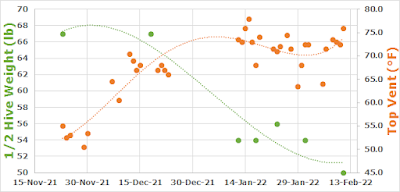
My 8-frame hive is wrapped in a hive cozy. On warm afternoons in December and January, bees flew vigorously and performed orientation flight. These 2021-2022 measurements show that bees are most likely consuming their honey stores and raising late winter brood.  

  • Temperature measurements are taken at dawn at the top vent using an inexpensive RadioShack Waterproof Pocket IR Thermometer. The orange trend line is most likely an increase in total bee metabolism/respiration (bees covering late winter brood). Peak temperature top vent measurement of 78°F (25.6ºC) is not the expected 89.6-96.8°F (32-36ºC) brood nest temperature, so why? Cold air flows into the hive entrance and screened bottom board and mixes with warm moist bee respiration and exits the top vent - usually I discover the warm moist air condensed to the outside of the hive cover.
  • Less frequently, I weigh the hive using an inexpensive luggage scale. The green trend line is most likely winter consumption of honey stores. I would prefer to connect densely sampled weight measurements (points) with a spline instead of the polynomial trend line.  However, extra hive weight measurements are not possible with my travel schedule. 
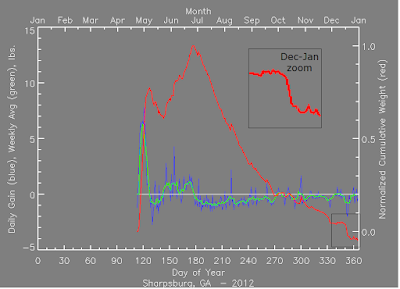
  • Also shown are HoneyBeeNet 2012 hive weight measurements from Cowetta GA (40 miles from Atlanta). HoneyBeeNet is a NASA hive and climate citizen science project. The zoom into these end of year weight measurements show a similar sharp drop in hive weight. 

Wednesday, November 17, 2021

Probiotics for Bees

beekeeping,Beekeeping Today Podcast,probiotic,bee,fall,winter

Kim Flottum mentioned probiotics for bees at the monthly MABA meeting and I learned more on Beekeeping Today Podcast where Kim Flottum and Jeff Ott interviewed the makers of SuperDFM, a dry blend of sucrose and 7 probiotic bacteria.    

Vera and Slava (makers of SuperDFM) write, "Multiple bacteria are present in all nectars, pollens, propolis and the environment. Honey bees need these bacteria to aid not only in digestion, but also to improve immune response and combating stressors detrimental to their health."

I reduced the stack of bee supers in preparation from winter and applied 10g of SuperDFM to the top-bars which the bees voraciously consumed.

Links to more information:

Monday, March 1, 2021

chilled brood 2021

beekeeping,bee,hivemind,tipping point,winter,chilled brood,

beekeeping,bee,hivemind,tipping point,winter,chilled brood,

I discovered these dragged out and chewed brood parts on the hive landing board. Deconstructed brood makes it difficult to identify brood gender and to understand the hivemind.   Is the hive responding to:
  • chilled brood (death by exposure to cold) - are the number of adult bees out of sync with the ability to keep the peripheral brood warm?
  • cell reallocation pressures - removing brood to store:
    • honey?
    • pollen?
    • raise more workers?
    • reduce the number of drones?
beekeeping,bee,hivemind,tipping point,winter,chilled brood,

February ended with a sunny warming trend, then March temperatures began with a small cooling correction. From the temperature table, it's not obvious that we crossed a tipping point on March 1st. Perhaps the hivesmind can forecast temperatures and foraging opportunities days or weeks in advance and therefore the hive experiences this tipping point in ways that make my analysis look too simplistic.

Saturday, February 27, 2021

winter-flowering cherry 2021

bee,beekeeping,foraging,winter, winter-flowering cherry

bee,beekeeping,foraging,winter, winter-flowering cherry

Here are a few lucky iPhone photos which overcome bright back-lighting and fast moving honey bees. While this is not a spectacular year for most winter-flowering ornamental cherry trees, the neighborhood has a few stunning specimens in bloom attracting so many bees that you can hear the buzz at a distance.

Tuesday, February 9, 2021

mahonia Feb '21

beekeeping,mahonia,bee,foraging,beeline,winter,bee cozy,

Both backyard hives have NOD Bee Cozy R8 insulated hive wraps and do not fly during cold gray winter days.  During a week of decidedly sunny days, bees fly vigorously and are found foraging on mahonia. Standing by the mahonia, I looked in direction of the hives for the beeline bearing.  A straight 38 ft (11.6 m) line connects hives and mahonia, but the straight line nicks the corner of the chicken coop which is 7 ft (2.1 m) tall. Some bees are seen flying over the coop while other bees fly around the coop. These mahonia foraging bees are of the same mind regarding where and what to forage, but not how to get there.

Tuesday, February 2, 2021

winter water foraging 2020


beekeeping,bee,collecting water,memory,foraging,winter,watering bees,

I consistently see bees gathering water in an overturned bucket on sunny winter days when temperatures almost reach 50 °F. This unplanned mucky water supply is in their collective bee memory, they return to this location whether water is present or not. The neighbor's hot tub is another favorite location - bees learn and develop water foraging habits most likely based on:

  • water mineral qualities
  • sunny dry landing area
  • ice free winter dependability

Saturday, January 23, 2021

pollen color and winter 2020-2021

beekeeping,bee,pollen,growing degree days,foraging,winter,climate,

Here I'm using Growing Degree Days (GDD) to compare this Atlanta winter with previous winters. I calculated GDD using a web based calculator.  As seen in the table, this winter's GDD are much smaller than last year, with the nearest similar winter GDD found in 2013-2014. 

beekeeping,bee,pollen,growing degree days,foraging,winter,climate,

beekeeping,bee,pollen,growing degree days,foraging,winter,climate,
The back yard bees currently return with bright orange pollen and infrequently return with grey pollen - click on the image to enlarge. I'm using a wiki page of pollen colors of plants in hardiness zone 5, while Atlanta is found in plant hardiness zone 7 which presents challenges when comparing:

  • plant flowering dates
  • matching pollen color with a limited number of trees and plants

Other than color, I'm not able to analyze the bright orange pollen, but it's most likely sourced from winter-flowering ornamental cherry trees blooming in the neighborhood and attracting honey bees.

Using binoculars, I see that red maple trees are not yet flowering.  With evidence from previous years, I'll guesstimate that rosemary is the source of the grey pollen.

Sunday, January 10, 2021

R value of soft wood

beekeeping,bee,hive wrap,condensation,winter,bee cozy,climate,darwinian beekeeping,cloake board,
In cold 30℉ weather, condensation is seen at the top vent and cloake board entrance. Warm moist air exiting from these locations are 11℉ warmer than the outside air and this resulted in a large drops of condensation and a wet cloake board landing area.  Foam board insulation above the inner cover and R8 Bee Cozy hive wrap enhances condensation outside of the hive - not inside the hive. Compared to home building codes, R8 insulation does not seem large, but this hive wrap is a wind break and equivalent to 6 inches (15cm) of soft wood. This equivalent hive wall thickness is more like a natural tree cavity wall thickness.

Friday, December 25, 2020

insulated hive wrap and cloake board stack


beekeeping,bee,hive wrap,condensation,winter,bee cozy,respiration,climate,arctic oscillation,cloake board,

beekeeping,bee,hive wrap,condensation,winter,bee cozy,respiration,climate,arctic oscillation,cloake board,

In Atlanta, cold 20°F temperatures arrived on Christmas Day and the ensemble of 11 arctic oscillation forecast a large negative downturn. I used these metrics as significant evidence that winter temperatures are here to stay.  Since 2010, I have reused my NOD Bee Cozy R8 insulated hive wraps  and believe hive wraps improved the chance of overwintered bee hive survival. As a lazy (aka stubborn) beekeeper and despite warm winter fluctuations, I'll leave the Bee Cozy on till spring 2021.

Photo shows joined hives - overwintered hive below and a March 23rd spring swarm capture above an open Cloake Board. The bee cozy is designed for 10-frame equipment, so it easily slipped over the Bloake Board without removing 8-frame boxes. 

I'm encouraged to see warm moist air (bee respiration) condense outside the hive at the top vent and Cloake Board Entrance. 

Here are current the hive elements:

Thursday, December 10, 2020

bee freeloading

beekeeping,bee,beeline,foraging,Thomas D. Seeley,winter,

I enjoyed a break outdoors sitting in warm late fall sunshine.  When I returned indoors to continue my work-from-home I heard the familiar buzz, but I was not able to find the bee on my clothing.  The next day she was captured in a clear solo cup which are kept handy as a remedy for bee freeloading.  The bee was not moving in a coordinated way, so I added a few drops of honey in the clear cup, but she was not interested in feeding.  

Taken from my beelining playbook, I placed the clear cup in a darken area to encourage feeding. Yeah, I'm obsessed with beelining and see the world of insects through a beelining lens. For this freeloading bee, light seeking behavior was stronger than foraging behavior.

Thursday, March 12, 2020

salvage (rescue) honey


bee, beekeeping, combcapper, crush and strain, harvesting, winter,
  bee, beekeeping, combcapper, crush and strain, harvesting, winter,
bee, beekeeping, combcapper, crush and strain, harvesting, winter,
Cathy's bees did not pull through winter.  Capped frames were off-season honey harvested.  The right angle end of hive tool makes quick work scrapping capped comb from plastic foundation.   The combcapper confidently locks to frame and 5 gal bucket.   (A stainless steel nail ships with the combcapper, but I threw that component in the trash.)

Sixth warmest winter on record for contiguous U.S.


bee, beekeeping, climate, dandelion, checkerboarding, winter, bee cozy
In "Assessing the U.S. Climate in February 2020", NOAA writes,
  • December through February was much warmer than normal across the contiguous United States, while precipitation remained above-average. 
  • Georgia ranked second wettest, while Alabama and North Carolina ranked third wettest.
  • Alabama and Georgia had their wettest winter on record, while South Carolina saw its second wettest.
NOAA's summary match my Atlanta weather experience and is consistent with the early arrival of flowering trees and plants.  I don't commonly see bees on dandelion flowers (many neighbors use lawn herbicides).   Wikipedia lists the  pollen color of  dandelion as "red yellow, orange" and typically flowering in  Apr-May.

Today, I removed the bee cozy hive wrap and checker-boarded the honey cap of my hives. From the top box, I swapped half of my drawn frames with no-comb foundationless frames.   The removed drawn frames are added to a new top box where half of the frames are no-comb foundationless.  I first learned about this beekeeping practice in 2015 where Steve Page spoke at Georgia Beekeepers Association.