Showing posts with label foraging. Show all posts

Monday, February 19, 2024

winter-flowering ornamental cherry tree 2024

beekeeping,bee,winter-flowering cherry,spring,foraging,

Year after year, this tree has produced great bee photos foraging on winter-flowering cherry tree.   The time was 2 PM, the temperature was 57°F (13.9°C), blue sky, sunshine, and a loud buzz of bees on this quiet street.

What's next?  Crabapple trees (thanks to Trees Atlanta) are beginning to leaf-out and those flowers will be here soon and attracting honey bees too.

Wednesday, April 6, 2022

tulip poplar windfall and other spring flowers '22

beekeeping,bee,tulip poplar,white clover,chinese wysteria,amur honeysuckle,spiderwort,pollen,foraging,

1st Windfallday of year
April 10, 2011100
March 27, 201287
April 19, 2013109
April 12, 2015102
April 15, 2017105
April 5, 201895
April 11, 2019101
April 7, 202197
April 6, 202296
  
median100

I found this year's first Tulip Popular flower windfall on April 6, 2022 (96th day of the year) and in a few days afterward the ground was covered with Tulip Popular flowers and bees returned with cream colored pollen.   April 6 is just a few days earlier than expected.  However March 27, 2012 is the big outlier, nearly 2 weeks earlier than expected.

Other nectar sources at this time (not shown):

Thursday, March 24, 2022

dandelion, rosemary and native crabapple 2022

bee, beekeeping,dandelion,crabapple,redbud tree,rosemary,spring,foraging,trees atlanta,

In my opinion, this spring attracted more bees to dandelion flowers than previous years. Thank you to my neighbors who do not spray herbicides.

Strong spring wind gusts made photographing bee foraging difficult and I consequently have not included bees visiting blooming ornamental cherry trees and eastern redbud.   What's left on my iPhone are a few lucky snaps of bees on native crabapple (thanks to Trees Atlanta) and rosemary flowers.

Saturday, February 12, 2022

honey consumption and late winter brood rearing

bee,beekeeping,ventilation,temperature,hive weight,bee cozy,winter,brood,foraging,

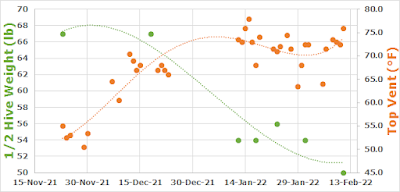
My 8-frame hive is wrapped in a hive cozy. On warm afternoons in December and January, bees flew vigorously and performed orientation flight. These 2021-2022 measurements show that bees are most likely consuming their honey stores and raising late winter brood.  

  • Temperature measurements are taken at dawn at the top vent using an inexpensive RadioShack Waterproof Pocket IR Thermometer. The orange trend line is most likely an increase in total bee metabolism/respiration (bees covering late winter brood). Peak temperature top vent measurement of 78°F (25.6ºC) is not the expected 89.6-96.8°F (32-36ºC) brood nest temperature, so why? Cold air flows into the hive entrance and screened bottom board and mixes with warm moist bee respiration and exits the top vent - usually I discover the warm moist air condensed to the outside of the hive cover.
  • Less frequently, I weigh the hive using an inexpensive luggage scale. The green trend line is most likely winter consumption of honey stores. I would prefer to connect densely sampled weight measurements (points) with a spline instead of the polynomial trend line.  However, extra hive weight measurements are not possible with my travel schedule. 
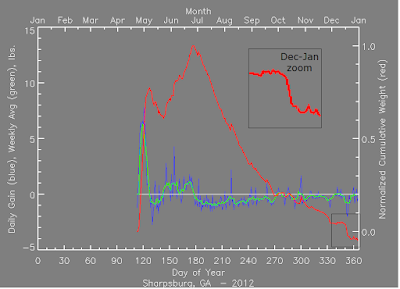
  • Also shown are HoneyBeeNet 2012 hive weight measurements from Cowetta GA (40 miles from Atlanta). HoneyBeeNet is a NASA hive and climate citizen science project. The zoom into these end of year weight measurements show a similar sharp drop in hive weight. 

Sunday, November 7, 2021

Autumn Blooming Ryan Gainey Chrysanthemums


beekeeping,bee,chrysanthemum,pollen,foraging,autumn,
Check out the amazing orange colored pollen!  Cold and windy weather confined the bees, followed by this sunny 47°F morning.  Ryan Gainey Chrysanthemums provided much needed autumn nectar and pollen - just in time as goldenrod flowers have finished blooming.

Sunday, October 3, 2021

goldenrod 2021

beekeeping,bee,fall,pollen,volatile organic compounds,foraging,climate,goldenrod,

beekeeping,bee,fall,pollen,volatile organic compounds,foraging,climate,goldenrod,

beekeeping,bee,fall,pollen,volatile organic compounds,foraging,climate,goldenrod,

Along the Atlanta BeltLine, I saw tall upright yellow flowering Goldenrod plants in sunny areas - see photos.

In recent fair weather, honey bees flew vigorously and returned with yellow pollen seen in the photo collage and I noticed a stronger and sour hive odor consistent with Goldenrod forage. 

In late afternoons, I saw a huge number of bees circulating at the sunny hive entrance, busy in orientation flight.  In Atlanta, there are potentially many more weeks of flowering Goldenrod left assuming more fair weather.  This gives me hope that the hive will have lots of bees going into winter.

Will there be a fall honey harvest?  Stay tuned.

Sunday, March 21, 2021

native crabapple and rosemary 2021

bee,beekeeping,crabapple,redbud tree,spiderwort,dandelion,iPhone,foraging,spring,

Thank you Trees Atlanta for planting pollinator friendly trees like:

  • eastern redbud
  • native crabapple
bee,beekeeping,crabapple,redbud tree,spiderwort,dandelion,iPhone,foraging,spring,

I was not going to include rosemary flowers, but iPhone 11 color saturation is fabulous.  This Mediterranean native shrub does well in Atlanta's zone 7 hardiness when located in a sunny location. 

Currently I can't find bees on dandelions and spiderwort flowers - is there an overabundance of honey bee forage?

Saturday, February 27, 2021

winter-flowering cherry 2021

bee,beekeeping,foraging,winter, winter-flowering cherry

bee,beekeeping,foraging,winter, winter-flowering cherry

Here are a few lucky iPhone photos which overcome bright back-lighting and fast moving honey bees. While this is not a spectacular year for most winter-flowering ornamental cherry trees, the neighborhood has a few stunning specimens in bloom attracting so many bees that you can hear the buzz at a distance.

Tuesday, February 9, 2021

mahonia Feb '21

beekeeping,mahonia,bee,foraging,beeline,winter,bee cozy,

Both backyard hives have NOD Bee Cozy R8 insulated hive wraps and do not fly during cold gray winter days.  During a week of decidedly sunny days, bees fly vigorously and are found foraging on mahonia. Standing by the mahonia, I looked in direction of the hives for the beeline bearing.  A straight 38 ft (11.6 m) line connects hives and mahonia, but the straight line nicks the corner of the chicken coop which is 7 ft (2.1 m) tall. Some bees are seen flying over the coop while other bees fly around the coop. These mahonia foraging bees are of the same mind regarding where and what to forage, but not how to get there.

Tuesday, February 2, 2021

winter water foraging 2020


beekeeping,bee,collecting water,memory,foraging,winter,watering bees,

I consistently see bees gathering water in an overturned bucket on sunny winter days when temperatures almost reach 50 °F. This unplanned mucky water supply is in their collective bee memory, they return to this location whether water is present or not. The neighbor's hot tub is another favorite location - bees learn and develop water foraging habits most likely based on:

  • water mineral qualities
  • sunny dry landing area
  • ice free winter dependability

Saturday, January 23, 2021

pollen color and winter 2020-2021

beekeeping,bee,pollen,growing degree days,foraging,winter,climate,

Here I'm using Growing Degree Days (GDD) to compare this Atlanta winter with previous winters. I calculated GDD using a web based calculator.  As seen in the table, this winter's GDD are much smaller than last year, with the nearest similar winter GDD found in 2013-2014. 

beekeeping,bee,pollen,growing degree days,foraging,winter,climate,

beekeeping,bee,pollen,growing degree days,foraging,winter,climate,
The back yard bees currently return with bright orange pollen and infrequently return with grey pollen - click on the image to enlarge. I'm using a wiki page of pollen colors of plants in hardiness zone 5, while Atlanta is found in plant hardiness zone 7 which presents challenges when comparing:

  • plant flowering dates
  • matching pollen color with a limited number of trees and plants

Other than color, I'm not able to analyze the bright orange pollen, but it's most likely sourced from winter-flowering ornamental cherry trees blooming in the neighborhood and attracting honey bees.

Using binoculars, I see that red maple trees are not yet flowering.  With evidence from previous years, I'll guesstimate that rosemary is the source of the grey pollen.

Thursday, December 10, 2020

bee freeloading

beekeeping,bee,beeline,foraging,Thomas D. Seeley,winter,

I enjoyed a break outdoors sitting in warm late fall sunshine.  When I returned indoors to continue my work-from-home I heard the familiar buzz, but I was not able to find the bee on my clothing.  The next day she was captured in a clear solo cup which are kept handy as a remedy for bee freeloading.  The bee was not moving in a coordinated way, so I added a few drops of honey in the clear cup, but she was not interested in feeding.  

Taken from my beelining playbook, I placed the clear cup in a darken area to encourage feeding. Yeah, I'm obsessed with beelining and see the world of insects through a beelining lens. For this freeloading bee, light seeking behavior was stronger than foraging behavior.

Sunday, November 1, 2020

Have you seen my pollen basket?

beekeeping,bee,chrysanthemum,pollen,foraging,autumn,

beekeeping,bee,chrysanthemum,pollen,foraging,autumn, 
Amazing orange colored pollen! These photos zoomed and cropped seem as vivid as the live experience. I don't know the chrysanthemum type, but this large flower size is not typical of chrysanthemums for sale.  

Sunday, October 18, 2020

autumn blooming chrysanthemum


beekeeping,betterbee,bee,chrysanthemum,beeline,foraging,autumn,goldenrod,Thomas D. Seeley,

beekeeping,betterbee,bee,chrysanthemum,beeline,foraging,autumn,goldenrod,Thomas D. Seeley,

beekeeping,betterbee,bee,chrysanthemum,beeline,foraging,autumn,goldenrod,Thomas D. Seeley,

I read Seeley's Following the Wild Bees and became keenly interested in beelining.  I ordered a beelining box from BetterBee and have since sealed the wood with water-based polyurethane. Without success I have been searching for honey bees on wild goldenrod flowers for beelining. Instead I found honey bees on Ryan Gainey Chrysanthemums.   You might say my beelining problem is solved, but I don't want to crush the neighbor's flower heads with the beelining box.  So, I'll wait and wait some more for honey bees to discover wild goldenrod flowers.

Saturday, August 29, 2020

nectar robbing

Carpenter Bees,beekeeping,bee,nectar robbing,salvia,foraging

Carpenter Bees,beekeeping,bee,nectar robbing,salvia,foraging

Carpenter Bees,beekeeping,bee,nectar robbing,salvia,foraging

On previous visits to this patch of salvia I didn't find any honey bees, just foraging bumble bees.    More recently I found honey bees nectar foraging, but have a closer look - these bees do not enter the flower (they're not pollinating).   Most likely carpenter bees chewed holes to rob nectar and these short tongue honey bees are exploiting the holes. 

Saturday, June 20, 2020

Artificial Grass


artificial grass, bee, beekeeping, collecting water, foraging, rainfall,
I'm amazed with realistic details of our artificial grass carpet.   We purchased the carpet with no expectation of attracting honey bees.   After rainfall, the carpet is slow to dry and a small number of bees are discovered crawling to the base of the carpet - another example of bees foraging for mucky water.

Saturday, June 13, 2020

pollinators - summer 2020

bee, beekeeping, foraging, native pollinator,
It makes sense, the Atlanta neighborhood is covered with this wiki list of host plants for the eastern tiger swallowtail.
    Wild black cherry Prunus serotina
    Ash - Fraxinus species
    Cottonwood - Populus species
    Wafer ash or hoptree - Ptelea trifoliata
    Common lilac - Syringa vulgaris
    Sweet bay magnolia - Magnolia virginiana
    Tulip poplar or tulip tree - Liriodendron tulipifera
    Willow - Salix species
bee, beekeeping, foraging, native pollinator,
Typically hydrangea do not attract pollinators, but here's a showy hydrangea bloom with honey bees.
bee, beekeeping, foraging, native pollinator,
Native bumbles and honey bees are consistently seen on this lovely lavender scrub.

Saturday, November 23, 2019

2019 - fall hive weight and water balance calculator

  • graph 1 - dramatic 2019 fall hive weight gain
  • graph 2 - flat to decreasing 2018 fall hive weight
  • water balance calculator table - 2019 shows a slightly positive fall water balance compared to past years, while 2018 shows a dramatically wet fall water balance
Many factors contribute to fall hive weight gain, but I speculate that that dry conditions favored optimal goldenrod and aster honey bee forage; sadly these dry conditions stressed shrubs and trees.  Local fall water balance appears to slowly cycle with a period of 3 to 4 years, meaning that fall 2020 might also be dry - stay tuned.
bee, beekeeping, bloom, climate, goldenrod, hive weight, water balance calculator, aster, foraging,

Wednesday, September 11, 2019

Ivy Bee in southern England - Colletes hederae

foraging, ivy bee, non-native solitary bee, southern England,
These photos of an ivy bee are taken on the chalk cliff top trail on the Kent Coast.

The Wildlife Trusts says "that this non-native solitary bee nests in loose, light or sandy soil on southern-facing banks and cliffs with ivy nearby for foraging. They are solitary bees, but when conditions are suitable, there may be thousands of nests in the same area." First UK identification in 2001, this non-native solitary bee has a hairy thorax and a shiny abdomen.

Ivy fruit is eaten and spread by birds, yet another reason why ivy is so difficult to control. 

Thursday, June 20, 2019

flowering trees - June '19

bee, beekeeping, bloom, foraging, mimosa, sourwood,
Mostly bumble bees, but a few honey bees are attracted to a flowering sourwood tree. Not shown, flowering mimosa tree which attract pollinators this time of year too. Mimosa have invasive tendencies.