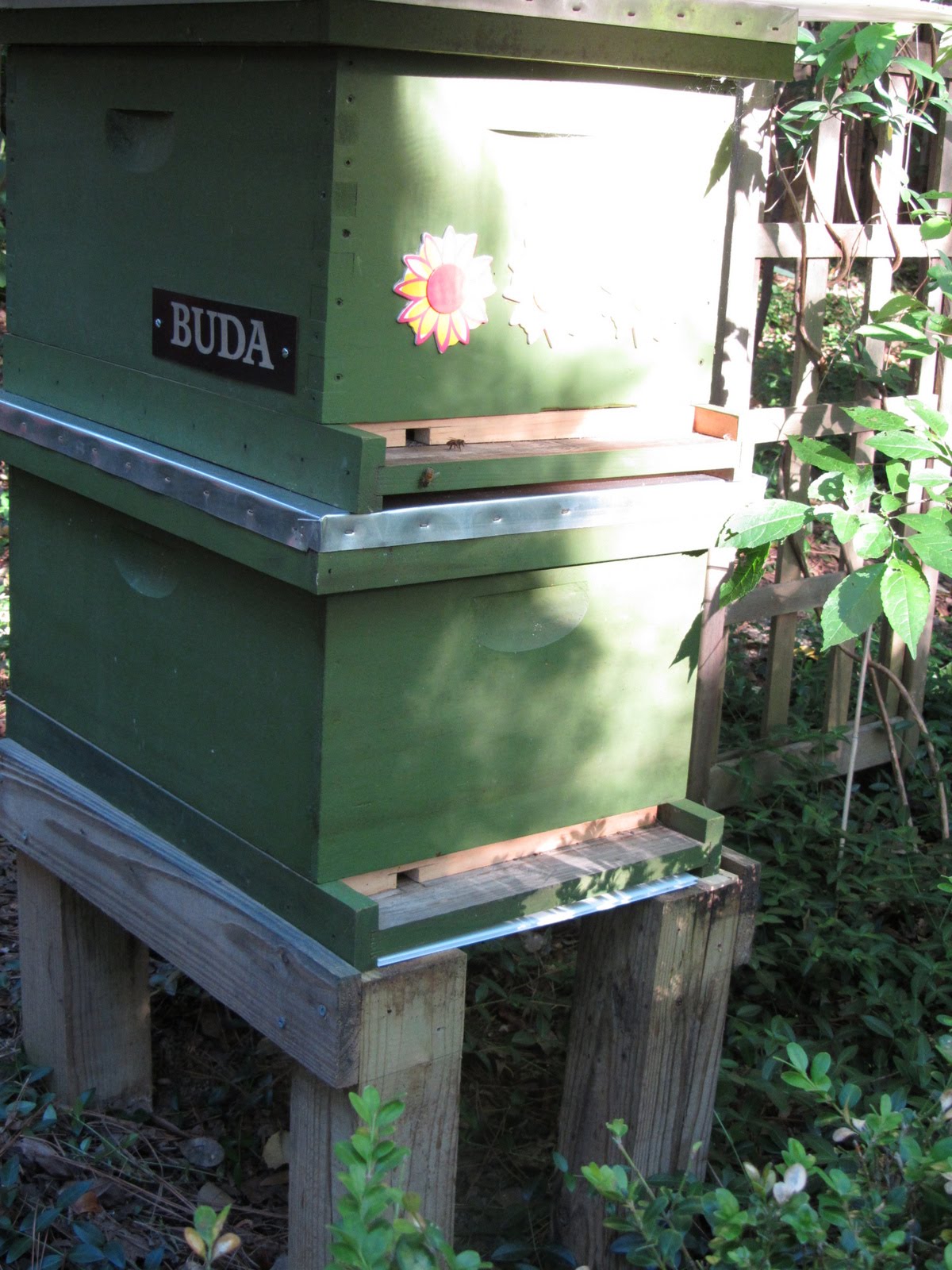
To my horror, several frames in the bottom box of this skyscraper hive contain SHB larvae crawling through pollen, honey and the dark brood comb. I created a new hive configuration containing no dark brood comb at all. I moved the small population of bees onto clean light colored comb, added a one gallon pail of 1:1 syrup (with Honey B Healthy) and reduced the entrance. Stay tuned.
Showing posts with label feeder. Show all posts
Sunday, June 30, 2013
small hive beetle larvae & dark brood comb
To my horror, several frames in the bottom box of this skyscraper hive contain SHB larvae crawling through pollen, honey and the dark brood comb. I created a new hive configuration containing no dark brood comb at all. I moved the small population of bees onto clean light colored comb, added a one gallon pail of 1:1 syrup (with Honey B Healthy) and reduced the entrance. Stay tuned.
Tuesday, May 1, 2012
one of two splits achieves a mated queen
From the parent hives I removed eggs, capped worker brood, pollen and bees and one of two splits achieves a mated queen. Not bad for a new-bee, but I have to credit the favorable spring weather and drones from local hives. Here's a summary of what went on with the two splits.
April 6th (day 20) with help from a visiting friend, Ray Karsch, we move the splits which have been sitting on top of their parent hive with the same entrance orientation. Without a cinch strap we gently stack both splits onto the same hive stand. Each split has their own deep division board feeder and the bottom split has a counting board to keep them warm. The top split is taking syrup while the bottom split is not. April 12th (day 26), bees return to the top split with pollen, while no pollen is found on the counting board of the bottom split. April 6th (day 30), I simply combine splits into a two deep box configuration. I'm convinced that one split contains a mated queen based on pollen foraging and syrup consumption.
April 23rd, I discover all the bees in the lower box, so I squeeze the resources into one deep box with a division board feeder. May 1st, I remove the deep division board feeder. Next I add a medium box with one frame of capped honey (bait frame from parent hive) and seven medium frames with wax strips. Above the inner cover I invert a one gallon pail and remove the counting board.
April 6th (day 20) with help from a visiting friend, Ray Karsch, we move the splits which have been sitting on top of their parent hive with the same entrance orientation. Without a cinch strap we gently stack both splits onto the same hive stand. Each split has their own deep division board feeder and the bottom split has a counting board to keep them warm. The top split is taking syrup while the bottom split is not. April 12th (day 26), bees return to the top split with pollen, while no pollen is found on the counting board of the bottom split. April 6th (day 30), I simply combine splits into a two deep box configuration. I'm convinced that one split contains a mated queen based on pollen foraging and syrup consumption.
April 23rd, I discover all the bees in the lower box, so I squeeze the resources into one deep box with a division board feeder. May 1st, I remove the deep division board feeder. Next I add a medium box with one frame of capped honey (bait frame from parent hive) and seven medium frames with wax strips. Above the inner cover I invert a one gallon pail and remove the counting board.
Labels:
bee,
beekeeping,
division board feeder,
feeder,
pail feeder,
pollen,
split,
swarm control
Saturday, March 17, 2012
making spring splits
On day fourteen (March 30th), I quickly checked beneath the inner cover of both splits. The dawn temperature was 59 °F and some reassuring warm moist escaped from beneath the inner cover. Both splits have a nice cluster of bees over several frames. One split consumed one cup of syrup and the other split consumed two quarts of syrup. So far, all seems well.
Labels:
bee,
beekeeping,
checkerboarding,
division board feeder,
feeder,
pollen,
split,
swarm control
Tuesday, June 28, 2011
looks great in beekeeping catalogs, but not my style
I want to maximize my beekeeping experience, do no harm, and keep only the essential set of beekeeping gadgets. Catalogs, in general, display colorful items that look so pretty/exciting/unique/flashy/nice. Sometimes the gadget evaluation requires more than my imagination, but actual experience. Here is a short list of items that look great in beekeeping catalogs, but after testing in my backyard (in-town Atlanta apiary) are just not my style:
- leather bee gloves
- bee brush
- boardman entrance feeder
- hive top feeder
- pollen substitute
Tuesday, October 19, 2010
removing medium honey super
My spouse, the voice of reason, captured many excellent photos during the removal of the medium honey super, but my favorite is the image of bees peering upwards between the frames. I have an extra inner cover and extra 1gal pail feeder allowing the bees to leave the equipment and return to their hive in their own good time. The AJ Beetle eaters were stuck solidly to the frames with propolis and required some coaxing followed by extra care to keep from spilling the vegetable oil. The last slide is our 2010 MABA live auction item created by John Parris. The under powered electric window box fan (not shown) failed to blow the bees off the frames, so I returned to more conventional bee clearing methods--frame shaking and frame bumping.
Labels:
AJ's Beetle Eater,
bee,
beekeeping,
feeder,
harvesting,
honey,
inner cover,
John Parris,
MABA,
pail feeder
Wednesday, September 8, 2010
1gal pail feeder
I'm using one gallon pail feeders and Honey B Healthy purchased from P.N. Williams. It's seems easier to make large batches of syrup and have two pail feeders per hive.
According to the official climate summary, this is a record setting warm summer which followed a prolonged winter--as always it seems difficult to apply the conventional rules of a normal beekeeping year when no two years have the same weather. As I heard Malcolm T. Sanford says, "all bee keeping is local," meaning that continuous feeding may not work in your apiary.
- bees take a few minutes to clear the pail feeder and if a pail feeder is left completely empty, then propolis may cover the pail feeder screen
- electrical tape helps line-up the pail feeder screen and inner cover hole
- inverting the pail feeder over a bucket helps control ant attracting spills
According to the official climate summary, this is a record setting warm summer which followed a prolonged winter--as always it seems difficult to apply the conventional rules of a normal beekeeping year when no two years have the same weather. As I heard Malcolm T. Sanford says, "all bee keeping is local," meaning that continuous feeding may not work in your apiary.
Thursday, July 1, 2010
3qt deep division board feeder experience
Here is my experience with a 3qt deep division board feeder. I fed two new bee packages using a deep division board feeder, where the feeder took the place of one outermost deep frame. The new feeders were tested for leaks using water, then 3qts of syrup (plus Honey-B-Healthy) was added and topped up with more syrup as needed. I opened the small black door and poured syrup into the middle filling compartment which raised the floats and bees too. If the bees became defensive, then I:
A second deep box was added when all the wax strips had lots of comb. I moved one frame of comb (as bait) and the deep division board feeder to the second deep box. After seven weeks, comb inside the feeders began to interfere with the floats and the division board feeders were replaced with wax strips and I started pail feeding.
Now I get to inspect the empty feeders. In one empty feeder, no (zero) drowned bees are discovered. In the other empty feeder, three drowned bees are in the central filling compartment. What a relief not to find too many dead bees. On the web I read the experiences of others using less sophisticated division board feeders that have a tendency to collapse or drown bees.
- try to slow down my (hand) movements
- slid (not removed) the inner cover to the right exposing only the feeder

Now I get to inspect the empty feeders. In one empty feeder, no (zero) drowned bees are discovered. In the other empty feeder, three drowned bees are in the central filling compartment. What a relief not to find too many dead bees. On the web I read the experiences of others using less sophisticated division board feeders that have a tendency to collapse or drown bees.
Saturday, June 27, 2009
watering bees
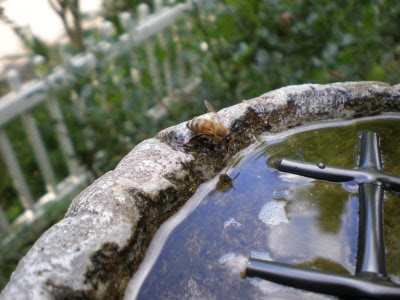
I filled a boardman feeders with 1) filtered water, 2)water with a trace of honey b healthy, 3)water with a trace of kosher salt or 4)water with lots of kosher salt. The results are no success with bee watering. Additionally, I have 3 birdbaths that are not attracting bees. This year I am using woven plastic straw rafts in the (unlikely) event that a bee lands in the birdbath. Last year I attached, the plastic straws with hot glue, but those rafts were easily damage by freezing winter temperatures. With regular day time highs in the 80's Fahrenheit, where are the bees gathering water? Clearly, somewhere else. For a few hot days, a small number of bees were collecting water at the "bird girl" statue--see photo.
Labels:
bee,
beekeeping,
collecting water,
feeder,
Honey B Healthy,
plastic straw,
rafts,
watering bees,
woven
Wednesday, May 13, 2009
baggie feeder
After a number of stings (on the hand), I began to search for something other than a boardman style feeder. I started using a one gallon baggie, but I had to solve some questions:
- transporting filled baggies without creating leaks
- checking for leaky baggies
- where to puncture the baggie
- how much syrup to place in the baggie
Labels:
baggie feeder,
bee,
beekeeping,
feeder,
hive,
Honey B Healthy,
lemongrass,
oil,
spearmint
Sunday, November 30, 2008
2009 wish list
Where does reading get me? Reading about bees is very satisfying and builds my vocabulary, but how much is appropriate to the tiny Atlanta in-town apiary? I mostly rely on listening to my Metro Atlanta Beekeepers Association (MABA) friends, re-reading Keith Delaplaine's book "First Lessons in Beekeeping" and of course trying to learn from my mistakes. Here is my 2009 wish list:
- Running two AJ Beetle Eaters (+vegetable oil) per box, not one per hive as in 2008
- Purchasing nematodes (Southeast Insectary in Perry 877 967 6777) for spring SHB treatment
- Replacing concrete blocks with new hive stands that lift the hives higher and let more light reach the ground
- Painting a unique entrance for each hive as described in The Buzz about Bees by Jürgen Tautz
- Trying a bucket syrup feeder and certainly repeating the baggie feeding
- Purchasing more queen excluders and running a single deep brood chamber, not two as in 2008
- Trying a queen marking kit and practicing on a few drones
- Purchasing swarm traps (+lures), not the reactive ladder based swarm capturing as in 2008
- Trying MegaBee served dry using a bird (meal worm) feeder--no protein served in 2008
- Trying SuperBoost brood pheromone during the summer
- Trying Honey B Healthy (+water) for front entrance boardman feeding--not letting the neighbor water my bees using their salt water system swimming pool as in 2008
Subscribe to:
Comments (Atom)