Showing posts with label pail feeder. Show all posts

Friday, May 12, 2023

Swarm Trap - May 12th 2023

pail feeder,plastic starter strip,UV-blue entrance,bee,swarm,swarm capture,swarm trap,bee keeping,swarm lure,Honey B Healthy,queen excluder,

pail feeder,plastic starter strip,UV-blue entrance,bee,swarm,swarm capture,swarm trap,bee keeping,swarm lure,Honey B Healthy,queen excluder,

On Friday, May 12th

  • 2:00 PM - active scouting at one swarm trap, zero scouting at other traps 
  • 3:00 PM - very active scouting at one swarm trap, zero scouting at other traps
  • 6:24 PM - air is thick with bees
  • 6:48 PM - the majority of bees settled on the outside of the swarm trap and began to move in
  • 8:23 PM - bees reversed and are on the outside of the trap

On Saturday, May 13th

  • setup 8-frame deep box near the swarm trap; in the last photo, check out the homemade rectangular UV-reactive blue 8-frame entrance
  • add a queen excluder beneath the deep box
  • spray the bees with sugar water
  • carefully lower the swarm trap
  • carefully walk the swarm trap to the deep box
  • spray the bees with sugar water
  • brush bees into the deep box
  • add frames
  • move the pheromone lure from the swarm trap to the landing board
  • add an inner cover and telescoping lid
  • after 2 hours, all the loose bees have reoriented to their new home

On Sunday, May 14th

  • add a gallon pail feeder with 32 ounces of 1:1 syrup

I'm guessing that 

  • the swarm was hanging very close to their preferred swarm trap, and the scout bees ignored my other swarm traps
  • this swarm contains more than 1 queen

Tuesday, April 4, 2023

moving swarm to 8-frame equipment

plastic starter strip,UV-blue entrance,bee,swarm,tulip poplar,swarm capture,swarm trap,bee keeping,swarm lure,pail feeder,

plastic starter strip,UV-blue entrance,bee,swarm,tulip poplar,swarm capture,swarm trap,bee keeping,swarm lure,pail feeder,

Today I moved the swarm to 8-frame equipment. In one week, all 5 frames had similar new comb construction on the plastic starter strips

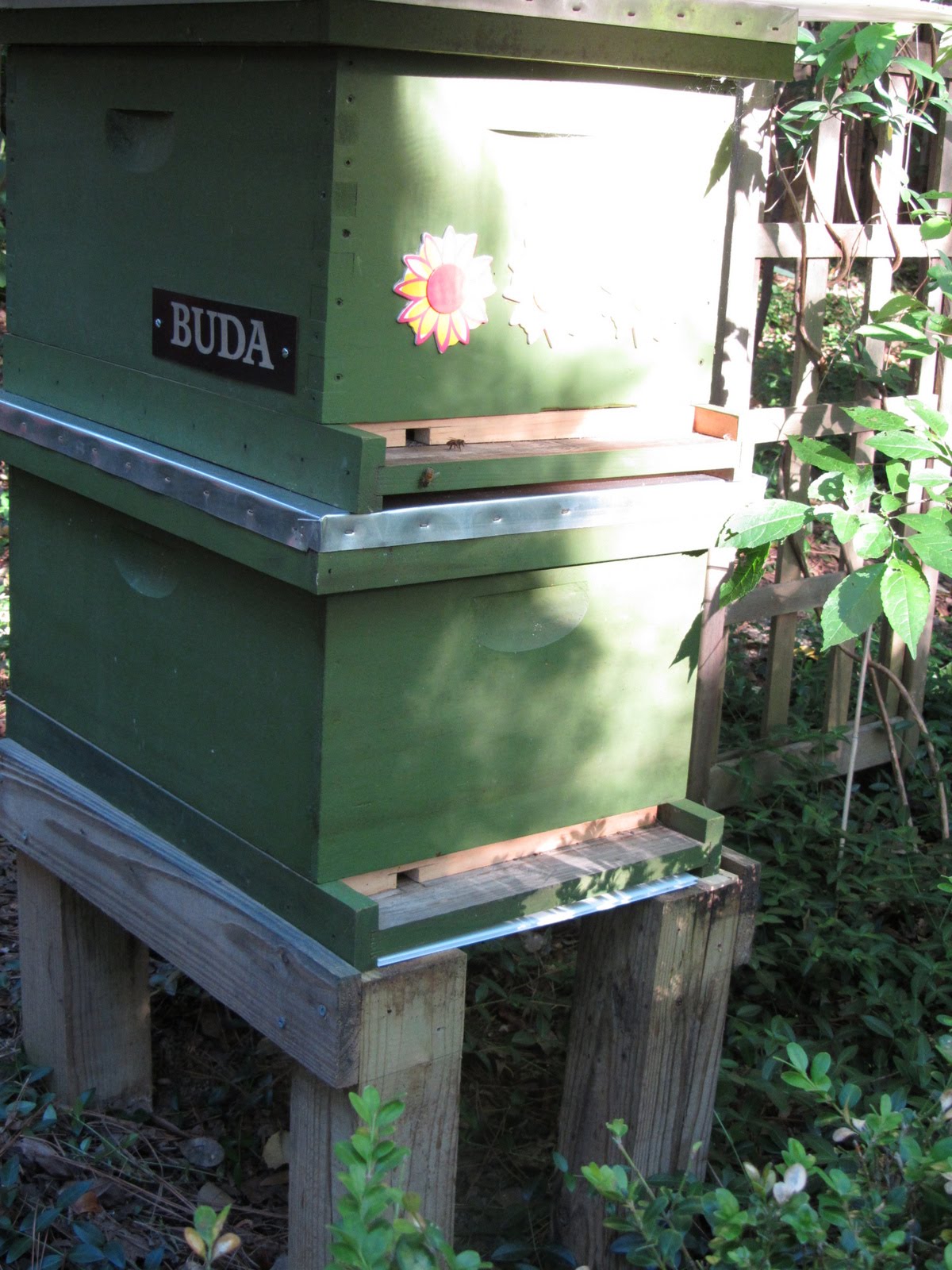
I moved the swarm lure to the 8-frame landing board, and the remaining bees entered the 8-frame equipment in under 2 hours - I did not bump bees off the swarm trap. In the last photo, notice the homemade rectangular UV-reactive blue 8-frame entrance.

The bees returned with cream-colored Tulip Poplar pollen and slowly consumed 1:1 syrup.

Wednesday, April 15, 2015

swarm attached to outside of swarm trap

bee, beekeeping, Honey B Healthy, pail feeder, queen includer, swarm lure, swarm trap,
This story begins with several days of bees scouting my 4 swarm traps - each trap contains some brood comb and a swarm lure.  Next, I discovered a huge swarm attached to the outside of my tree hanging 8-frame swarm trap.  During back-to-back cool drizzly weather days, I wait for the swarm to move into the box.

After 2 days, I give up waiting and successfully lower the trap and bees to their new location.  After the bump transfer, I discovered 3 pieces of comb - previously hidden beneath the swarm.    Outdoor comb construction was almost beyond my imagination.

For a few days, I will keep a queen includer beneath the new hive and a 1gal pail feeder with Honey-B-Healthy above the inner cover.

Sunday, June 30, 2013

small hive beetle larvae & dark brood comb

bee, beekeeping, dark brood comb, feeder, Honey B Healthy, pail feeder, retinue, Small Hive Beetle,
If I told you what happened, you probably would not believe it. The first photo contains the queen's retinue. When my finger tips touch these bees, enough space opens up for me to see her majesty - this experience is a rare gift.
bee, beekeeping, dark brood comb, feeder, Honey B Healthy, pail feeder, retinue, Small Hive Beetle,
I have been away for one week and returned to a hive with significantly fewer bees - maybe the hive swarmed, perhaps more than once.  My concern is that this hive has a huge surplus of honey, and many deep frames of dark brood comb attractive to small hive beetles (SHB) - too many frames, too much space and too few bees to keep the SHB confined to the margins of hive.

To my horror, several frames in the bottom box of this skyscraper hive contain SHB larvae crawling through pollen, honey and the dark brood comb.   I created a new hive configuration containing no dark brood comb at all.  I moved the small population of bees onto clean light colored comb, added a one gallon pail of 1:1 syrup (with Honey B Healthy) and reduced the entrance.  Stay tuned.

Sunday, August 26, 2012

Beetlejail Entrance Trap

bee, beekeeping, beetlejail entrance trap, brushy mountain, pail feeder, Small Hive Beetle,

Over the winter I prepared the Beetlejail Entrance Trap for attachment to an 8 frame Brushy Mountain bottom board.  I used a foam brush for the green paint and white spray paint for the novel grooved entrance.  From the look of the bleeding white paint I should have used the expensive green FROG TAPE. Apparently, the small hive beetles (SHB) try to escape the bees by running around the grooved rectangular perimeter..  The bottom edge of the perimeter leads to a pull-out drawer which has three chambers of olive oil.  Dave Miller suggested a lure is not necessary - "the hive odor is more than sufficient as a lure" says Dave, and I have to agree.

In June I noticed the SHB corralled beneath the inverted 1 gallon pail feeder or corralled between the cover and inner cover.  On July 7th I added the Beetlejail Entrance Trap to a functioning hive, my split.   This installation was slightly tricky.  I moved the box away from landing area, then attached the trap to the existing bottom board.  The last step is to coax back the box flush with the trap.    

Esthetically the hive now has the charming (or outrageous) look of an elephant seal.  I added a rectangle of plastic window screen to the inner cover hole after I stopped feeding with an inverted pail.   The window screen prevents the SHB from entering by way of the top of the hive.  Initially the bees propolized the perimeter of the inner cover hole, now the bees have completely propolized the inner cover hole. 

Has the trap eliminated all SHB?  Probably not, but it has been a lot of fun.

Tuesday, May 1, 2012

one of two splits achieves a mated queen

From the parent hives I removed eggs, capped worker brood, pollen and bees and one of two splits achieves a mated queen.  Not bad for a new-bee, but I have to credit the favorable spring weather and drones from local hives.   Here's a summary of what went on with the two splits.
bee, beekeeping, division board feeder, feeder, pail feeder, pollen, split, swarm control,
April 6th (day 20) with help from a visiting friend, Ray Karsch, we move the splits which have been sitting on top of their parent hive with the same entrance orientation.  Without a cinch strap we gently stack both splits onto the same hive stand.  Each split has their own deep division board feeder and the bottom split has a counting board to keep them warm.  The top split is taking syrup while the bottom split is not.  April 12th (day 26), bees return to the top split with pollen, while no pollen is found on the counting board of the bottom split.  April 6th (day 30), I simply combine splits into a two deep box configuration.  I'm convinced that one split contains a mated queen based on pollen foraging and syrup consumption.
 
April 23rd, I discover all the bees in the lower box, so I squeeze the resources into one deep box with a division board feeder.  May 1st, I remove the deep division board feeder.  Next I add a medium box with one frame of capped honey (bait frame from parent hive) and seven medium frames with wax strips.  Above the inner cover I invert a one gallon pail and remove the counting board.
bee, beekeeping, division board feeder, feeder, pail feeder, pollen, split, swarm control,

Tuesday, October 19, 2010

removing medium honey super


My spouse, the voice of reason, captured many excellent photos during the removal of the medium honey super, but my favorite is the image of bees peering upwards between the frames.  I have an extra inner cover and extra 1gal pail feeder allowing the bees to leave the equipment and return to their hive in their own good time.  The AJ Beetle eaters were stuck solidly to the frames with propolis and required some coaxing followed by extra care to keep from spilling the vegetable oil.  The last slide is our 2010 MABA live auction item created by John Parris.  The under powered electric window box fan (not shown) failed to blow the bees off the frames, so  I returned to more conventional bee clearing methods--frame shaking and frame bumping.

Wednesday, September 8, 2010

1gal pail feeder

bee, bee package, beekeeping, counting board, debris, feeder, Honey B Healthy, Lula Georgia, P.N. Williams, pail feeder, Small Hive Beetle, varroa,
I'm using one gallon pail feeders and Honey B Healthy purchased from P.N. Williams.  It's seems easier to make large batches of syrup and have two pail feeders per hive.
  • bees take a few minutes to clear the pail feeder and if a pail feeder is left completely empty, then propolis may cover the pail feeder screen
  • electrical tape helps line-up the pail feeder screen and inner cover hole
  • inverting the pail feeder over a bucket helps control ant attracting spills
These bee packages have been fed continuously since May.  According to my counting board results, this has been my best year for controlling small hive beetles and varroa mites--this is also the first year with Lula Georgia bee packages and continuous feeding with Honey B Healthy

According to the official climate summary, this is a record setting warm summer which followed a prolonged winter--as always it seems difficult to apply the conventional rules of a normal beekeeping year when no two years have the same weather.  As I heard Malcolm T. Sanford says, "all bee keeping is local," meaning that continuous feeding may not work in your apiary.