Showing posts with label swarm trap. Show all posts

Monday, August 24, 2026

Does UV-Blue Really Make a Better Swarm Trap?

I was first introduced to Brian Fleishmann’s September 2022 Bee Culture article, “Impact of UV-Induced Blue Fluorescence Entrances in Bee Culture,” through the MABA swarm trap build group. I was quickly convinced to give it a try. In 2023, I purchased four UV-reactive blue swarm trap entrances from the ApiTekStore. Not everyone in the swarm trap-building community was convinced. Brian’s experiment points toward a positive result, but with only six observations, the evidence isn’t strong enough to call the results statistically conclusive.  Still, I keep coming back to Brian’s experiment because, regardless of the statistical limitations, I think the experimental design is beautiful.

Brian’s article came to two conclusions:

  • UV-reactive blue swarm trap entrances nearly doubled the number of scout bees observed compared with the control entrances.
  • Swarms selected the trap with the UV-blue entrance over the control 100% of the time.

Those are pretty compelling results for a beekeeper looking for an edge in swarm trapping. Before getting too excited, it’s worth looking at how the experiment was conducted.


Scout Bee Activity LoggedTrap Selected
Year 1 - 2020  
Location 1YesUV-reactive blue
Location 2 UV-reactive blue
Location 3 UV-reactive blue
   
Year 2 - 2021 (trap entrance swapped)  
Location 1YesUV-reactive blue
Location 2 none
Location 3 UV-reactive blue

Brian conducted the experiment from May through August in 2020 and 2021 in western New York.
The basic setup:

  • Traps were attached to trees 8–10 feet above the ground.
  • Each trap had a 1.25-inch (3.2 cm) circular entrance hole.
  • Trap cavity volume was 1.59 cubic feet (45 liters).
  • Each trap contained four frames without comb and one frame with some comb.
  • Three locations faced open fields with bee forage.
  • Two traps were placed at each location, approximately 200 feet apart.
  • One trap had a 3D-printed entrance made from UV-reactive blue filament.
  • The other used white filament as the control.
  • Swarm lure spray was applied weekly.
  • Weather permitting, one location was monitored for scout bees between 11:30 a.m. and 4:00 p.m.

There was also a particularly clever element to the 2021 experiment: the UV-reactive and control entrances were swapped between traps.  Why? To control for the possibility that the bees simply preferred one particular tree. That detail is one of the reasons I like the experiment so much. Brian wasn't just asking, “Do bees like blue?” He was trying to eliminate other explanations for the bees' behavior. 

The biggest weakness is the sample size.
With only six observations, the results don't provide the kind of statistical confidence needed to make a definitive claim that UV-blue entrances attract more swarms. A larger experiment with more traps, locations, and swarm events would be much more convincing.  

To see whether Brian's findings had any support from other research, I asked Perplexity to look for academic, peer-reviewed citations of his article. Unfortunately, it couldn't find any. That isn't necessarily surprising. Brian's article appeared in Bee Culture, a trade publication, rather than an academic journal.
Perplexity did uncover a related 2018 study by Ostroverkhova et al., “Understanding innate preferences of wild bee species: responses to wavelength-dependent selective excitation of blue and green photoreceptor types.” Brian also references this study in his article.  Ostroverkhova found that significantly more bees were captured in their “attractive” traps equipped with blue fluorescent vanes than in the other traps they tested, with a statistically significant result of P < 0.05.  That doesn't prove Brian's swarm-trap experiment was correct. The experiments were not identical, and we shouldn't treat them as interchangeable.  It does provide an interesting piece of supporting evidence: bees can show a measurable attraction to particular blue wavelengths.  So while Brian's experiment has limited statistical power because of its small sample size, its findings don't exist in complete isolation. They point in a direction that is also supported by a separate experiment with stronger statistical evidence.
 

Fast-Forward to 2026
My original UV-reactive PLA swarm trap entrances from ApiTekStore have now been through several seasons, and they're showing their age. The plastic has become brittle and the blue color has faded.  Then, in April 2026, I met MABA speaker Ryun Forsman, better known as The3DBee, who gave a presentation on 3D printing.  Ryun makes swarm trap entrances using durable PETG filament, and his design has a much larger footprint along with a stronger UV-reactive response than my original entrances.  I bought six and I’m putting them to work.

Here's a short video of scout bees visiting one of my traps on March 10, 2026.

On April 13 2026, at 12:30 PM all the scouts vanished and shortly after the swarm started to move in.  Here’s a time lapse video of the swarm arrival. 

There Is No Perfect Swarm Trap Recipe
At this point, I'm comfortable saying that UV-blue entrances add value to my swarm trap management.  There are many best-practice swarm trap variables that may never have a settled answer.  For example, I'll share two things I do differently from Brian's experiment:

  1. I use a slow-release Nasanov pheromone vial.
  2. I don't put old comb in my swarm traps.

Despite those differences, neither practice appears to have hurt my year-over-year success.  Swarm trapping isn't about finding a single magic recipe. It's about stacking the odds in your favor.

Wednesday, April 29, 2026

3 feet or 3 miles -- oversimplification

bee,beekeeping,swarm trap,foundation-less,move hive,

One of the most repeated maxims in beekeeping is the advice on moving hives: “Move them either 3 feet or 3 miles.” It’s simple, memorable… and, in my experience, not quite the full story.

This spring, two of my four hanging swarm traps successfully attracted swarms.

Swarm #1: The Neighbor’s Backyard Adventure
On March 22, a swarm chose a trap hung on a tree limb in a neighbor’s backyard. After letting them settle in for a couple of days, I lowered the trap to a more stable, level position. These traps held five deep, foundation-less frames, so keeping things level was important. My backyard hive stand is only about 540 feet away—far too close for a direct move without causing confusion among returning foragers—ask me how I know.

Using the MABA Bee Neighbor List, I found a fellow club member just over a mile away who was willing to host my temporary relocation. After dusk—bees safely inside—the trap rode shotgun (literally, balanced on my knees while my spouse drove) to its temporary home.

Five days later, I brought the trap back to my backyard hive stand, where it stayed another four days before I finally transferred the frames into a proper nuc box. The bees handled it beautifully.
Swarm #2: A Backyard Puzzle

The second swarm, on April 13, selected my backyard hanging swarm trap—just 50 feet from where I ultimately wanted them.

This time, instead of a long-distance detour, I moved the trap in 10 foot steps. Each move was planned carefully: I leveled the next location the night before, then moved the trap at dawn.

In total, it took five intermediate moves to reach the final hive stand.

What I observed was fascinating: a 10-foot move caused only minor confusion among the bees, and they seemed to reorient themselves within about four hours. No chaos, no mass disorientation—just a brief adjustment period.

Rethinking “3 Feet or 3 Miles”
After these experiences, I’m not convinced the classic maxim tells the whole story. It’s a helpful guideline, sure—but real-world conditions offer more flexibility than it suggests.

If I had to rewrite it based on what I’ve seen, it might sound more like:

Move them less than 10 feet… or at least a mile away.

Not quite as catchy—but perhaps a bit closer to reality.

Sunday, May 5, 2024

Swarm Trap - May 5th 2024

bee,beekeeping,swarm trap,swarm lure,bee bearding,bee nest,scout bees,

Swarm summary: It was an unusual swarm trap season.🤣 My neighbors helped me see a swarm select a sycamore tree cavity, and 43 days later this bee nest swarms and selected my swarm trap 7 houses away. Flight vigor at the bee nest has since increased - the bee nest is a gift that keeps giving!
 
I was hoping for something else! 
  • 9th March - I installed 4 swarm traps in my neighborhood
  • active scouting began at two 40-liter swarm traps hanging from crepe myrtle limbs. Each swarm trap contained:
  • 23rd March in the early afternoon - my traps are passed over as the bees selected a cavity in the sycamore tree trunk using a cut-off limb entrance and active scouting of swarm traps subsided
  • 29th April - sycamore bee nest entrance was obscured by a huge bee beard - see the 2nd photo.

In a roundabout way, the moment I've been waiting for!   

  • active scouting restarted at the two 40-liter swarm traps
  • 5th May at 5:30PM - bees selected my backyard 40-liter swarm trap and the sycamore bee nest entrance is no longer obscured by a huge bee beard - a flight journey of 290 feet (88 meters) - see the 1st photo.
  • over the next 6 days after dark, I moved the occupied swarm trap in 5 steps towards my empty backyard hive stand.  The after-dark move was made easier by leveling the next location during daylight hours.
  • 13th May - I transferred 5 deep swarm trap frames to 8-frame equipment and moved the swarm lure to the 8-frame landing board. No smoking or brushing of bees was required. - see the 5th photo.

Tuesday, July 11, 2023

summer inspection of 2023 swarms

beekeeping,intestinal microbiota,probiotic,bee,ChatGPT,pesticide,propolis,swarm capture,swarm trap,

This spring 3 swarms selected one of my 4 swarm traps as their nest cavity. During summer heat, I waited for a cool dawn to inspect these swarms now moved into 8-frame hives. That cool morning arrived with 69 °F (20.6 °C) temperatures.  

As usual, the preparation was longer than the actual inspection task that included lighting the smoker -- just in case 😉.  I even remembered to take out the SuperDFM probiotic from the refrigerator.  

The bees did not take flight or behave defensively - the smoker was not used.  

I added one tablespoon (15 ml) of probiotic to the top bars and workers moved to gather this sweet treat - sucrose is the primary ingredient. The first iPhone photo has the best color balance and shows dramatic red propolis on the top bars. The last 2 photos required correction as the brilliant white probiotic screwed up the iPhone color balance.

Vera and Slava (makers of SuperDFM) write, "Multiple bacteria are present in all nectars, pollens, propolis and the environment. Honey bees need these bacteria to aid not only in digestion, but also to improve immune response and combating stressors detrimental to their health." 

ChatGPT generated haiku 

Summer hive's embrace,
Dearth shadows, health blooms within,
Immune strength sustains.

Friday, May 12, 2023

Swarm Trap - May 12th 2023

pail feeder,plastic starter strip,UV-blue entrance,bee,swarm,swarm capture,swarm trap,bee keeping,swarm lure,Honey B Healthy,queen excluder,

pail feeder,plastic starter strip,UV-blue entrance,bee,swarm,swarm capture,swarm trap,bee keeping,swarm lure,Honey B Healthy,queen excluder,

On Friday, May 12th

  • 2:00 PM - active scouting at one swarm trap, zero scouting at other traps 
  • 3:00 PM - very active scouting at one swarm trap, zero scouting at other traps
  • 6:24 PM - air is thick with bees
  • 6:48 PM - the majority of bees settled on the outside of the swarm trap and began to move in
  • 8:23 PM - bees reversed and are on the outside of the trap

On Saturday, May 13th

  • setup 8-frame deep box near the swarm trap; in the last photo, check out the homemade rectangular UV-reactive blue 8-frame entrance
  • add a queen excluder beneath the deep box
  • spray the bees with sugar water
  • carefully lower the swarm trap
  • carefully walk the swarm trap to the deep box
  • spray the bees with sugar water
  • brush bees into the deep box
  • add frames
  • move the pheromone lure from the swarm trap to the landing board
  • add an inner cover and telescoping lid
  • after 2 hours, all the loose bees have reoriented to their new home

On Sunday, May 14th

  • add a gallon pail feeder with 32 ounces of 1:1 syrup

I'm guessing that 

  • the swarm was hanging very close to their preferred swarm trap, and the scout bees ignored my other swarm traps
  • this swarm contains more than 1 queen

Tuesday, April 4, 2023

moving swarm to 8-frame equipment

plastic starter strip,UV-blue entrance,bee,swarm,tulip poplar,swarm capture,swarm trap,bee keeping,swarm lure,pail feeder,

plastic starter strip,UV-blue entrance,bee,swarm,tulip poplar,swarm capture,swarm trap,bee keeping,swarm lure,pail feeder,

Today I moved the swarm to 8-frame equipment. In one week, all 5 frames had similar new comb construction on the plastic starter strips

I moved the swarm lure to the 8-frame landing board, and the remaining bees entered the 8-frame equipment in under 2 hours - I did not bump bees off the swarm trap. In the last photo, notice the homemade rectangular UV-reactive blue 8-frame entrance.

The bees returned with cream-colored Tulip Poplar pollen and slowly consumed 1:1 syrup.

Tuesday, March 28, 2023

Swarm Trap - March 28th 2023

scout bees,plastic starter strip,bee,swarm,swarm capture,swarm trap,bee keeping,swarm lure,UV-blue entrance

The moment I've been waiting for!

On February 20th, I set out two 40-liter swarm traps hanging from crepe myrtle limbs.   Each swarm trap contains:

In another 3 days, scout bees visited the swarm traps.  Though I waited for 33 more days before a swarm would select one of the swarm traps.

Monday, March 6, 2023

scout bees at swarm trap 2023

scout bees,UV-blue entrance,bee,swarm trap,Thomas D. Seeley,swarm lure,spring,crabapple,trees atlanta,

scout bees,UV-blue entrance,bee,swarm trap,Thomas D. Seeley,swarm lure,spring,crabapple,trees atlanta,

scout bees,UV-blue entrance,bee,swarm trap,Thomas D. Seeley,swarm lure,spring,crabapple,trees atlanta,
From mid-February to early March, Atlanta's maximum temperatures were warmer than expected. On February 21st, the high temperature was 21°F above maximum normals (1991-2020).   

On March 7th, pollen counts soared to 3937 - outdoor surfaces were covered with yellow pollen (pine, oak, sweet gum, hackberry, and birch).    Walking the dog, I discovered bees (mining, carpenter, and European honey) visiting crabapple tree flowers on my street - thanks to Trees Atlanta.

I set 4 hanging swarm traps on 3 properties in my neighborhood, each with: 

2 of these traps are on my property and conveniently located where I can watch the swarm trap entrance and the behavior of scout bees from a window. See the video and read page 62 of Honeybee Democracy describing scout bees.

So far, the traps did not attract a swarm - my swarm trap hopes rest with a return to more normal temperatures after this week of frigid spring weather.

Friday, January 20, 2023

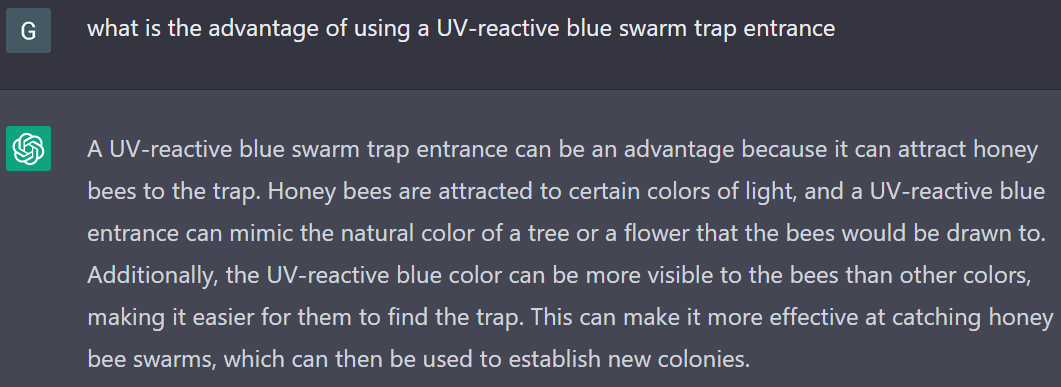
ChatGPT - what do you know about honey bees?

beekeeping,bee,varroa,artificial intelligence,swarm trap,ChatGPT

beekeeping,bee,varroa,artificial intelligence,swarm trap,ChatGPT

Here is my experience with asking ChatGPT about honey bees.

  • easy to use 
  • replied quickly with niche knowledge about honey bees
  • challenges web search business
  • if a portion of the reply is incorrect, I pressed the "Regenerate" button; the screenshot is the best reply after 5 tries; including "simple terms" in the request kept the reply short
beekeeping,bee,varroa,artificial intelligence,swarm trap,ChatGPT

Wednesday, September 28, 2022

swarm traps (bait hives) with UV-reactive blue entrance


beekeeping,bee,swarm,swarm trap,Thomas D. Seeley,UV-blue entrance,swarm lure,scout bees,

Impact of UV-Induced Blue Florescence Entrances concludes:

  • UV-reactive blue swarm trap entrances nearly doubled the number of scout bees observed over the control
  • Swarms selected the trap with the UV-blue entrance over the control 100% of the time
 method and materials:
  • conducted from May to August in 2020 and 2021 in western New York
  • 1.25 inch (3.2 cm) circular entrance hole
  • 1.59 cubic ft (45 liter) cavity volume
  • 4 frames without comb + 1 frame with some comb
  • attached to a tree at a height of 8-10 feet
  • 3 locations facing an open field with bee forage
  • 2 traps per location 200 feet apart with a 3D printed trap entrance using 1) UV-reactive blue filament or 2) white filament (control)
  • swarm lure spray applied weekly
  • weather permitting, 1 location included scout bee counting between 11:30am-4:00pm
 

Scout Bee Activity LoggedTrap Selected
Year 1 - 2020  
Location 1 YesUV-reactive blue
Location 2  UV-reactive blue
Location 3 UV-reactive blue
   
Year 2 - 2021 (traps swapped)  
Location 1 YesUV-reactive blue
Location 2  none
Location 3 UV-reactive blue

Monday, May 16, 2022

May 16th swarm

beekeeping,bee,swarm,swarm trap,abscond,

At 7 pm, I stepped outside and heard the loud buzz in the backyard.  The buzz was the strongest standing in front of the hive and looking straight up into the tree canopy the blue sky was darkened by bees. I'm not sure what happened:

  • Did my hive swarm or abscond then return landing and accumulating on the outside of their hive?   It's hard to imagine that this weak hive had a population this large and certainly 1/2 of the hive population was not this large.  This is where I wished I had a recent baseline hive weight measurement.
  • Did a neighborhood hive or wild nest swarm and chose my hive boxes over the hanging 40-liter swarm traps.  For the past few days, I watched scout bees investigating my swarm traps.   I suppose 6 boxes filled with drawn comb is more attractive than the swarm traps - a furnished home with all the modern conveniences versus an unfurnished selection!
Time will tell what's going on.
beekeeping,bee,swarm,swarm trap,abscond,
Here's a photo the next morning.  I'm so pleased the bees moved in last night and that I did not intervene - the bees executed a plan, a plan that I did not understand.  Previously in my first-hand experience, swarms choose the hanging swarm trap and not a vacant hive.

Saturday, June 5, 2021

40-liter Swarm Trap


scout bees,plastic starter strip,bee,swarm,swarm capture,swarm trap,bee keeping,swarm lure,

On May 9th, the front porch video captured scout bees at my new 40-liter swarm trap.  Ultimately this trap was not chosen by the swarm.  In the still photo, I reused a hanging location for the 40-liter trap where a 8-frame trap successfully attracted a swarm on May 10th.

Each 40-liter trap contains:

Two 40-liter traps were sourced from one sheet of 4 by 8 foot 1/2 inch birch plywood.   Each trap required the following pieces:

  • 2x front (or back) pieces - 19 5/8 inch by 17 1/4 inch
  • 2x side pieces - 7 7/8 inch by 17 1/4 inch with 5/8 inch by 1/4 inch rabbit for frame hanging
  • 1x top piece - 19 5/8 inch by 8 7/8 inch
  • 1x bottom piece - 18 5/8 inch by 7 7/8 inch

Additional materials:

  • 1x circular Betterbee hive portal (optional)
  • 1x 1 inch bolt and wing nut (optional)
  • 2x fender washers (optional)
  • Aluminum Roll Flashing cut with a Dremel Fiberglass Reinforced Cut-Off Wheelcutting disk
  • Titebond II wood glue and clamps 

Monday, May 10, 2021

swarm trap and capture - May 2021


bee,bee keeping,scout bees, plastic starter strip,swarm,swarm capture,swarm lure,swarm trap

bee,bee keeping,scout bees, plastic starter strip,swarm,swarm capture,swarm lure,swarm trap
bee,bee keeping,scout bees, plastic starter strip,swarm,swarm capture,swarm lure,swarm trapbee,bee keeping,scout bees, plastic starter strip,swarm,swarm capture,swarm lure,swarm trap

On March 7th, I set out two 8-frame swarm traps hanging from crepe myrtle limbs.  I also prepared two hive stands as 8-frame swarm traps.   Each trap contains:

Immediately the traps were visited by scout bees, though I waited 64 days before a swarm would select one.  Here I share my 2021 swarm experience - so far.

On May 3rd, I set out two 40 liter (2441 cubic inch) swarm traps which contain similar elements as above except that there are just 5x deep frames in the top half and considerable volume (space) without frames beneath this tall and narrow configuration.   I'll share more details and photos of the 40 liter trap in future blog posts. If you are keeping count, I now have set out six swarm traps.

On May 6, the Nextdoor website mentioned that a swarm had landed at gusto! on Ponce, a restaurant near Clermont Hotel.   Last year I used Nextdoor information to locate and capture two swarms.  Nextdoor continues to be my main source of social media knowledge of local swarms.

On May 9 mid-afternoon, active scouting began at one swarm trap and by late afternoon two other traps had active scouting.  

On May 10 noon, all six swarm traps have scouts with the most intense active scouting focused at one hanging swarm trap.  I went for a 30 minute dog walk and in that short time I missed the swarm arrival.  At 3:30 I captured the attached video of bees completing their move into the 8-frame hanging swarm trap.

On May 11 dawn, I lowered the hanging swarm trap, closed its bottom entrance and set the left-right leveled trap onto a 3-step A-frame ladder.   In following days, I moved this 'ladder + trap' configuration at dawn 3 meters (10 feet).  I repeated these moves until I reach the desired backyard hive stand location.  Moving the trap created bee confusion and including a nearby closed patio umbrella in the move seemed to reduce this confusion.  On May 19, I transferred deep trap frames into a deep 8-frame box with a screened bottom board.   Every frame contained bees building new comb with the majority of bees found on the frame of dark comb.

Wednesday, April 7, 2021

tulip poplar windfall and other spring flowers '21


bee,beekeeping,tulip poplar, white clover,spiderwort,spring,swarm trap,swarm lure,

I discovered my first 2021 tulip popular flower windfall.  Click to zoom and see ants attracted to tulip flower sweetness.

Stuck working from home, I have become impatient with all things, including waiting for the Atlanta swarm season to start.  On March 7th I hung 8-frame deep swarm traps from crepe myrtle trees and baited unoccupied hives too - welcome to all scout bees. My overwintered bees are heavy but not drawing new comb or scouting the swam traps as I hoped.  The Atlanta swarm season will start when it starts.

Thursday, April 11, 2019

2019 tulip popular

amur honeysuckle, bee, beekeeping, checkerboarding, clover, foundationless. invasive plant, nectar, swarm trap, tulip poplar,


amur honeysuckle, bee, beekeeping, checkerboarding, clover, foundationless. invasive plant, nectar, swarm trap, tulip poplar, spiderwort,
I discovered my first 2019 windfall of the tulip popular flower kind.  Also shown is an invasive shrub which attracts pollinators, amur honeysuckle.  Other nectar sources at this time (not shown) include white clover and spiderwort.

Last weekend, I entered the hives for the first time this year.   The honey cap of one hive was checkerboard using foundation-less frames with no drawn comb.  The other hive was left in its winter configuration.

Weeks ago, I set tree hanging 8-frame swarm traps, but yet to see any scout bees.

Sunday, May 14, 2017

off-label use of cloake board

bee, beekeeping, cloake board, emergency queen, off-label, queen excluder, sustainable, swarm, swarm trap,
I purchased the cloake board with an intention to raise emergency queens, but I've drifted into off-label territory.  My success with two swarm traps catches and limited bee yard space encouraged me to combine the swarms with the cloake board.  Both entrances face in the same direction and the movable floor is removed.   For several weeks, these swarms have been connected by way of the queen excluder which is integrated into the cloake board.

Saturday, April 22, 2017

2nd swarm trapping

bee, beekeeping, dark brood comb, sustainable, swarm, swarm lure, swarm trap,
This morning it's not clear whether I'm observing active scouting or a move-in at the hanging swarm trap.   After a few more hours, I looked again and now convinced there's a move-in - see the large lump of bees attached to the bottom of the box that was not previously present.  Tomorrow the forecast calls for rain - so, I'm glad they'll stay dry.  This is my 2nd successful swarm trapping this spring.

This is my largest swarm ever, I always say that.  In a few days, I'll transfer the frames and can really judge the size of this swarm.

This hanging 8-frame deep contains 1 frame of brood comb, 7 frames with foundation and a swarm lure.   A hole saw was used to create two entrances - one that you can see and another on the bottom side.

Hanging swarm trap advantages:
  • no ladder climbing required with this rope hanging scheme
  • large volume created by 8 deep frames
  • movable frames can be transferred into other deep boxes without cutting comb 
  • bottom entrance encourages complete move-in and discourages comb building beneath the box
  • sustainable alternative to splitting
Hanging swarm trap disadvantages:
  • requires foundation as the swarm trap is not left-right level
The best element of the hanging swarm trap scheme is the safety of no ladder climbing. My next steps include using window screen and duct tape to cover the bottom entrance and to gradually move the trap to its final location.  I'll move small distances every day or every other day to minimize bee entrance confusion.

Saturday, March 25, 2017

Swarm Trap - March 25th '17

bee, beekeeping, dark brood comb, swarm, swarm lure, swarm trap,
Active scouting quickly changed into a mid-afternoon move-in.   Bees appear to be pouring sideways into the swarm trap entrance. This hanging 8-frame deep contains 1 frame of brood comb, 7 frames with foundation and a swarm lure.   A hole saw was used to create two entrances - one that you can see and another on the bottom side.  I don't want to use foundation, but the non-level box is not suitable for foundation-less frames.   It's too good to be true, this swarm did not demonstrate any comb building behavior beneath the box.   After an hour, everyone was inside.   It rained last night. I'm glad they stayed dry and are presumably busy drawing comb.

Wednesday, April 15, 2015

swarm attached to outside of swarm trap

bee, beekeeping, Honey B Healthy, pail feeder, queen includer, swarm lure, swarm trap,
This story begins with several days of bees scouting my 4 swarm traps - each trap contains some brood comb and a swarm lure.  Next, I discovered a huge swarm attached to the outside of my tree hanging 8-frame swarm trap.  During back-to-back cool drizzly weather days, I wait for the swarm to move into the box.

After 2 days, I give up waiting and successfully lower the trap and bees to their new location.  After the bump transfer, I discovered 3 pieces of comb - previously hidden beneath the swarm.    Outdoor comb construction was almost beyond my imagination.

For a few days, I will keep a queen includer beneath the new hive and a 1gal pail feeder with Honey-B-Healthy above the inner cover.

Sunday, April 12, 2015

spring 2015

bee, bee cozy, beekeeping, swarm trap, tulip poplar,
Reached yet another bloom marker, Tulip Poplar flowers - and with some weather luck, more nectar forage for the bees.  Already, other nectar flows required that I add more medium boxes to two over-wintered hives which are busting with bees.

Earlier this year, I replaced two hanging 5-frame swarm traps with 8-frame swarm traps and removed the bee cozy.  Scouting of the new traps began in early March - stay tuned for move-in news.