Showing posts with label wax. Show all posts

Saturday, September 2, 2023

clean wax with slow cooker 2023

beekeeping,bee,slow cooker,crush and strain,ChatGPT,wax,

beekeeping,bee,slow cooker,crush and strain,ChatGPT,wax,

beekeeping,bee,slow cooker,crush and strain,ChatGPT,wax,
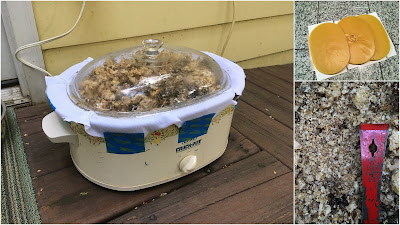
I switched to a round slow cooker (crock pot) to clean the crushed honeycomb and this led me to simplify my crushed comb cleaning steps using a colander.
  • crushed honeycomb - link for bee yard and kitchen activities
  • after several days of straining, I rinsed the crushed comb in warm water
  • selected a colander of the same diameter as the round slow cooker lid
  • line colander with cotton fabric and I mounded with rinsed crushed comb 
  • added lid and joined cotton fabric edges with 2 bull clips
  • removed the colander and added 1 cup of water and lid to the slow cooker
  • be safe and melt the wax outdoors
  • set slow cooker on high for 1 3/4 hours
  • turned off the slow cooker and let it cool undisturbed to room temperature with the lid on

ChatGPT generated haiku 

Crush, strain, honey's flow,
Slow cooker's gentle embrace,
Clean comb's sweet glow.


Saturday, June 17, 2023

counting board debris

ants,bee,counting board,Small Hive Beetle,pollen,debris,bee keeping,wax moth larvae,wax,
I'm not a fan of leaving the counting board beneath the screen.  However, for spring swarms I usually start with the board and remove it when entering warmer weather.
 
Budgeting time between my day job, gardening, dog walking, going to physical therapy, blah blah blah - Well, I left the board in place without inspection for too long - 77 days, what was I thinking?
 
I tugged on the corrugated plastic sheet without success.   I shared my why do I keep making my life difficult story with a friend, Michael Willis, who had a great idea - attach a strip of duct tape along the length of the plastic sheet for additional grip.  If one duct tape strip is good, I thought to myself, let's try two duct tape strips, let's include a handle.  No luck, the board would not move!   In desperation, I pushed an 18-inch metal ruler beneath the screen a few times and was able to move, then pull out the board in one piece.
 
The debris consists of:
  • lots of beeswax and you guessed it, wax moth larvae
  • pollen
  • ants 
  • small hive beetles
The last photo was taken after discarding the fine debris with a screen.  The wax scales/flakes look fabulous.

Thursday, April 14, 2022

imperfect comb

My foundation-less beekeeping results in comb with a gentle wave across the frame where bees 1) merged distinct regions of top bar attached comb like a clothing zipper, or 2) transitioned comb construction between worker and drone sized cells.

On Two Bees in a Podcast Michael Smith spoke about imperfect comb.   Here are links to the topic of where bees created 4, 5, 7, 8 and 9-sided non-hexagonal cells:

Sunday, June 13, 2021

crush and strain 2021

beekeeping,bee,slow cooker,crush and strain,honey,combcapper,escape,wax,

beekeeping,bee,slow cooker,crush and strain,honey,combcapper,escape,wax,

beekeeping,bee,slow cooker,crush and strain,honey,combcapper,escape,wax,

Here's my crush and strain experience so far this year:

bee yard activities:

  • inserted a triangular bee escape beneath a deep box and next day removed 8 fat deep frames 
  • halfway (8 steps) between hive and Storage Tote brushed small number of bees from the frame
  • one deep frame donated to "May 10th" swarm and remaining frames taken indoors
 kitchen activities:
  • attached (with blue painter's tape) brown paper on floor and cabinets
  • placed food safe 5 gallon bucket on brown paper and attached combcapper
  • plugged frame into combcapper and cut capped comb from frames with paring knife
  • crushed comb with 2 inch Plastic Joint Knife attached to a pole
  • filtered crushed comb with small mesh fabric strainer and bottler stack - yielded 3.4 gallons (12.9 liters) of honey 
  • in 3 cycles, I used 1 cup of water, coarse cotton fabric and a 5qt round slow cooker set on high for 1.75 hours to catch wax impurities which resulted in 1.54 lbs (700 gm) of wax

Sunday, September 6, 2020

harvest 2020


beekeeping,foundationless walter t kelly,bee,harvesting,crush and strain,honey,escape,wax,

beekeeping,foundationless walter t kelly,bee,harvesting,crush and strain,honey,escape,wax,

beekeeping,foundationless walter t kelly,bee,harvesting,crush and strain,honey,escape,wax,
Notice the thin stripe above the 3rd box (count from the bottom), it's the triangular bee escape. 24 hours prior, I added the escape so that I can harvest frames above the escape without disturbing the vast majority of bees. I found more bees than expected during harvest and the reason can be seen in the third photo, a frame of brood.

I brushed off bees from harvested frames halfway between the hive and the plastic tub (2nd photo) - which is twenty steps away from the hive. 

I've not shown the crush and strain harvest of 5 fat frames which yielded 1.4 gallons of honey.

Friday, August 16, 2019

wax blocks 2019


beekeeping,bee,slow cooker,crush and strain,wax,

After crush and strain, I rinsed the wax with warm water. Crushed wax was melted outdoors in a large thrift store slow cooker. I used one cup of water and cotton fabric to catch wax impurities. I set the cooker on high for nearly 2 hours and left everything to cool for another 4 hours. I repeated this cycle 3 times. Click on the photo and have a look at the tidy elliptical wax blocks.

Wednesday, July 31, 2019

crush and strain 2019


bee, beekeeping, combcapper, crush and strain, escape, foundationless. walter t kelly, harvesting, honey, slow shutter, Strainer and Bottler, wax,
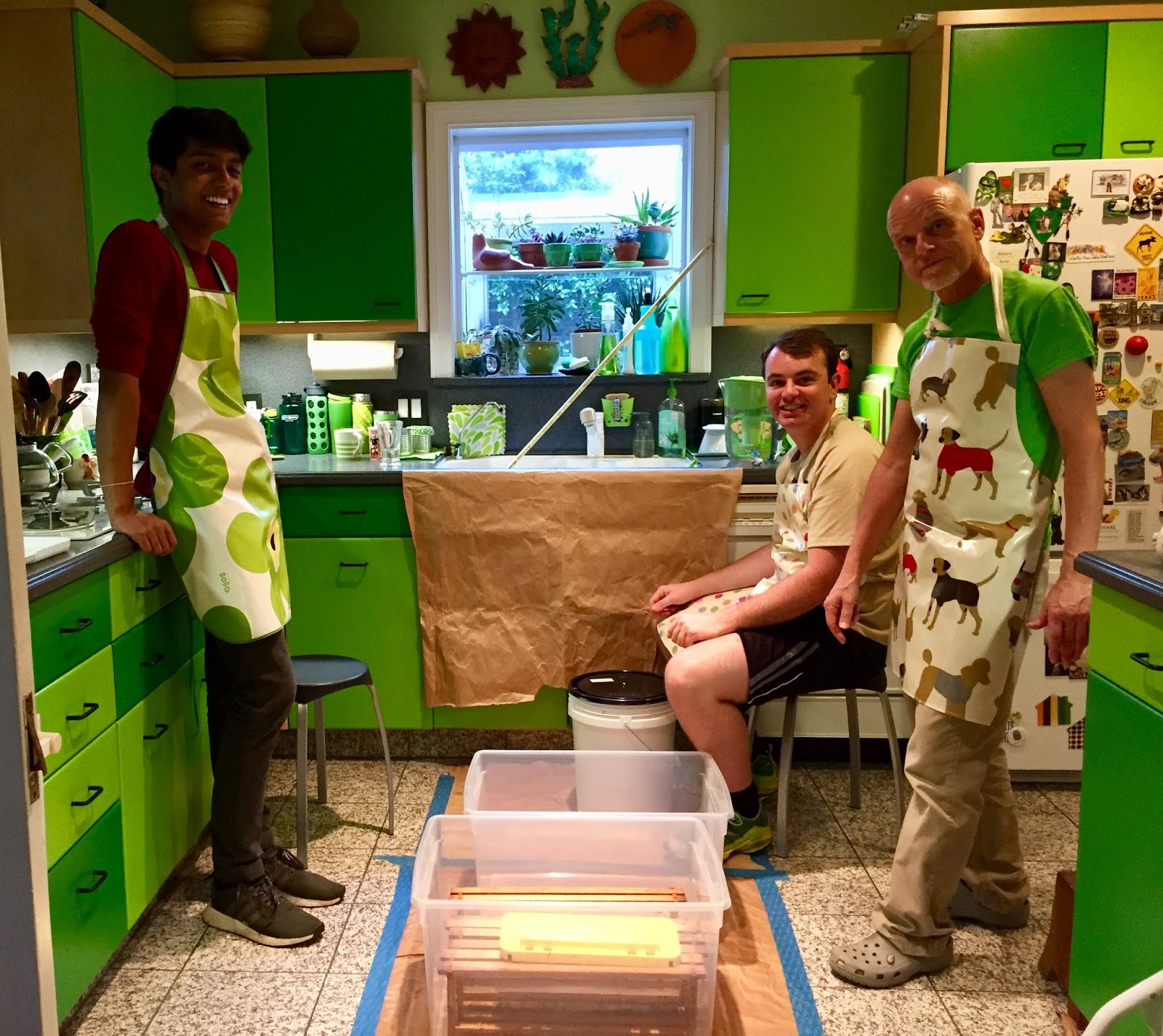
We worked in the middle of the kitchen floor to contain the sticky clean-up.  Imagine a compact vertical stack - from the bottom up: 
Sagar and Quin (co-workers) cut comb with a paring knife from foundationless frames. Comb was crushed in the bucket using a 2 inch Plastic Joint Knife attached to a pole.

Crushed comb was poured into the strainer bottler and left to sit for a few days so that foam (tiny air bubbles) can rise before bottling.

After cutting away honey comb, frames are returned to the Storage Tote. Over-night, honey dripped into the Tote and were captured too. Sticky frames were stacked outside in a location away from the hives.  Bees assisted with the final honey clean-up of sticky frames - a circle of life scene which reminds me of sky burial.

In the 3rd photo, I used a slow shutter iPhone app.  Crawling bee behavior looks like white dots while flying behavior looks like brown lines (classic multiple exposure).

Tuesday, July 30, 2019

harvest 2019

bee, beekeeping, escape, harvesting, honey, wax, foundationless. walter t kelly,
Click on the first photo and notice the thin stripe above the 3rd box (count up from the botttom), it's the triangular bee escape. 24 hours prior, I added the escape so that I can inspect frames above the escape without disturbing the vast majority of bees. I placed a plastic tub twenty steps away from the hive and a few remaining bees were brushed from the frame halfway between the hive and the plastic tub. Harvesting frames went so smoothly that I began to doubt why did I wear a hoodie.

Click on the second photo, this is a stunning example of comb building using foundation-less frames.  What I found unusual is that all the honey cells are completely capped.

Most likely my honey surplus will be considerably smaller than last year. In the third photo, frames are blue tape sealed inside the plastic tub and ready for the next step which is to cut out the comb.  More about this in the next blog post.

Wednesday, June 13, 2018

crush and strain simplified

bee, beekeeping, combcapper, crush and strain, escape, foundationless. walter t kelly, Strainer and Bottler, brushy mountain, escape, harvesting, honey, wax,
It's called crush and strain, but there are surrounding steps to this simple slogan.  My honey harvest starts with the bee escape and ends with bottling.  So that foam can rise before bottling, strained honey is left to sit for a few days. With just one 5 gallon bottler, lots of honey and a busy day job, I had to modify my sequential honey harvest process.

Lucky for me, Home Depot sells food safe 5 gallon buckets - I bought two buckets to store crushed comb (wax and honey).  When the bottler becomes available, then I pour crushed comb into the strainer bottler

I'm trying to avoid making a large horizontal sticky mess in the kitchen.   So, I work in the middle of the kitchen floor.  Imagine a compact vertical stack - from the bottom up: brown paper, 5 gallon bucket, combcapper and medium foundationless frame of capped honey. In under an hour, Melissa and Dillon help cut comb from 14 frames with a paring knife.  Comb is crushed in the bucket using 2 inch Plastic Joint Knife attached to a pole.

Friday, June 8, 2018

crush and strain with Combcapper

bee, beekeeping, combcapper, crush and strain, foundationless. walter t kelly, honey, wax,
Combcapper gadget simplified my crush and strain process.  I'm not using the supplied nail and cut the medium foundationless frame down in thirds, guiding each 1/3 piece by hand into the 5 gallon bucket.  The combcapper holds the frame securely - an essential element when using a sharp paring knife. Michael Willis, coworker and beekeeper, helped me in the kitchen extracting 12 frames which yielded 4 gallons of strained honey.

Sunday, October 8, 2017

wax moth larvae cleanup

bee, beekeeping, chicken, debris, honey comb, Small Hive Beetle, wax, wax moth larvae,
Lazy beekeeping has a few downsides. This summer, two tall stacks of boxes with drawn comb and no bees attracted wax moths.  Next, the wax moth larvae ate the drawn comb...all the comb.    Larvae chewed the wood too, compromising some frames and boxes.  What was I thinking - to busy with other things, to hot to wear the beekeeping hoodie.   The not so lazy cleanup went on and on.  I'm a philosophical contradiction.

The chickens enjoyed live snacks and a few wasps helped with the crushed larvae.  I'm grateful that the problem was not small hive beetles. 

Sunday, August 14, 2016

third hand tool - wood shims

bee, beekeeping, crush and strain, hive tool, Strainer and Bottler, third hand tool, wax, wood shim,
This year, I asked for help in the beeyard - a neighborhood beekeeper (aka He who must not be taken seriously) helped brush bees off capped honey frames and then place those frames into a covered storage tote.   Later the same day, friends Lauren and Todd helped in the kitchen, cut-out comb, then crush and strain the honey crop.   These are wonderful examples of an extra pair of hands.

Now imagine working solo in the beeyard - pry a gap beneath the top box with a standard hive tool and insert wood shims as a third hand tool.  Move to the opposite side of the box and repeat the process.   Now it's easier to lift the top box without fighting sticky propolis re-gluing the gap.  As wood shims are hard to recover against a leaf litter background - I add a piece of blue tape to the thick end of shim.

Tuesday, July 5, 2016

clean wax with slow cooker

bee, beekeeping, crush and strain, slow cooker, solar wax melter, wax,

bee, beekeeping, crush and strain, slow cooker, solar wax melter, wax,
I retired my solar wax melter and use a slow cooker exclusively to clean wax.  For safety, I operate the slow cooker outdoors and place concrete pavers beneath the hot appliance and wood table top. After crush and strain honey extraction, wax from thirteen frames are rinsed in warm water and cleaned in two slow cooker batches.   I added half the wax and two cups of water to the large oval slow cooker. Shown is cotton fabric and blue tape which suspend the wax above the water bath.  After two to three hours on the high setting, I turn off the slow cooker and leave all components (lid, cotton fabric and wax impurities) undisturbed until the slow cooker has completely cooled.

Wednesday, July 1, 2015

sky burial - stack of sticky frames after crush-and-strain

bee, beekeeping, brushy mountain, crush and strain, honey, Strainer and Bottler, wax,
I'm complaining about a good problem, too many frames of capped honey.  I credit the success mostly to honey bees from over-wintered hives and favorable Atlanta spring weather.  

I purchased a Sterilite® ClearView™ Storage Tote - Transparent with White Lid 66Qt. from Target.  The 12.25 " H x 16.25 " W x 23.5 " L dimensions are ideal for the storage of 15 medium frames of capped honey - the maximum processing capacity of the 2 (5-gallon) bucket strainer and bottler.

I'm using a a third 5-gallon bucket and a plastic scraper attached to a pole to thoroughly crush the honey comb.   I'm not a solo act - Ram, Melissa and Dillon volunteered to help - not counting the kitchen clean-up and hanging brown paper, the crush-and-strain process takes about 30 minutes.

After cutting away the honey comb, the frames are returned to the Storage Tote.  Over-night, a considerable amount of honey drips into the Tote and I captured these honey dripping too.  As seen in the photo, I stacked the sticky frames outside and in a location away from the hives.   The bees assist with the final honey clean-up of the sticky frames - a circle of life scene which reminds me of sky burial.

Tuesday, May 7, 2013

Foundationless Frames by Walter T Kelly


bee, beekeeping, foundationless. walter t kelly, frame, wax,

I discovered  a conversation to reduce the current center-to-center frame spacing from 1 3/8" to 1 1/4" in the brood chamber.  Although narrow frames are not commercially available,  the commercial medium sized Foundationless Frames caught my attention - I ordered the foundationless frames and  assembled them using the glue on day1 and nail on day2 strategy.

bee, beekeeping, foundationless. walter t kelly, frame, wax,

I wanted to add a thin layer of beeswax to the center guide, but advice on the Internet seemed either messy or complicated.   I filled an empty food can with beeswax - after removing the can from the boiling water bath, the wax remains liquid for many minutes - long enough for me to dab wax onto the center guide using a piece of cardboard.  My application method needs more work -  imagine a brushing style and not Jackson Pollock dripping paint.   I placed a large cardboard sheet on top of the working counter top - a few wax drips landed in the wrong place, but the cleanup was easy.

Saturday, June 2, 2012

crush and strain 2012

bee, beekeeping, brushy mountain, crush and strain, honey, solar wax melter, Strainer and Bottler, wax,
The day before the crush and strain, I removed eight deep frames of capped honey from the freezer and left the frames to thaw inside their plastic bag.  I cut away the honey comb and nearly filled a five gallon bucket - probably the limit of my strainer

Including preparation and clean-up, the entire crush portion took just one hour - a new record.  Here's my best effort with a material balance.
  • 48.0lb of honey + 8 deep frames + wax
  • 42.6lb of honey + wax
  • 37.0lb of honey
After two days of straining, stirring and settling, I filled 73 x 8oz bottles of honey.
bee, beekeeping, brushy mountain, crush and strain, honey, solar wax melter, Strainer and Bottler, wax,
I rinsed the wax pieces in warm water and dried those pieces on the sunny driveway.  Next, I placed the pieces in bags which are stored in the freezer until I was ready to use the solar melter.  Sounds extreme, but a few years ago wax moths made a complete mess of unprocessed wax which I left  indoors.
bee, beekeeping, brushy mountain, crush and strain, honey, solar wax melter, Strainer and Bottler, wax,
Coincidentally, I started the solar melting during Atlanta's all-time record of 106°F.   The block of wax smells great and has a beautiful deep yellow color - I'm blown away.

Sunday, May 27, 2012

triangular bee escape

bee, beekeeping, brushy mountain, escape, harvesting, honey, wax,
Puzzled why I did not use this triangular bee escape sooner, but after many years in storage, I gave it a try.  The picture shows the interesting triangular side of the bee escape, but remember that this side faces downwards.  I added the bee escape beneath an 8 frame deep super with capped honey.  Above the deep super, I closed the small vent notch of the inner cover.

After twenty four hours most of the bees cleared the deep super except for a small patch of bees beneath the inner cover hole and another small patch associated with drone brood. After removing the bee escape, I found that bee escape exit passages were not blocked by drones--which I heard was a problem with other bee escape designs.

Wednesday, August 3, 2011

crush and strain honey


Each deep frame of capped honey comb was wrapped in a large plastic bag and put in the freezer a few weeks ago.  Freezing allowed me to postpone the crush and strain and kill any trace of small hive beetle larva.  The day before the crush and strain, frames were removed from the freezer and left to thaw inside their plastic bag. 

Comb was cut away from the frame in 3 parts and dropped into a 5 gallon bucket.  Nearly 6 deep frames of capped honey comb filled the bucket to the top.  Last year, instead of using a complete sheet of wax foundation, each frame was started with a narrow strip of  wax foundation.   What a pleasure that none of frames were wired.  So, I did not have to hassle with cutting away wire.   

I reused the cardboard and packing paper from Brushy Mountain before sending both to recycling.   The cardboard was reused twice, first to catch glue and paint drops (from assembly of deep hive body) and then to cover the kitchen floor during crush and strain.  Packing paper was used to cover the cabinet doors which sped up the kitchen clean-up too.  Including preparation and clean-up, the entire crush portion took just two hours--seems a lot easier than last year.

After straining and settling, nearly 6 deep frames of capped honey fills 40 x 8oz bottles of honey.

Tuesday, December 7, 2010

crush and strain


In the past, crushing honey comb using a hand scrapper on the kitchen counter top required lots of sticky clean-up.  Backwards Beekeepers inspired me to change the crush portion of my honey harvesting process.  I purchased a 2 inch plastic knife ($.98), a 5 gallon bucket ($3.98) and lid ($.98).  The plastic knife was attached to 1/2 inch CPVC pipe using stainless steel machine screws and stainless steel nylon lock nuts.  A plug added to the end of the CPVC pipe prevents the honey from entering the CPVC pipe.  I am not concerned with puncturing the bucket as the knife moves very slowly through the viscous honey comb mash.  This 8-frame medium super contains 30lb of honey comb or 24lb of honey (43 8oz bottles).

Sunday, September 26, 2010

IPM counting board debris map

bee, beekeeping, counting board, debris, gnuplot, ipm, map, pollen, propolis, screen, Small Hive Beetle, wax,
Each week I removed the IPM counting board and drew the outlines of the counting board debris into my journal.  The debris consists of wax, pollen, propolis and other items like the occasional small hive beetle.  After cleaning off the debris, the counting board is returned to the hive.  I transferred  my journal debris maps into a spreadsheet grid where I (one or zero) scored the presence or absence of debris.  The debris mostly lands along blurry east-west lines which relate to the bee space between frames.  Probably most of the blurring of the debris is attributed to:
  • debris falling off the bees as they bounce in and out of the hive entrances above the screen 
  • debris bouncing or rolling on the screen
  • debris moved by ants or wax moth larva beneath the screen on the counting board
To sharpen the debris map blurring, I used a moving 3 week sum which creates a debris map with three intensities.  All of my work is done twice, as I follow two side-by-side hives that were started this year. So, what story might describe these gnuplot contoured debris maps?
  • In the beginning, the debris tends to be concentrated near the hive entrances which face west.
  • Over may weeks the debris concentration moves east away from the hive entrances and also north.   The two hives consume syrup at different rates, have different flight activity and have different weekly debris maps.  However, both hives show the same overall shift of debris concentration when measured over many weeks. 
Where will I find the debris concentrated this fall?  What about this winter?  What about next spring?