
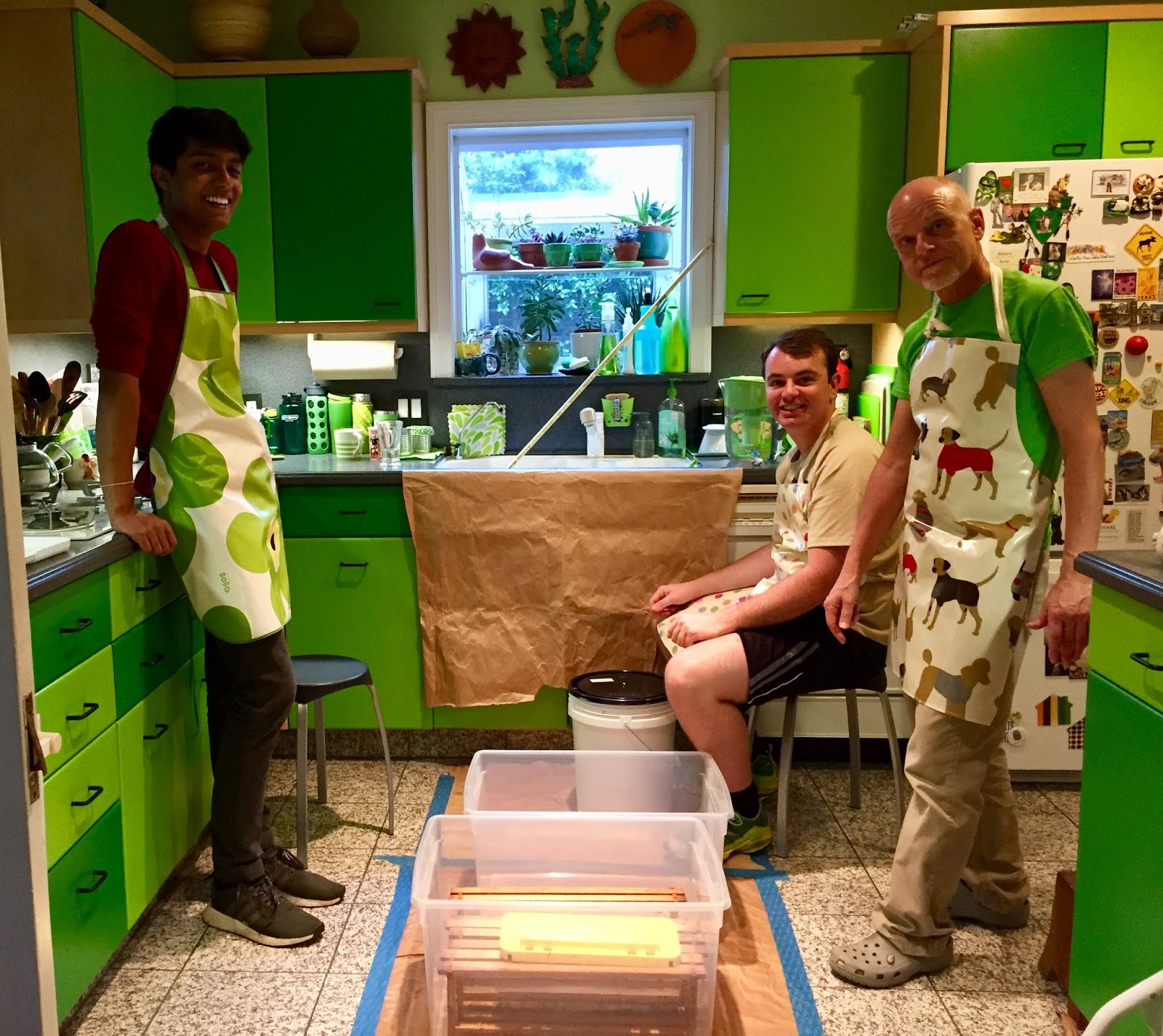


We worked in the middle of the kitchen floor to contain the sticky clean-up. Imagine a compact vertical stack - from the bottom up:
- brown paper
- food safe 5 gallon bucket
- combcapper
- medium frame of capped honey.
Crushed comb was poured into the strainer bottler and left to sit for a few days so that foam (tiny air bubbles) can rise before bottling.
After cutting away honey comb, frames are returned to the Storage Tote. Over-night, honey dripped into the Tote and were captured too. Sticky frames were stacked outside in a location away from the hives. Bees assisted with the final honey clean-up of sticky frames - a circle of life scene which reminds me of sky burial.
In the 3rd photo, I used a slow shutter iPhone app. Crawling bee behavior looks like white dots while flying behavior looks like brown lines (classic multiple exposure).


1 comment:
Nice update on the crush and strain process—keeping things simple and low-intervention really brings out the natural quality of honey. Since this method preserves raw characteristics, it also adds strong value when it comes to honey packaging and positioning as a premium, minimally processed product. Great work!
Post a Comment