Showing posts with label ventilation. Show all posts

Wednesday, December 25, 2024

learning from natural honey bee nests

beekeeping,bee,winter,bee cozy,winter cluster,bee nest,bee space,air flow,ventilation,
It’s winter and I’m thinking about my bees in these recent cool temperatures; my curiosity turned to Google Scholar and searching for the beekeeper and engineer - Derek Mitchell. Here I found Derek’s 2024 paper in the Journal of Thermal Biology - Are man-made hives valid thermal surrogates for natural honey bee nests.  This is a highly technical read with an exotic mix of scientific units, but I found take-home nuggets useful to my hobby beekeeping. My goal is not to keep bees in a tree, but to modify my wintering of bees in a thin-walled wood box by learning what bees have, on their own, achieved living in tree cavities.
Man-made hive Tree nest
Top ventilation Beekeeper’s  choice None 
Wall properties Thin low R-value Thick high R-value
Comb to wall surface Continuous bee space separation Comb attached to the wall with a few small gaps
Comb to roof surface Continuous bee space separation Comb maximally attached to tree cavity roof
Comb to bottom surface Continuous bee space separation made more complex with multiple boxes One continuous separation
Vertical comb length Single frame height whether using one or multiple boxes  Continuous
Made with HTML Tables

Using 16 variables adjusted to experimental observation, Derek used computational fluid dynamics (CFD) modeling and compared the convective air flow and metabolic impact to bees in a standard British National Hive (one box of 35 Liters) versus a synthetic tree nest (45 liters).

Derek writes, “bee space above combs increases heat loss by up to ∼70%; hives, compared to tree nests, require at least 150% the density of honey bees to arrest convection across the brood area.”

Derek recommends blocking the bee space above the combs in a man-made hive, which I interpreted as adding a clear plastic sheet resting directly on the top bar frame. I have a box of letter-sized plastic sheets designed for overhead projector presentations - it seems perfect for the task. Stay tuned for how this works out for me as I am over-wintering two hives with a different number of boxes. One hive has two medium boxes, and the other hive has one deep box. I spliced sheets together with tape and trimmed the extended sheet to fit inside my eight-frame box. Each hive received one trimmed plastic sheet beneath its inner cover resting directly on the top bar frame. No doubt the bees will glue the plastic to the top bar frame and this will require some vigorous spring cleanup effort. 🤣

Perhaps you want to give this small modification a try and use different materials (e.g., wood, thick acrylic, or coroplast).

Saturday, February 10, 2024

Winter Top Ventilation

If you turn to page 116 of Seeley's book The Lives of Bees, you'll find a reference to Derek Mitchell a PhD Candidate in Mechanical Engineering at the University of Leeds.   With web-based searching, I discovered Derek's 2017 article in the American Bee Journal (Vol. 157 No. 8) Honey Bee Engineering: Top Ventilation And Top Entrances.   The article illustrates that adding top ventilation significantly reduces humidity and the depth of the heat pool when compared to an uninsulated hive.  Why?  Warmer air is more buoyant and flows faster through the top vent.

Providing hive insulation in winter reduces bee-generated heat loss and this increases the temperature of the heat pool found at the top of the hive - see the image from Derek's article.  I'm using the word heat pool as temperatures measured relative to the top of the hive -- I recognize, pool is commonly used with liquids that fill upwards from the bottom of containers. I currently use insulated hive wraps in winter and plan to close my top vent moving forward.

beekeeping,bee,ventilation,winter,bee cozy,
In email conversation, Derek recommends adding more hive insulation above the hive compared to the hive sides to discourage condensation from raining down on the bees.

Derek has simulated the heat flow of a winter bee cluster in a thin-walled wooden hive and compared those results with measurements collected by other researchers.  I plan to discuss this article in an upcoming blog post.

Saturday, February 12, 2022

honey consumption and late winter brood rearing

bee,beekeeping,ventilation,temperature,hive weight,bee cozy,winter,brood,foraging,

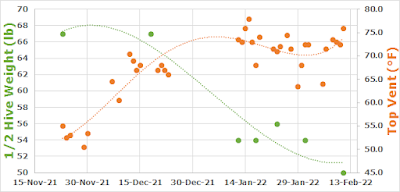
My 8-frame hive is wrapped in a hive cozy. On warm afternoons in December and January, bees flew vigorously and performed orientation flight. These 2021-2022 measurements show that bees are most likely consuming their honey stores and raising late winter brood.  

  • Temperature measurements are taken at dawn at the top vent using an inexpensive RadioShack Waterproof Pocket IR Thermometer. The orange trend line is most likely an increase in total bee metabolism/respiration (bees covering late winter brood). Peak temperature top vent measurement of 78°F (25.6ºC) is not the expected 89.6-96.8°F (32-36ºC) brood nest temperature, so why? Cold air flows into the hive entrance and screened bottom board and mixes with warm moist bee respiration and exits the top vent - usually I discover the warm moist air condensed to the outside of the hive cover.
  • Less frequently, I weigh the hive using an inexpensive luggage scale. The green trend line is most likely winter consumption of honey stores. I would prefer to connect densely sampled weight measurements (points) with a spline instead of the polynomial trend line.  However, extra hive weight measurements are not possible with my travel schedule. 
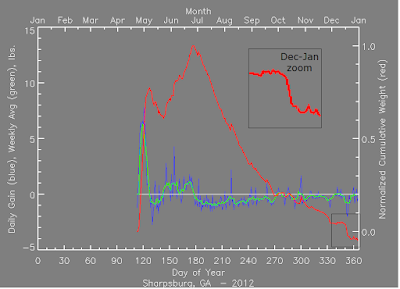
  • Also shown are HoneyBeeNet 2012 hive weight measurements from Cowetta GA (40 miles from Atlanta). HoneyBeeNet is a NASA hive and climate citizen science project. The zoom into these end of year weight measurements show a similar sharp drop in hive weight. 

Saturday, July 11, 2020

March 13th swarm

bee, beekeeping, betterbee, nucleus box, screened bottom board, swarm, swarm capture, ventilation, slow shutter,

bee, beekeeping, betterbee, nucleus box, screened bottom board, swarm, swarm capture, ventilation, slow shutter,
This small March 13th swarm did not outgrow their 5-frame home, but moisture management was not optimum and the old wood nucleus box was failing - see the new hole in the lower right corner of the brown box.  The bees are very calm, I moved the frames into a new 8-frame home using no smoke. These photos are taken hours later and all the bees attached to their old home have moved on.

Their new 8-frame home has loads of ventilation:
  • Hive stand is 13 inches tall.
  • Bottom board is screened and I'm not using a counting board.   
  • Inner cover has a ventilation notch.

My intention is to add deep frames of capped honey in August.

Sunday, April 12, 2020

condensation on cloake board

bee, beekeeping, cloake board, condensation, queen excluder, respiration, spring, swarm capture, ventilation,

bee, beekeeping, cloake board, condensation, queen excluder, respiration, spring, swarm capture, ventilation,
52 °F and there's a puddle of something on the cloake board landing area.  I dip my finger into the liquid and confirm the taste of simple water - nothing sweet about it.  Stacking the medium sized swarm atop an overwintered hive creates enough combined warm moist respiration to create condensation. Condensation, common in winter has taken me by surprise in spring.

Sunday, November 24, 2019

2019 Bee Cozy


Ants create tunnels and nest in the extruded polystyrene foam boards in warmer weather, so I postponed insulating the hives until now. In Atlanta, first frost arrived on November 12th which is just on the early side of historical average.  November 12 also marked the first subtle Arctic Oscillation downturn this winter.

Here are current the hive elements:
arctic oscillation, bee, bee cozy, beekeeping, hive wrap, respiration, temperature, ventilation, winter,

Friday, March 15, 2019

bee respiration with and without Bee Cozy

bee, bee cozy, beekeeping, hive wrap, respiration, temperature, ventilation, winter,

Here I'll compare winter bee respiration with and without the Bee Cozy hive wrap for two hives.  On the graph, think of the horizontal axis as outdoor temperature and vertical axis as the bee respiration temperature.  See previous posts for the measurement method.  All graph points have top vent temperatures greater than paver temperatures which is consistent with an active and alive hive. Red circles without fill are measurements with no Bee Cozy.

In the graph notice:
  • all points are consistently closer to the upper left corner with the Bee Cozy
  • hive #1 has top vent temperatures as large as 80 ℉ and consistently warmer than hive #2
  • the last measurement (blue circle with fill) is consistently closer to the upper left corner than other graph points.  
Hive #1 has more flight activity than hive #2 and the last measurement (blue circle with fill) is most likely attributed to a larger bee population in response to spring forage and warmer spring temperatures.

Monday, July 16, 2018

with and without Bee Cozy hive wrap

bee, beekeeping, temperature, ventilation, winter, cloake board, respiration, bee cozy, hive wrap,
There's no ideal way to compare winter bee respiration with and without the Bee Cozy, but I'll do my best here.

IR temperature measurements started on 12-Nov-2017 without the Bee Cozy.  See a previous post, bee respiration, for measurement method.  On 2-Jan-2018, the 17.0°F outdoor temperature convinced me to add the Bee Cozy to two vertically stacked hives.  Only the queen excluder portion of a cloake board separate these hives.  1 Bee Cozy is added to the bottom hive (4 boxes) and 2 overlapping Bee Cozys are added to the top hive (5 boxes). The Bee Cozy is designed for 10 frame equipment.  So, the Bee Cozy easily slips over my 8 frame boxes and cloake board with no effort.  This 2-Jan-2018 measurement point appears as a blue dot in the lower left corner of dots - Paver temperature equals 17.0°F and Top Vent temperature equals 31.0°F.  On the graph, think of the horizontal axis as outdoor temperature and vertical axis as the bee respiration temperature.

All graph points lie above the green line (x= y) which is consistent with an active and alive hive. Blue dots are measurements without the Bee Cozy and trend beneath orange dots which are measurements with the Bee Cozy.  Excluding a few points, the Bee Cozy consistently increases bee respiration (Top Vent) temperature.

Wondering why I went into winter with such a tall stack of boxes which requires step ladder beekeeping - there's no good reason other than lazy beekeeping.

Tuesday, January 2, 2018

bomb cyclone

bee, bee cozy, beekeeping, climate, cloake board, condensation, respiration, telescoping cover, ventilation, winter,
Winter storm Grayson brought cold temperatures to Atlanta, but no snow.  Use this link to see NOAA's satellite image.

Here's a photo of the upside down telescoping cover.  Warm moist bee respiration which left the inner cover notch, condenses on the cold telescoping cover and froze as a white ring.  Click the image for more detail.

17 °F temperatures encouraged me to add the bee cozy hive wrap now.    The hive wrap is designed for 10 frame equipment, so easily slips over my 8 frame boxes and cloake board.   I'm overwintering a tall vertical double stack of hives.   The stack contains a cloake board, where I removed the cloake board's sliding floor leaving its queen excluder to separate the two hives.  I added two overlapping cozys on the upper large stack of boxes and one cozy to cover the smaller lower stack of boxes.

From the bottom up, here are the hive elements at this time.
  • screen bottom board with counting board insert removed
  • 1 bee cozy hive wrap surrounding 1 deep box and 3 medium boxes 
  • cloake board with integrated queen excluder and sliding floor removed
  • 2 overlapping bee cozy hive wraps surrounding 2 deep boxes and 3 medium boxes
  • inner cover with top notch ventilation
  • two sheets of 3/4 inch XPS insulation 
  • telescoping cover
  • white corrugated plastic sheet overhang
  • concrete pavers on top

Tuesday, February 14, 2017

chilled drone brood

bee, bee cozy, beekeeping, chilled brood, temperature, ventilation, winter,
This morning, the low temperature was 35 °F and I found chilled drone brood at one of the hives.   On the landing board, you can see a range of drone development by way of eye color...no color, pink, purple then black.   On the top edge of the photo you can see that the bee cozy insulator is still on.  

The hive with chilled brood has a temperature measured at the inner cover notch of 84.5 °F.    It's sad that this hive became out of sync with the number of adult bees and are not able to keep the periphery of the brood chamber warm.  The next hive over measured 77.5 °F at the inner cover notch and is found without chilled brood.

Saturday, January 23, 2016

Winter Storm Jonas, bee respiration and flight activity

bee, beekeeping, climate, condensation, temperature, ventilation, winter,
Winter Storm Jonas brought 1.8 inches of rain and a dusting of snow to Atlanta.   The bees are not flying this chilly morning, but the inner cover notch is where I'm focusing my attention.   25.5°F outdoor temperature are compared to warm moist air, bee respiration, exiting the inner cover notch.

At the notch, I measured the temperature of three hives as 31.5°F, 36.5°F and 34.0°F using an inexpensive IR thermometer.   This small range of notch temperatures correlate with how I judged flight activity on warmer days.    In other words, the 36.5°F hive flies most vigorously on warmer days. Notice the drop of condensation (not rain) hanging on the telescoping cover.

Wednesday, December 3, 2014

warm bee respiration and non-invasive winter measurements

bee, beekeeping, temperature, ventilation, winter,
I am using an inexpensive RadioShack Waterproof Pocket IR Thermometer to measure temperature differences between cool outdoor air and warm bee respiration.  Winter temperatures arrived and this makes these contrasting temperature measurements possible.  At dawn I record the top vent and concrete paver temperature.  The concrete paver sits on top of the hive and acts as a surrogate for smoothed outdoor air temperature. These 2014 measurements are a follow up from a previous post two years ago, winter ventilation and pocket IR thermometer.

I have three bee hives (Kent, Buda and Pest) and mid-day flight activity at the Kent hive is consistently greater than the other two hives.    

If hive visits do not permit mid-day flight observation, then this non-invasive method provides some assurance that:
  • The hive is still alive provided that the graph points are above the green x= y line.
  • Greater contrast with outdoor temperatures correlate with increased mid-day flight activity.  The Kent hive trend line is further from the green x= y line, while less flight active hives have a trend line closer to green x= y line.

Saturday, January 19, 2013

condensation

bee, bee cozy, beekeeping, condensation, Styrofoam, ventilation,
Today's 31°F dawn temperature condenses warm moist bee respiration on the outside of the hive. Ages ago, I inserted a 1" slab of Styrofoam insulation beneath the outer cover to prevent condensation inside the hive.  On cold mornings, it's not unusual to discover condensation near the top vent, but wetness near the hive entrance is less common. Only one hive has condensation at the entrance - in warm weather, this is the hive that flies more vigorously than my two other hives.

Tuesday, December 18, 2012

winter ventilation and pocket IR thermometer

bee, bee cozy, beekeeping, condensation, crowding, humidity, temperature, ventilation, winter, winter cluster,

Last year as an impulse buy, I purchased an inexpensive RadioShack Waterproof Pocket IR Thermometer.  This budget gadget has a limited range, so get close to your target when taking a temperature reading.  At dawn I record the top vent and concrete paver temperature.  The paver sits on top of the hive and acts as a surrogate for smoothed outdoor air temperature.  The top vent temperature acts as surrogate for bee respiration temperature.  Imagine this - on cool mornings, the bees are tucked inside the hive, cold air flows into the entrance and screened bottom while warm moist bee respiration exits the top vent - sometimes I discover the warm moist air condensed to the outside of the hive cover - see photo.  
bee, bee cozy, beekeeping, condensation, crowding, humidity, temperature, ventilation, winter, winter cluster,
What is the relationship between outdoor air and bee respiration temperature?  During a cool morning, the respiration temperature is greater than the air temperature.  In other words, all graph points (and trend lines) lie above the y= x line.  For example, a dead hive plots on the y= x line.  Bee respiration temperature decreases with decreasing outdoor temperature - this is consistent with air exiting the top vent as a mixture of fresh air and bee respiration.  In other words, the warm bee respiration is diluted by cooler fresh air.

How do the hives differ?  Three hives (Kent, Buda and Pest) are located in a row, but each has a unique amount of shade and access to morning sunshine.

  • Pest's third order polynomial trend line respiration temperature is warmer than the other hive trend lines. Probably Pest has the largest bee population. Pest is a 2011 swarm, captured with the help of Cassandra and John. Pest is a powerful force of nature - what Cassandra refers to type A behavior.
  • Kent's trend line respiration is less warm than the Pest trend, yet Kent usually flys more vigorously than the other hives. FYI, Kent receives more morning sunshine than the other hives. My range of temperature measurements (Nov 18th to Dec 3rd) contains many stretches where the mid-day outdoor temperature is too low for foraging. Perhaps Kent's interesting sigmoid trend line represents 1) winter clustering in the flat lower left region, 2) typical non-clustered state in the flat upper right region and 3) a sloped line which represents a continuum of changes connecting these end-points.
  • Buda's trend line respiration is cooler than the other two hives. Buda is a 2012 spring split. Probably Buda has the smallest bee population compared to the other over-wintered hives.

Saturday, November 17, 2012

powdered sugar & bee cozy

bee, bee cozy, beekeeping, counting board, debris, dusting, phoretic mites, powdered sugar, Small Hive Beetle, varroa, ventilation,
On a 40°F November morning, I opened the hive top and applied/dusted one cup of powdered sugar onto the hive by tapping a flour sifter with a hive tool.  The rarely used bee brush found a purpose - this time to brush off powdered sugar resting on the top bar of the frames.  I left the boxes stacked as one unit and carefully let the powdered sugar fall straight downwards onto adult bees and not into cells.  After five hours I inspected the debris on the counting board - it's mostly powdered sugar with a trace of tiny light colored phoretic varroa mites and a dozen or so small hive beetles (SHB).   This is the first year that powdered sugar dusting knocked down SHB.  Past years knocked down many larger dark colored phoretic varroa mites .
bee, bee cozy, beekeeping, counting board, debris, dusting, phoretic mites, powdered sugar, Small Hive Beetle, varroa, ventilation,

I added the bee cozy and made bungee cord adjustments to keep the top vent and bottom entrance open. The cozy fits best on my eight frame hives when stacking one deep box and two medium supers.  Hives with two deep boxes requires that I curl over the top of the bee cozy to make things fit.  Like last year, I am going into winter with a screened bottom board and no counting board.

Friday, October 26, 2012

Beetlejail Entrance Trap - continued

bee, beekeeping, beetlejail entrance trap, Small Hive Beetle, ventilation,

I  removed the window screen which was used to exclude small hive beetles (SHB) entering the top of the hive.  As you can see, the bees propolized the screen which does not fit my winter ventilation plans.  Another downside is that palmetto bugs resided unchallenged between the cover and inner cover.  Compare the two pictures - the bottom hive side looks food safe while the top side has palmetto bug droppings - yuck.

The last clean-out of the beetlejail entrance trap was September 27th.   Today, I found zero SHB in the oil or crawling on the pull-out drawer.  I'll conclude that SHB are no longer flying.  Beneath the inner cover I discovered a few SHB - oh well.

Sunday, November 22, 2009

condensation: outside versus inside the hive

air, bee, beekeeping, brushy mountain, condensation, hive, moist, Styrofoam, telescoping cover, ventilation, warm,
This fall, water was discovered between the telescoping cover and inner cover.  The dawn temperature of  45 °F, thin plywood construction of the telescoping cover and warm moist hive air is a recipe for condensation.  In the morning, I also discovered condensation on the landing board near the reduce hive entrance.

Using 2 pieces of Styrofoam Block 18"x12"x1" from Micheals, a 1" slab of Styrofoam is fitted to the inside of the telescoping cover.  The small bee escape notch on the top side of the brushy mountain inner cover permits some warm moist air to leak from the hive.  See the photo--Now, the warm moist air leaking from the hive is seen appropriately condensing on the outside of the telescoping cover.   Problem solved, I no longer find water between the telescoping cover and inner cover.

Monday, July 27, 2009

bee bearding


"Bearding," what's next? Why does one hive, Kent, have a greater tendency to beard? Kent is followed for three weeks, where 1) bearding (or lack of), 2) outdoor temperature and 3) outdoor relative humidity are logged at 7AM. In contrast to a normally warm July, a cold front creates record low temperatures, extending the range of measured temperatures for analysis. The compact three week data collection period help exclude other annual population/reproduction cycles that Kent may experience. Lastly, the 7AM (approximately dawn--temperature nadir) measurement time is characterized by slowly varying temperature and an absence of sun light striking Kent.

Web: A quick look on the Internet shows that the beekeeping community speculates that the bearding bees implies:
  • lack of ventilation
  • high temperature
  • high humidity
  • crowding--preparation to swarm
Bearding Score: Sometimes I made entries in the log, other times my spouse (voice of reason) made those entries. As seen below, this is the relaxed language found in the log. The bearding is a somewhat binary phenomena, so traditional area units seemed to strict for the log.

  • 0= none(zero)
  • 1= tiny(very little)
  • 2= small(some)
  • 3= small (some) to medium
  • 4= medium
  • 5= medium to lots
  • 6= lots
Bearding versus Temperature: At Kent, bearding begins at ~61 °F and bearding increases with increasing temperature. A few points are not in agreement with the linear fit. For example, a zero bearding point is seen with a temperature of 70 °F. This point follows a day with a 5 inch rainfall.

Bearding versus Humidity: Surprisingly, no relationship between bearding and humidity is found. In other words, along the humidity axis, there is no bearding (bubble size) trend.

Bearding versus other theories:Lastly, Kent has not swarmed--so far. All hives have the same screened bottom board and the same inner cover to outer cover gap. In other words, Kent likes to beard for reasons I do not completely understand.