Showing posts with label swarm. Show all posts

Monday, August 24, 2026

Does UV-Blue Really Make a Better Swarm Trap?

I was first introduced to Brian Fleishmann’s September 2022 Bee Culture article, “Impact of UV-Induced Blue Fluorescence Entrances in Bee Culture,” through the MABA swarm trap build group. I was quickly convinced to give it a try. In 2023, I purchased four UV-reactive blue swarm trap entrances from the ApiTekStore. Not everyone in the swarm trap-building community was convinced. Brian’s experiment points toward a positive result, but with only six observations, the evidence isn’t strong enough to call the results statistically conclusive.  Still, I keep coming back to Brian’s experiment because, regardless of the statistical limitations, I think the experimental design is beautiful.

Brian’s article came to two conclusions:

  • UV-reactive blue swarm trap entrances nearly doubled the number of scout bees observed compared with the control entrances.
  • Swarms selected the trap with the UV-blue entrance over the control 100% of the time.

Those are pretty compelling results for a beekeeper looking for an edge in swarm trapping. Before getting too excited, it’s worth looking at how the experiment was conducted.


Scout Bee Activity LoggedTrap Selected
Year 1 - 2020  
Location 1YesUV-reactive blue
Location 2 UV-reactive blue
Location 3 UV-reactive blue
   
Year 2 - 2021 (trap entrance swapped)  
Location 1YesUV-reactive blue
Location 2 none
Location 3 UV-reactive blue

Brian conducted the experiment from May through August in 2020 and 2021 in western New York.
The basic setup:

  • Traps were attached to trees 8–10 feet above the ground.
  • Each trap had a 1.25-inch (3.2 cm) circular entrance hole.
  • Trap cavity volume was 1.59 cubic feet (45 liters).
  • Each trap contained four frames without comb and one frame with some comb.
  • Three locations faced open fields with bee forage.
  • Two traps were placed at each location, approximately 200 feet apart.
  • One trap had a 3D-printed entrance made from UV-reactive blue filament.
  • The other used white filament as the control.
  • Swarm lure spray was applied weekly.
  • Weather permitting, one location was monitored for scout bees between 11:30 a.m. and 4:00 p.m.

There was also a particularly clever element to the 2021 experiment: the UV-reactive and control entrances were swapped between traps.  Why? To control for the possibility that the bees simply preferred one particular tree. That detail is one of the reasons I like the experiment so much. Brian wasn't just asking, “Do bees like blue?” He was trying to eliminate other explanations for the bees' behavior. 

The biggest weakness is the sample size.
With only six observations, the results don't provide the kind of statistical confidence needed to make a definitive claim that UV-blue entrances attract more swarms. A larger experiment with more traps, locations, and swarm events would be much more convincing.  

To see whether Brian's findings had any support from other research, I asked Perplexity to look for academic, peer-reviewed citations of his article. Unfortunately, it couldn't find any. That isn't necessarily surprising. Brian's article appeared in Bee Culture, a trade publication, rather than an academic journal.
Perplexity did uncover a related 2018 study by Ostroverkhova et al., “Understanding innate preferences of wild bee species: responses to wavelength-dependent selective excitation of blue and green photoreceptor types.” Brian also references this study in his article.  Ostroverkhova found that significantly more bees were captured in their “attractive” traps equipped with blue fluorescent vanes than in the other traps they tested, with a statistically significant result of P < 0.05.  That doesn't prove Brian's swarm-trap experiment was correct. The experiments were not identical, and we shouldn't treat them as interchangeable.  It does provide an interesting piece of supporting evidence: bees can show a measurable attraction to particular blue wavelengths.  So while Brian's experiment has limited statistical power because of its small sample size, its findings don't exist in complete isolation. They point in a direction that is also supported by a separate experiment with stronger statistical evidence.
 

Fast-Forward to 2026
My original UV-reactive PLA swarm trap entrances from ApiTekStore have now been through several seasons, and they're showing their age. The plastic has become brittle and the blue color has faded.  Then, in April 2026, I met MABA speaker Ryun Forsman, better known as The3DBee, who gave a presentation on 3D printing.  Ryun makes swarm trap entrances using durable PETG filament, and his design has a much larger footprint along with a stronger UV-reactive response than my original entrances.  I bought six and I’m putting them to work.

Here's a short video of scout bees visiting one of my traps on March 10, 2026.

On April 13 2026, at 12:30 PM all the scouts vanished and shortly after the swarm started to move in.  Here’s a time lapse video of the swarm arrival. 

There Is No Perfect Swarm Trap Recipe
At this point, I'm comfortable saying that UV-blue entrances add value to my swarm trap management.  There are many best-practice swarm trap variables that may never have a settled answer.  For example, I'll share two things I do differently from Brian's experiment:

  1. I use a slow-release Nasanov pheromone vial.
  2. I don't put old comb in my swarm traps.

Despite those differences, neither practice appears to have hurt my year-over-year success.  Swarm trapping isn't about finding a single magic recipe. It's about stacking the odds in your favor.

Sunday, March 15, 2026

15 Minutes of Bee Flight

  bee,beekeeping,swarm,growing degree days,spring,


bee,beekeeping,swarm,growing degree days,spring,

Growing Degree Days
According to Growing Degree Days (GDD), accumulated heat levels in Atlanta are already brushing up against historic highs. You can see it everywhere: trees leafing out, stone fruit bursting into bloom, and pollinators getting a head start on their busiest season. In my neighborhood, bees are making the rounds—crabapple, ornamental cherry, holly, even the occasional dandelion are all part of the early buffet.  Dave Marshall, our swarm commander, received our first swarm call on March 3rd.


15 Minutes of Bee Flight

Back in 2012, NASA coined the unforgettable phrase “Seven Minutes of Terror” to describe the landing of the Curiosity Rover on Mars. It captured a brief, intense, high-stakes moment. I found myself thinking about that on Sunday, March 15, when my own backyard delivered a headline-worthy event: “15 Minutes of Bee Flight.”  At 11 a.m., under warm sun and blue skies, my five-frame hive swarmed.


If you’ve never seen a swarm in motion, it’s easy to miss—or misunderstand. From a distance, it’s just a buzzing cloud. Are they leaving? Arriving? It’s impossible to tell. But when you focus—really focus—on the landing board, the story sharpens. In my case, it looked like a moving walkway, a steady stream of bees flowing outward. The old queen and roughly half of the workers and honey are gone!     


I managed to capture it on my iPhone, a small victory considering how fleeting these moments are. Within minutes, the airborne cloud settled high in a Leyland Cypress tree—far too high to reach. So I did what any beekeeper would do in that situation: grabbed binoculars, stared upward, and chatted with a neighbor about the spectacle.


By the next morning, the story had changed.

I was out at dawn, scanning for the swarm. The good news: they had moved on. The bad news: the temperature had dropped hard overnight. On the neighbor’s driveway lay the aftermath—hundreds upon hundreds of dead bees, casualties of the cold. Maybe a thousand in total. Not nearly enough to represent the full swarm, but enough to tell a sobering story.


These were the bees that formed the outer shell, sacrificing themselves to give the colony a chance to survive. It’s a stark reminder of how collective survival works in a hive—individual loss in service of the whole. My neighbors, wonderfully kind about the whole thing, even asked if I wanted to hold a proper ceremony for the fallen. 


In Summary

And that’s the thing about beekeeping, especially in a year like this. 

What begins as a perfectly timed departure—a warm, sunny launch into the promise of spring—can collide almost immediately with the unpredictability of nature. A brilliant plan meets a sudden freeze. It’s hard not to view it through a human lens, to look for logic or fairness in it. But the bees don’t operate that way. They respond, adapt, endure—or don’t.


Monday, February 16, 2026

Climate Prediction 2026

bee,beekeeping,climate,winter,BroodMinder,growing degree days,swarm,

bee,beekeeping,climate,winter,BroodMinder,growing degree days,swarm,
Brood Break Observations in Two Backyard Hives

8-Frame Hive:
This colony experienced a brief brood break from October 19 to November 19, 2025, but showed no noticeable response to the January 10, 2026 cold snap. In fact, a few drones were spotted on February 8. Overall, the colony’s behavior resembles an early spring buildup more than typical winter activity.
5-Frame Hive:
In contrast, the 5-frame colony slowly responded to the January 10 cold spell with an additional brood break. It has recently begun raising internal temperatures back into the brood range of 92°F–98°F, signaling renewed brood rearing. 

Understanding the BroodMinder Graph
The 5-frame hive graph includes three temperature curves:

  • Raspberry curve: Temperature at the top of the lower box
  • Purple curve: Temperature at the top of the second box, just beneath the inner cover. 
  • Red curve: Outdoor temperature from a third-party source

At present, the purple curve remains below brood-zone temperatures, indicating no brood in the upper box. Meanwhile, the raspberry curve has climbed back toward brood-range temperatures following the most recent brood break.

Understanding the Growing Degree Days (GDD) Graph
The smooth brown line represents the multi-decade average of Atlanta’s Growing Degree Day (GDD) accumulation. GDD measures accumulated heat units and can seem abstract at first.
The jagged green line shows the current 2026 GDD. Prior to January 10, it tracked above the brown average line, reflecting warmer-than-normal temperatures. After January 10, the flat section of the green line indicates temperatures below 50°F. At present, the 2026 GDD has returned to near-average levels. In my swarm-obsessed view, average GDD values suggest a typical start to the Atlanta swarm season.

What’s Next?
The outlook from the National Oceanic and Atmospheric Administration offers limited hope for drought relief. For Atlanta, a modest chance of warmer and drier conditions could support foraging activity.  There is always a gray area between long-term climate outlooks and short-term weekly forecasts, so patience will be essential as the 2026 bee season unfolds.
February and March are likely to bring swings between unseasonably warm spells and freezing conditions. During cold, damp, overcast days with no flight activity, it can be unsettling not knowing what’s happening inside the hive. Fortunately, BroodMinder temperature loggers continue to provide valuable insight and reassurance. Stay tuned for further updates as we follow how these colonies navigate an unpredictable winter.

Monday, December 22, 2025

citizen science - free-living bees

bee,citizen science,wild,swarm,bee nest,

bee,citizen science,wild,swarm,bee nest,

I’ve been poking around the internet for the next interesting journal article. This month, I typed citizen science + honeybee into Google Scholar, and one paper really stood out: “Monitoring free-living honeybee colonies in Germany: Insights into habitat preferences, survival rates, and citizen science reliability.”  The study compares research-grade observations of free-living honeybee colonies around Munich (N=107), with observations from a much larger citizen science project across Germany (N=423). Where possible, the authors aim to combine high-quality research data with citizen science observations to expand the geographic scope of the study. 

Free-living honeybee takeaways

  • 63% of colonies nest in large-diameter, mature trees
  • 31% nest in buildings

Why survival was overestimated
Colonies monitored directly by researchers in Munich showed only about 12% overwinter survival. Citizen scientists reported much higher survival (around 29%), but this turned out to be biased due to fewer follow-up reports and poorly timed observations.
Many “surviving” colonies reported by volunteers were actually new swarms discovered early in the season (46% overlapped with the swarming period).
Abandoned nest sites were often not reported, making colonies appear longer-lived than they really were.

Cavity entrance direction: buildings vs. trees
Radar plots show that:

  • Tree cavities have a strong preference for south-facing entrances (20%)
  • Building cavities show a preference for west (22%) and south (16%)

Cavity entrance height: buildings vs. trees

  • Median entrance height for tree cavities: 4 meters (13.1 ft)
  • Median entrance height for building cavities: 6 meters (19.7 ft)

Big-picture takeaway
What are your swarm trap plans for 2026? Will they look like unused bee equipment stacked on blocks, or purpose-built swarm traps raised and baited with pheromones? Does this study change how you’ll deploy your traps?  When building and tree cavity entrance direction are combined, even an unlikely north-facing entrance appeared about 10% of the time. In other words, it’s surprisingly hard to get this wrong. From a next-door homeowner’s perspective, having a swarm-trap plan—any plan—is far better than having none at all.

Friday, December 5, 2025

Feral Honey Bees in Urban Environments


bee,citizen science,wild,swarm,bee nest,
 bee,citizen science,wild,swarm,bee nest,
Above: Exterior view showing the window shutter from outside.
Below: Interior view of the window shutter box with the access panel removed.

Introduction to the Citizen Science Article Earlier this year, I uploaded a photo of a local Atlanta bee nest entrance—found in a cut-off sycamore limb—to the Free Living Bees website. Not long after, I came across a fascinating citizen science journal article featured on the same site. As someone obsessed with swarms, I found it absolutely captivating.

Urban Population Density The research focuses on the city of Belgrade, Serbia—a large and densely populated urban environment. Residents reported both honey bee nests and swarms, often seeking help with their removal. Interestingly, the number of reports increased exponentially with population density (a relationship shown clearly in the paper’s data).  To verify and expand on these reports, the authors conducted phone interviews with the residents and followed up with on-site field studies.

Reported Swarms vs. Nests
 
At first, I assumed that reports of swarms and nests would occur in roughly equal numbers—but not so. The study found 261 swarms compared to only 90 nests, meaning swarms were reported nearly three times more often.  Most swarms (about 78%) were seen at heights between 1–9 meters, remarkably similar to what Seeley describes in Honeybee Democracy (p. 52). Reported nest heights, on the other hand, were concentrated between 3–15 meters (about 74% of cases).

Interior–Exterior Shutter System
 Jovana Bila Dubaić kindly sent me photos to help clarify the distinction between (1) the wooden window shutter and (2) the wooden window shutter box. Many buildings in Belgrade feature a combined interior–exterior shutter system.
When closed, pedestrians see the wooden window shutter covering the exterior. When retracted, however, the shutter rolls upward into a wooden box located inside the building, above the window. Astonishingly, 30.7% of reported nests were found inside these shutter boxes.

Exploring with Google Street View
 Curious, I used Google Street View to explore some of Belgrade’s most populated neighborhoods—imagining myself as a scout bee. What I “saw” was extraordinary: street after street lined with windows that offer easy access to those wooden shutter boxes. From a bee’s perspective, it’s a smorgasbord of indoor nesting opportunities.

In summary
 Don’t be intimidated by the lengthy title: “Unprecedented Density and Persistence of Feral Honey Bees in Urban Environments of a Large SE-European City.” The paper is well worth the read, and if you reach out with questions, you’ll likely find that the lead author, Jovana Bila Dubaić, is remarkably generous with her responses.

Thursday, September 4, 2025

Moving the BroodMinder sensor

bee,beekeeping,swarm,BroodMinder,

bee,beekeeping,swarm,BroodMinder
Graph Interpretation
This hive is built from three stacked 5-frame deep boxes—what I call “the tower.” By late July, my BroodMinder temperature graph became nearly impossible to interpret. Frustration set in: back in May, this same 2025 swarm showed far steadier brood-temperature regulation. Why, I wondered, does the BroodMinder sensor not come with clearer instructions? I should have known better than to confuse gadget guidance with actual beekeeping wisdom.
Temperature Events (red pins)
The BroodMinder “temperature events” logic drops red pins everywhere, but that wasn’t my real concern. The bigger story was that this hive swarmed in early June. That event lowered brood temperature by nearly 10°F. Gradually, though, the colony recovered and brood temperatures crept back into a stable thermoregulation range by late June.
Sensor Location
At $40, the hive gets just one sensor from me. This colony began as a single five-frame deep in mid-April, so I initially placed the BroodMinder at the top of that box, above the brood frame, as the BroodMinder instructions suggested. Since then, I’ve twice bottom-supered, so the hive now stands as three stacked deeps. I’m open to moving the sensor—but only with a theory in hand. Random changes don’t sit well with me. My best reasoning so far: (1) the brood nest shifted downward as I added boxes underneath, and (2) bees prioritize brood temperature regulation over regulating honey storage temperatures.
Conclusion
In early August, I finally moved the sensor from the top of the third box down to the top of the second. Coincidentally, Atlanta cooled off that same week, with outdoor highs never breaking 70°F. As the graph shows, this new placement hit the “brood sweet spot”: readings stayed firmly in the Brood Zone Band (92–98°F) despite the cooler weather. For once, life is good—and I’ll just have to find another beekeeping puzzle to obsess over.
Looking back, there was never much at stake. I changed one variable: the location in the stack where I measured temperature. Still, I can’t resist narrating the drama.

Tuesday, June 3, 2025

BroodMInder Temperature Event


bee,beekeeping,swarm,BroodMinder,

In the beginning
On April 13, 2025, a swarm selected my swarm trap, I transferred these swarm trap frames into a five-frame deep box and added a BroodMinder temperature sensor to the top bar of a brood frame. Hourly the BroodMinder stores the temperature °F (purple line), and when I am within bluetooth range, the temperature data is transferred to the cloud using my iPhone.   The outdoor temperatures °F (red dashed line) are provided by a web provider (Weather Source). 
Flash forward and the graph interpretation
Flash forward to June 2025, and the hive has been twice bottom-supered into something we call ‘the tower’ - a stack of 3x5-frame deep boxes. In an ideal hive, the brood temperature (purple line) is centered in the gray band (92-98 °F) with very little fluctuation over time. However this is not such an “ideal” hive, bursting with overwintered bees. The brood temperature of ‘the tower’ fluctuates in sync with the outdoor temperature and on a good day achieves temperatures in the gray band. I have not discussed the red pins, but hang on, I'm getting there.
The red pins
If the brood temperature is above 92°F, then the sensor logic compares previous temperature measurements with the current measurement. Large temperature increases over a short period of time are flagged as a ‘Temperature Event’ or a swarm detection. “No way,” I said.  “Experimental feature,” I said. On June 3, 2025, I was out skating and my spouse called to say, ‘the tower is swarming, the bees are pouring out of the entrance.”  When I returned to the house, things looked normal-ish…well, the flight activity was less vigorous. After transferring the brood temperature data to the cloud, the graph shows that the spouse’s phone call and the red pin align in time, 11:30 AM. I guess the ‘Temperature Event’ detection worked - it’s not an experimental software gimmick after all. 
Adjusted expectations
The BroodMinder does not inspect, manage, or automate my beekeeping; I put those fantastical expectations aside. Apparently, I created more beekeeping tasks for myself like replacing its battery annually, weekly transferring the brood temperature data to the cloud, and the biggest task of all - interpreting the graph. After the temperature event, “the tower” brood temperature continued to fluctuate in sync with the outdoor temperature. After 16 days, the brood temperature reappeared in the gray band. A re-queening intervention was not attempted and, in hindsight, not required. For a small first-year hive, the broodminder is an interesting data logging tool, and requires lots of graph interpretation.  If graph interpretation is your thing, here’s a link to the BroodlMinder. 

Sunday, March 9, 2025

Growing Degree Days and swarm collection

bee,beekeeping,swarm,growing degree days,Kim Flottum,

bee,beekeeping,swarm,growing degree days,Kim Flottum,
In Better Beekeeping, Kim Flottum described Growing Degree Days (GDD) and how this measure of heat accumulation predicts plant blooming. A growing degree day is a formula that reflects temperatures above 50°F which is the most common base temperature.

For example, red maples (Acer rubrum) begin to bloom when they reach a GDD threshold of 30–50 GDD (base 50°F). I started thinking that there was a relationship between GDD and swarms. I returned to Kim’s GDD page over several years struggling to relate GDD and collecting swarms - my favorite aspect of beekeeping.

At first glance, GDD calculator rules and heat accumulation bookkeeping results might look abstract - you are not alone.

Atlanta, GA Atlanta, GA
First Swarm Date - Growing Degree Days 
Date from David Marshall(GDD BASE 50 °F) data from NOAA GDD calculator
2-Mar-22173
25-Feb-23312
1-Mar-24176

Explanation of the Atlanta first swarm date versus Atlanta GDD table

Thanks to MABA’s swarm commander, David Marshall, I have three years of swarm collection data and combined these three first swarm dates with NOAA’s GDD plot. GDD measured on the first swarm day shows that 2023 GDD has a surprisingly large value compared to 2022 and 2024. In the table, two of these 3 data points (2022 and 2024) are extremely similar, but I nevertheless connected all points with a straight line. Wow, a relationship between GDD and swarm collection seems within reach!

Explanation of the Accumulated GDD graph
  • Smooth brown line is an average of several decades of Atlanta’s GDD calculations
  • Blue line is Atlanta’s historically highest GDD calculation (2017)
  • Red line is Atlanta’s historically lowest GDD calculation (1915)
Black line passes through Atlanta’s first swarm dates of 2022, 2023, and 2024. For simplicity, Atlanta’s GDD curves for these three years are not shown, but those curves lie between the blue and brown curves. I hypothesize that years with GDD curves closer to the blue curve also have their first swarm date earlier in the year - as much as eight days earlier in the Atlanta area compared to an “average” year.

Explanation of NOAA’s historical last freeze day

Georgia includes a wide range of historically average last freeze dates, which implies that your local bee club GDD curves do not match my experience in Atlanta. Please do not hesitate to share your club’s swarm collection dates with me - I promise to treat your data with respect and acknowledgment.
In summary, it’s not too early to make a plan to find your swarm traps (bait hives) in winter storage and spruce up that trap (paint, frames, and lure) before the start of the 2025 swarm season. Keep an eye on your local GDD curve. In hindsight, Atlanta’s 2023 higher-than-average GDD trend was detectable in late January.

Thursday, August 15, 2024

Google Alerts

beekeeping,bee,swarm,google alerts,news media,

After a few missteps, I shaped my internet news query about swarms - my favorite aspect of beekeeping.  For the past few months I received daily emails from Google Alerts and I'm ready to share how the news media covers the topic of swarms.  I was not surprised to see the media crafted eyeball attracting internet headlines (clickbait). 

Here are 7 different internet headlines about the same bee event.  The beekeeper never appears in the headline so it's hard to describe the story as balanced.

3 workers stung by swarm of bees while trimming trees in New Jersey - FOX 5 New York

Police: 3 people hospitalized as bee swarm takes over Paramus neighborhood News 12 - New Jersey

Neighbors told to stay home after swarm of angry bees injures 3 tree trimmers, cops say
- NJ.com

Bee swarm injures workers in Paramus as police urge residents to stay inside -
northjersey.com

Cops in NJ warn of 'large swarm' after bees attack 3 workers - Audacy

Angry Bees Attack Three Tree Trimmers In Paramus: 'Cover Your Face!' (Update)
- Daily Voice

Bees Sting Employees In Bergen County Town, Sending 1 To Hospital | Wyckoff, NJ Patch
Paramus police closed Howland Avenue for a time and dispatched a beekeeper to the scene, Chief Robert Giudetti said. "The Bee Keeper arrived and accessed the situation determining if the bees are left alone they will return to the nest in the trunk of the tree ... The bees returned to the hive and the scene was cleared."

Some of the news was sad

75-year-old grandfather killed by swarm of bees while working on Texas ranch - New York Post
75-year-old Bryce Smith was clearing some trees on his property in Bedias. He was using the bulldozer and incidentally took down a bee hive while clearing the trees.

Where is the line between exploitation of the public's fear versus suggesting caution about bees?  Do semantics matter to our neighbors, or is it just me?  I cringe when people write hive when they mean nest, or write swarm when they mean guard bees.  I'm shocked by these dramatic internet news headlines, but still interested in exploring Google Alerts.

Tuesday, June 18, 2024

Honey Bee Swarm Seasonality

beekeeping,bee,swarm,climate,Thomas D. Seeley,
Using David Marshall's (MABA’s swarm commander) 2022-2023 Atlanta swarm records I created a histogram graph with eight bins. The raw data has many of days with no swarms and combining two years in a simple graph does not completely patch days with no swarms days or sufficiently smooth the data. The histogram peaks on March 28 ± 10.5 days, and then there is a long tail into the summer months. 
beekeeping,bee,swarm,climate,Thomas D. Seeley,
I discovered a paper, Seasonal Cycle of Swarming in Honeybees, that combined six years of Ithaca, NY swarm emergence dates - I digitized the paper’s Figure 1A.  I created a histogram plot with nine bins. Figure 1A and the resulting histogram graph show a bimodal seasonal pattern – peaking on June 9 ± 7.5 days with a smaller peak in the summer months. 
 
beekeeping,bee,swarm,climate,Thomas D. Seeley,
 
I exchanged emails with one of the authors, Thomas Seeley, and shared how spring frost and fall frost climate data might reconcile these Atlanta and Ithaca swarm peaks. 
  • The Ithaca x-axis contains fewer days than the Atlanta y-axis and is consistent with Ithaca's shorter growing season.
  • In Atlanta and Ithaca, the peak swarm (orange circle) appeared before the local last spring frost.
I’ll leave it to the readers why honey bees in Atlanta don’t have a smaller summer peak like Ithaca – I don’t know. Having a pattern bias has sometimes served me well in making quick decisions, detecting missing data, or spotting corrupted data - what the typical swarm season pattern should look like is still up for grabs!


Friday, May 12, 2023

Swarm Trap - May 12th 2023

pail feeder,plastic starter strip,UV-blue entrance,bee,swarm,swarm capture,swarm trap,bee keeping,swarm lure,Honey B Healthy,queen excluder,

pail feeder,plastic starter strip,UV-blue entrance,bee,swarm,swarm capture,swarm trap,bee keeping,swarm lure,Honey B Healthy,queen excluder,

On Friday, May 12th

  • 2:00 PM - active scouting at one swarm trap, zero scouting at other traps 
  • 3:00 PM - very active scouting at one swarm trap, zero scouting at other traps
  • 6:24 PM - air is thick with bees
  • 6:48 PM - the majority of bees settled on the outside of the swarm trap and began to move in
  • 8:23 PM - bees reversed and are on the outside of the trap

On Saturday, May 13th

  • setup 8-frame deep box near the swarm trap; in the last photo, check out the homemade rectangular UV-reactive blue 8-frame entrance
  • add a queen excluder beneath the deep box
  • spray the bees with sugar water
  • carefully lower the swarm trap
  • carefully walk the swarm trap to the deep box
  • spray the bees with sugar water
  • brush bees into the deep box
  • add frames
  • move the pheromone lure from the swarm trap to the landing board
  • add an inner cover and telescoping lid
  • after 2 hours, all the loose bees have reoriented to their new home

On Sunday, May 14th

  • add a gallon pail feeder with 32 ounces of 1:1 syrup

I'm guessing that 

  • the swarm was hanging very close to their preferred swarm trap, and the scout bees ignored my other swarm traps
  • this swarm contains more than 1 queen

Tuesday, April 4, 2023

moving swarm to 8-frame equipment

plastic starter strip,UV-blue entrance,bee,swarm,tulip poplar,swarm capture,swarm trap,bee keeping,swarm lure,pail feeder,

plastic starter strip,UV-blue entrance,bee,swarm,tulip poplar,swarm capture,swarm trap,bee keeping,swarm lure,pail feeder,

Today I moved the swarm to 8-frame equipment. In one week, all 5 frames had similar new comb construction on the plastic starter strips

I moved the swarm lure to the 8-frame landing board, and the remaining bees entered the 8-frame equipment in under 2 hours - I did not bump bees off the swarm trap. In the last photo, notice the homemade rectangular UV-reactive blue 8-frame entrance.

The bees returned with cream-colored Tulip Poplar pollen and slowly consumed 1:1 syrup.

Tuesday, March 28, 2023

Swarm Trap - March 28th 2023

scout bees,plastic starter strip,bee,swarm,swarm capture,swarm trap,bee keeping,swarm lure,UV-blue entrance

The moment I've been waiting for!

On February 20th, I set out two 40-liter swarm traps hanging from crepe myrtle limbs.   Each swarm trap contains:

In another 3 days, scout bees visited the swarm traps.  Though I waited for 33 more days before a swarm would select one of the swarm traps.

Wednesday, September 28, 2022

swarm traps (bait hives) with UV-reactive blue entrance


beekeeping,bee,swarm,swarm trap,Thomas D. Seeley,UV-blue entrance,swarm lure,scout bees,

Impact of UV-Induced Blue Florescence Entrances concludes:

  • UV-reactive blue swarm trap entrances nearly doubled the number of scout bees observed over the control
  • Swarms selected the trap with the UV-blue entrance over the control 100% of the time
 method and materials:
  • conducted from May to August in 2020 and 2021 in western New York
  • 1.25 inch (3.2 cm) circular entrance hole
  • 1.59 cubic ft (45 liter) cavity volume
  • 4 frames without comb + 1 frame with some comb
  • attached to a tree at a height of 8-10 feet
  • 3 locations facing an open field with bee forage
  • 2 traps per location 200 feet apart with a 3D printed trap entrance using 1) UV-reactive blue filament or 2) white filament (control)
  • swarm lure spray applied weekly
  • weather permitting, 1 location included scout bee counting between 11:30am-4:00pm
 

Scout Bee Activity LoggedTrap Selected
Year 1 - 2020  
Location 1 YesUV-reactive blue
Location 2  UV-reactive blue
Location 3 UV-reactive blue
   
Year 2 - 2021 (traps swapped)  
Location 1 YesUV-reactive blue
Location 2  none
Location 3 UV-reactive blue

Monday, May 16, 2022

May 16th swarm

beekeeping,bee,swarm,swarm trap,abscond,

At 7 pm, I stepped outside and heard the loud buzz in the backyard.  The buzz was the strongest standing in front of the hive and looking straight up into the tree canopy the blue sky was darkened by bees. I'm not sure what happened:

  • Did my hive swarm or abscond then return landing and accumulating on the outside of their hive?   It's hard to imagine that this weak hive had a population this large and certainly 1/2 of the hive population was not this large.  This is where I wished I had a recent baseline hive weight measurement.
  • Did a neighborhood hive or wild nest swarm and chose my hive boxes over the hanging 40-liter swarm traps.  For the past few days, I watched scout bees investigating my swarm traps.   I suppose 6 boxes filled with drawn comb is more attractive than the swarm traps - a furnished home with all the modern conveniences versus an unfurnished selection!
Time will tell what's going on.
beekeeping,bee,swarm,swarm trap,abscond,
Here's a photo the next morning.  I'm so pleased the bees moved in last night and that I did not intervene - the bees executed a plan, a plan that I did not understand.  Previously in my first-hand experience, swarms choose the hanging swarm trap and not a vacant hive.

Saturday, June 5, 2021

40-liter Swarm Trap


scout bees,plastic starter strip,bee,swarm,swarm capture,swarm trap,bee keeping,swarm lure,

On May 9th, the front porch video captured scout bees at my new 40-liter swarm trap.  Ultimately this trap was not chosen by the swarm.  In the still photo, I reused a hanging location for the 40-liter trap where a 8-frame trap successfully attracted a swarm on May 10th.

Each 40-liter trap contains:

Two 40-liter traps were sourced from one sheet of 4 by 8 foot 1/2 inch birch plywood.   Each trap required the following pieces:

  • 2x front (or back) pieces - 19 5/8 inch by 17 1/4 inch
  • 2x side pieces - 7 7/8 inch by 17 1/4 inch with 5/8 inch by 1/4 inch rabbit for frame hanging
  • 1x top piece - 19 5/8 inch by 8 7/8 inch
  • 1x bottom piece - 18 5/8 inch by 7 7/8 inch

Additional materials:

  • 1x circular Betterbee hive portal (optional)
  • 1x 1 inch bolt and wing nut (optional)
  • 2x fender washers (optional)
  • Aluminum Roll Flashing cut with a Dremel Fiberglass Reinforced Cut-Off Wheelcutting disk
  • Titebond II wood glue and clamps 

Monday, May 10, 2021

swarm trap and capture - May 2021


bee,bee keeping,scout bees, plastic starter strip,swarm,swarm capture,swarm lure,swarm trap

bee,bee keeping,scout bees, plastic starter strip,swarm,swarm capture,swarm lure,swarm trap
bee,bee keeping,scout bees, plastic starter strip,swarm,swarm capture,swarm lure,swarm trapbee,bee keeping,scout bees, plastic starter strip,swarm,swarm capture,swarm lure,swarm trap

On March 7th, I set out two 8-frame swarm traps hanging from crepe myrtle limbs.  I also prepared two hive stands as 8-frame swarm traps.   Each trap contains:

Immediately the traps were visited by scout bees, though I waited 64 days before a swarm would select one.  Here I share my 2021 swarm experience - so far.

On May 3rd, I set out two 40 liter (2441 cubic inch) swarm traps which contain similar elements as above except that there are just 5x deep frames in the top half and considerable volume (space) without frames beneath this tall and narrow configuration.   I'll share more details and photos of the 40 liter trap in future blog posts. If you are keeping count, I now have set out six swarm traps.

On May 6, the Nextdoor website mentioned that a swarm had landed at gusto! on Ponce, a restaurant near Clermont Hotel.   Last year I used Nextdoor information to locate and capture two swarms.  Nextdoor continues to be my main source of social media knowledge of local swarms.

On May 9 mid-afternoon, active scouting began at one swarm trap and by late afternoon two other traps had active scouting.  

On May 10 noon, all six swarm traps have scouts with the most intense active scouting focused at one hanging swarm trap.  I went for a 30 minute dog walk and in that short time I missed the swarm arrival.  At 3:30 I captured the attached video of bees completing their move into the 8-frame hanging swarm trap.

On May 11 dawn, I lowered the hanging swarm trap, closed its bottom entrance and set the left-right leveled trap onto a 3-step A-frame ladder.   In following days, I moved this 'ladder + trap' configuration at dawn 3 meters (10 feet).  I repeated these moves until I reach the desired backyard hive stand location.  Moving the trap created bee confusion and including a nearby closed patio umbrella in the move seemed to reduce this confusion.  On May 19, I transferred deep trap frames into a deep 8-frame box with a screened bottom board.   Every frame contained bees building new comb with the majority of bees found on the frame of dark comb.

Saturday, July 18, 2020

late season swarm

bee, beekeeping, betterbee, nucleus box, swarm,

bee, beekeeping, betterbee, nucleus box, swarm,
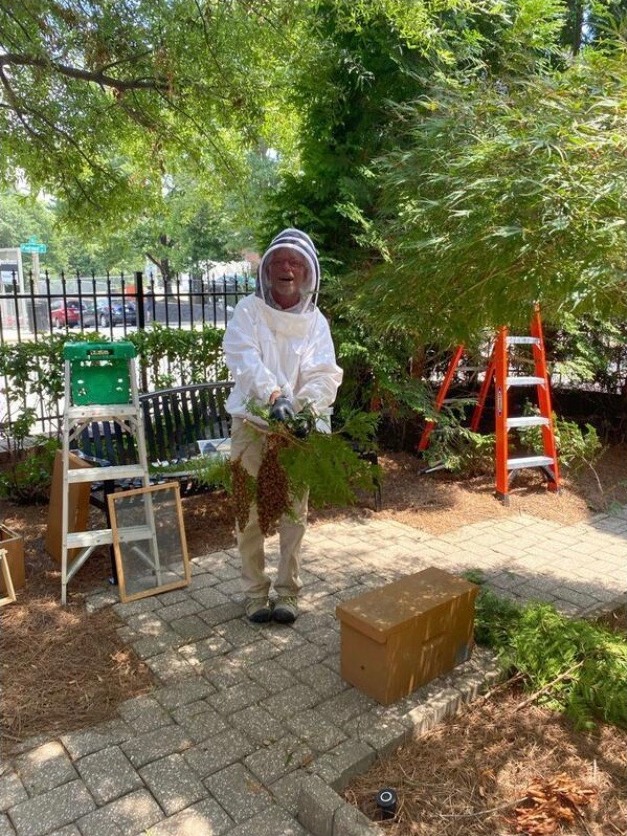
With the help of the Nextdoor website and the homeowner's 6 foot ladder I brought this late season swarm down in pieces.  Removing the lowest cluster of bees revealed yet another, then yet another clump of bees each higher up. I underestimated the size of this late season swarm and the July afternoon heat. With many of the bees inside the 5-frame box I left the site hoping the bees on the outside would continue to walk into the box.

I returned at sunset to collect the 5-frame box, but the swarm capture was not successful.

Saturday, July 11, 2020

March 13th swarm

bee, beekeeping, betterbee, nucleus box, screened bottom board, swarm, swarm capture, ventilation, slow shutter,

bee, beekeeping, betterbee, nucleus box, screened bottom board, swarm, swarm capture, ventilation, slow shutter,
This small March 13th swarm did not outgrow their 5-frame home, but moisture management was not optimum and the old wood nucleus box was failing - see the new hole in the lower right corner of the brown box.  The bees are very calm, I moved the frames into a new 8-frame home using no smoke. These photos are taken hours later and all the bees attached to their old home have moved on.

Their new 8-frame home has loads of ventilation:
  • Hive stand is 13 inches tall.
  • Bottom board is screened and I'm not using a counting board.   
  • Inner cover has a ventilation notch.

My intention is to add deep frames of capped honey in August.

Monday, March 23, 2020

Another swarm collection

bee, beekeeping, swarm, swarm capture,
The Nextdoor website brought me to my second swarm catch of 2020.    This medium sized swarm required a 3-step A-frame ladder.   I placed a 8-frame deep box on the ladder's paint shelf and my spouse pulled a cord attached to the limb.  Light rain had soaked the bees, so they stayed put without using the spray bottle of sugar water.

Over an inch of rain fell after the swarm collection. Maybe I share this to feel good about myself, but I don't believe the swarm would have survived if I had not put them in the box.