- lots of beeswax and you guessed it, wax moth larvae
- pollen
- ants
- small hive beetles
Saturday, June 17, 2023
counting board debris
Friday, May 12, 2023
Swarm Trap - May 12th 2023
On Friday, May 12th
- 2:00 PM - active scouting at one swarm trap, zero scouting at other traps
- 3:00 PM - very active scouting at one swarm trap, zero scouting at other traps
- 6:24 PM - air is thick with bees
- 6:48 PM - the majority of bees settled on the outside of the swarm trap and began to move in
- 8:23 PM - bees reversed and are on the outside of the trap
On Saturday, May 13th
- setup 8-frame deep box near the swarm trap; in the last photo, check out the homemade rectangular UV-reactive blue 8-frame entrance
- add a queen excluder beneath the deep box
- spray the bees with sugar water
- carefully lower the swarm trap
- carefully walk the swarm trap to the deep box
- spray the bees with sugar water
- brush bees into the deep box
- add frames
- move the pheromone lure from the swarm trap to the landing board
- add an inner cover and telescoping lid
- after 2 hours, all the loose bees have reoriented to their new home
On Sunday, May 14th
- add a gallon pail feeder with 32 ounces of 1:1 syrup
I'm guessing that
- the swarm was hanging very close to their preferred swarm trap, and the scout bees ignored my other swarm traps
- this swarm contains more than 1 queen
Tuesday, April 4, 2023
moving swarm to 8-frame equipment
Today I moved the swarm to 8-frame equipment. In one week, all 5 frames had similar new comb construction on the plastic starter strips.
I moved the swarm lure to the 8-frame landing board, and the remaining bees entered the 8-frame equipment in under 2 hours - I did not bump bees off the swarm trap. In the last photo, notice the homemade rectangular UV-reactive blue 8-frame entrance.
The bees returned with cream-colored Tulip Poplar pollen and slowly consumed 1:1 syrup.
Tuesday, March 28, 2023
Swarm Trap - March 28th 2023
The moment I've been waiting for!
On February 20th, I set out two 40-liter swarm traps hanging from crepe myrtle limbs. Each swarm trap contains:
- 5x deep frames with plastic starter strips
- UV-reactive blue swarm trap entrance
- synthetically produced Nasonov pheromone
Thursday, August 25, 2022
Run-Away Split
- inexpensive construction - $0.80 hive box using rough sawmill lumber and bamboo skewer as a top bar
- the demanding rhythm of Sam's calendar-driven queen-rearing business by grafting
- SARE grant - emergency queen rearing using Run-Away Splits, Sam's variation on Walk-Away Splits
In the absence of a queen, 1) open brood pheromone (versus capped brood) helps retain worker bees in both queen rearing methods (split or grafting) and 2) that new comb is desirable in the Run-Away Split method.
NCSU report compared Sam's 32 mated emergency queens to their database of all tested queens and graded Sam's emergency queens as A- (high reproductive potential). This dis-spelled my bias that emergency queens mate poorly.
Saturday, June 5, 2021
40-liter Swarm Trap
On May 9th, the front porch video captured scout bees at my new 40-liter swarm trap. Ultimately this trap was not chosen by the swarm. In the still photo, I reused a hanging location for the 40-liter trap where a 8-frame trap successfully attracted a swarm on May 10th.
Each 40-liter trap contains:
- 4x deep frames with either foundation or plastic starter strips
- 1x deep frame of dark comb
- 1x slow-release tube containing lemongrass oil
Two 40-liter traps were sourced from one sheet of 4 by 8 foot 1/2 inch birch plywood. Each trap required the following pieces:
- 2x front (or back) pieces - 19 5/8 inch by 17 1/4 inch
- 2x side pieces - 7 7/8 inch by 17 1/4 inch with 5/8 inch by 1/4 inch rabbit for frame hanging
- 1x top piece - 19 5/8 inch by 8 7/8 inch
- 1x bottom piece - 18 5/8 inch by 7 7/8 inch
Additional materials:
- 1x circular Betterbee hive portal (optional)
- 1x 1 inch bolt and wing nut (optional)
- 2x fender washers (optional)
- Aluminum Roll Flashing cut with a Dremel Fiberglass Reinforced Cut-Off Wheelcutting disk
- Titebond II wood glue and clamps
Monday, May 10, 2021
swarm trap and capture - May 2021
On March 7th, I set out two 8-frame swarm traps hanging from crepe myrtle limbs. I also prepared two hive stands as 8-frame swarm traps. Each trap contains:
- 7x deep frames with either foundation or plastic starter strips
- 1x deep frame of dark comb
- 1x slow-release tube containing lemongrass oil
Immediately the traps were visited by scout bees, though I waited 64 days before a swarm would select one. Here I share my 2021 swarm experience - so far.
On May 3rd, I set out two 40 liter (2441 cubic inch) swarm traps which contain similar elements as above except that there are just 5x deep frames in the top half and considerable volume (space) without frames beneath this tall and narrow configuration. I'll share more details and photos of the 40 liter trap in future blog posts. If you are keeping count, I now have set out six swarm traps.
On May 6, the Nextdoor website mentioned that a swarm had landed at gusto! on Ponce, a restaurant near Clermont Hotel. Last year I used Nextdoor information to locate and capture two swarms. Nextdoor continues to be my main source of social media knowledge of local swarms.
On May 9 mid-afternoon, active scouting began at one swarm trap and by late afternoon two other traps had active scouting.
On May 10 noon, all six swarm traps have scouts with the most intense active scouting focused at one hanging swarm trap. I went for a 30 minute dog walk and in that short time I missed the swarm arrival. At 3:30 I captured the attached video of bees completing their move into the 8-frame hanging swarm trap.
On May 11 dawn, I lowered the hanging swarm trap, closed its bottom entrance and set the left-right leveled trap onto a 3-step A-frame ladder. In following days, I moved this 'ladder + trap' configuration at dawn 3 meters (10 feet). I repeated these moves until I reach the desired backyard hive stand location. Moving the trap created bee confusion and including a nearby closed patio umbrella in the move seemed to reduce this confusion. On May 19, I transferred deep trap frames into a deep 8-frame box with a screened bottom board. Every frame contained bees building new comb with the majority of bees found on the frame of dark comb.
Sunday, July 26, 2020
Enviromental Sampling of Volatile Organic Compounds
During past and this summer, I have been able to smell the backyard hives, but the human nose is not designed to quantify or map a smell - see this link about Olfactory Fatigue. Here's how I compared the smell of 3 hives and compared each hive smell to background using a Volatile Organic Compound (VOC) sensor.
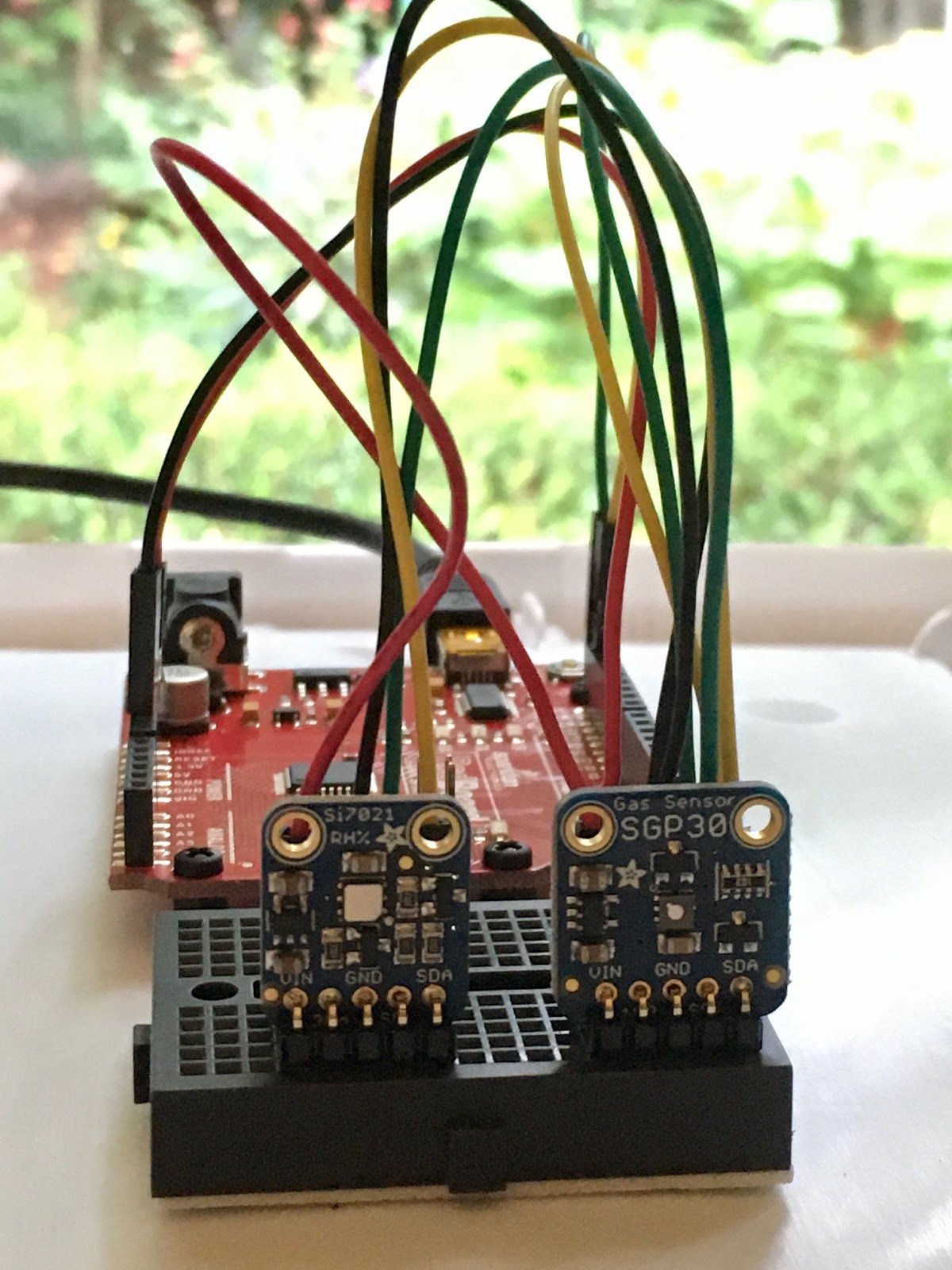
I purchased 2 breakout boards by adafruit, one measures VOC concentration and the other measures temperature and humidity. Seen in the photos:
- two breakout boards plugged into a mini stick-on breadboard
- red colored sparkfun arduino microprocessor attached to an upside down white plastic storage lid using black nylon standoffs by adafruit
- a mini serial cable connecting the microprocessor and laptop
- laptop attached to the ladder's paint-tray using a bungee cord
- chalk marked or flagged a 6 x 4 grid surrounding 3 hives - 4 grid points are skipped due to large shrubs
- selected a day with no wind so as not to disperse the VOC which pool near the hives
- selected an evening to avoid when most flowering plants produce VOC
- warmed-up the sensor system outdoors for an hour before sampling
- setup at a grid point, and sampled for 60 seconds. I stepped away from the 6 x 4 grid during sampling as my body both produces and disperses VOC
- after sampling 20 grid points, I repeated the first 5 grid points to examine reproducibility
- VOC are shown in parts per billion (ppb) units. As I do not have access to a reference gas mixture, you can think of these VOC values as relative values.
- The central (middle) hive had the highest concentration of VOC. This hive is a massive stack of boxes with 2 queens separated by a cloake board. On the bottom of this stack is an over wintered hive. On the top of this stack is a medium size swarm catch (March 23, 2020).
- A VOC plume from the central hive merged with the hive shown at the bottom of the map. The hive at the bottom of the map is a large overwintered hive.
- The hive at the top of the map is inconsequential in VOC production and resembles a background value. This hive is a tiny swarm catch (March 13, 2020).
Saturday, August 10, 2019
SAVE THE HONEY BEE license plate
Can your read my license plate - you are driving too close, stuck in Friday traffic or waiting for the light to change. Order your SAVE THE HONEY BEE license plate by way of the Georgia Beekeepers Association.
Sunday, March 31, 2019
hive weight - fall 2018 to spring 2019
- Hives loose weight between 30-Sep-2018 and 22-Dec-2018. Hive #1 looses more weight than hive #2.
- No measurements during winter.
- On 24-Mar-2019 hive #1 gains more weight than hive #2.
During the winter, these hives are insulated with Bee Cozy hive wraps and I don't disturb the bees with hive weight measurements.
In a similar explanation, greater spring weight gain for hive #1 is most likely attributed to hive #1 having a larger population compared to hive #2.