My foundation-less beekeeping results in comb with a gentle wave across the frame where bees 1) merged distinct regions of top bar attached comb like a clothing zipper, or 2) transitioned comb construction between worker and drone sized cells.
On Two Bees in a Podcast Michael Smith spoke about imperfect comb. Here are links to the topic of where bees created 4, 5, 7, 8 and 9-sided non-hexagonal cells:
Showing posts with label foundationless walter t kelly. Show all posts
Showing posts with label foundationless walter t kelly. Show all posts
Thursday, April 14, 2022


Sunday, September 6, 2020
harvest 2020


I brushed off bees from harvested frames halfway between the hive and the plastic tub (2nd photo) - which is twenty steps away from the hive.
I've not shown the crush and strain harvest of 5 fat frames which yielded 1.4 gallons of honey.
Wednesday, July 31, 2019
crush and strain 2019
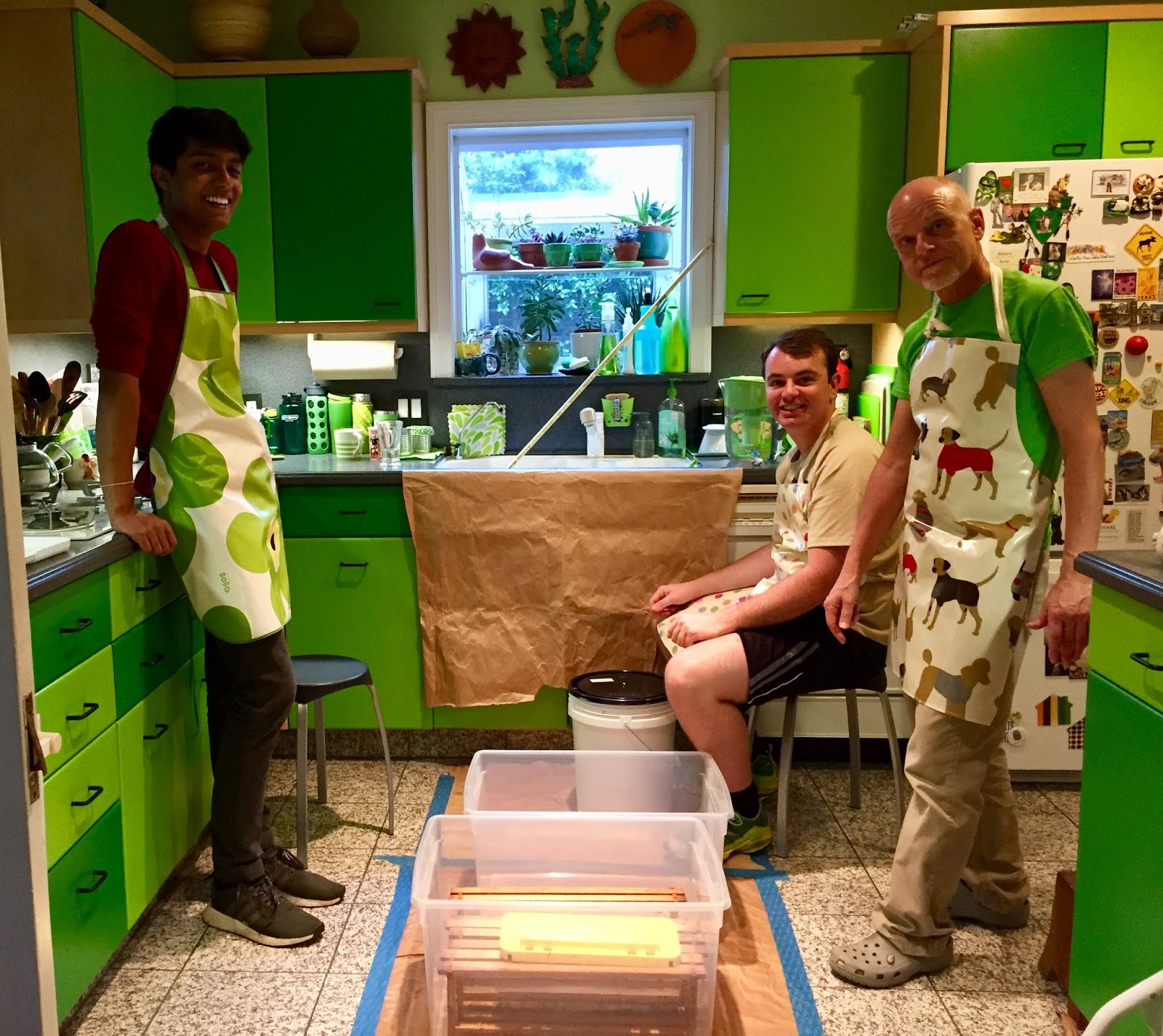


We worked in the middle of the kitchen floor to contain the sticky clean-up. Imagine a compact vertical stack - from the bottom up:
- brown paper
- food safe 5 gallon bucket
- combcapper
- medium frame of capped honey.
Crushed comb was poured into the strainer bottler and left to sit for a few days so that foam (tiny air bubbles) can rise before bottling.
After cutting away honey comb, frames are returned to the Storage Tote. Over-night, honey dripped into the Tote and were captured too. Sticky frames were stacked outside in a location away from the hives. Bees assisted with the final honey clean-up of sticky frames - a circle of life scene which reminds me of sky burial.
In the 3rd photo, I used a slow shutter iPhone app. Crawling bee behavior looks like white dots while flying behavior looks like brown lines (classic multiple exposure).
Tuesday, July 30, 2019
harvest 2019


Click on the first photo and notice the thin stripe above the 3rd box (count up from the botttom), it's the triangular bee escape. 24 hours prior, I added the escape so that I can inspect frames above the escape without disturbing the vast majority of bees. I placed a plastic tub twenty steps away from the hive and a few remaining bees were brushed from the frame halfway between the hive and the plastic tub. Harvesting frames went so smoothly that I began to doubt why did I wear a hoodie.
Click on the second photo, this is a stunning example of comb building using foundation-less frames. What I found unusual is that all the honey cells are completely capped.
Most likely my honey surplus will be considerably smaller than last year. In the third photo, frames are blue tape sealed inside the plastic tub and ready for the next step which is to cut out the comb. More about this in the next blog post.
Thursday, April 11, 2019
2019 tulip popular


I discovered my first 2019 windfall of the tulip popular flower kind. Also shown is an invasive shrub which attracts pollinators, amur honeysuckle. Other nectar sources at this time (not shown) include white clover and spiderwort.
Last weekend, I entered the hives for the first time this year. The honey cap of one hive was checkerboard using foundation-less frames with no drawn comb. The other hive was left in its winter configuration.
Weeks ago, I set tree hanging 8-frame swarm traps, but yet to see any scout bees.
Wednesday, June 13, 2018
crush and strain simplified

Lucky for me, Home Depot sells food safe 5 gallon buckets - I bought two buckets to store crushed comb (wax and honey). When the bottler becomes available, then I pour crushed comb into the strainer bottler.
I'm trying to avoid making a large horizontal sticky mess in the kitchen. So, I work in the middle of the kitchen floor. Imagine a compact vertical stack - from the bottom up: brown paper, 5 gallon bucket, combcapper and medium foundationless frame of capped honey. In under an hour, Melissa and Dillon help cut comb from 14 frames with a paring knife. Comb is crushed in the bucket using 2 inch Plastic Joint Knife attached to a pole.
Friday, June 8, 2018
crush and strain with Combcapper

Thursday, April 5, 2018
tulip popular flower windfall

In late February for one hive and mid-March for the other hive, I checkerboard the honey cap using foundation-less frames with no drawn comb. Both overwintered hives are flying with nearly equal vigor and have an amazing low number of small hive beetles during hive inspections, but are not drawing comb as I expected.
On March 29th I hung 8-frame deep swarm traps from crepe myrtle trees and now wait for the first scout bees - apparently I'm waiting impatiently.
Saturday, April 15, 2017
2017 nectar flow


This year, I started to checkerboard the honey cap of over-wintered hives on March 6th. Since then, I check the honey cap every three weeks. My version of checkerboarding uses foundation-less frames with no drawn comb. Yesterday, I added another medium box to each hive. I don't know how long this nectar flow will last, but I have monstrously tall hives.
My swarm capture is drawing comb and growing in size too, but at a much slower pace than over-wintered hives.
Sunday, March 12, 2017
2017 spring markers & honey cap


2009 2010 2011 2016 2017
day day day day day
Bradford Pear 65 79 60 56
Carpenter Bees 68 87 72 63
Acer palmatum leaf out 73 92 77 64
Carolina Cherry Laurel 73 97 83 57
Pollen Count over 1000 76 51
The point of tracking these day-of-year values is to synchronize my beekeeping practices with spring weather. The first step/acknowledgement is to admit that there is no such thing as an average year- we have never experienced an average year of weather. My journal contains spring marker dates which sometimes appear in different months. So, dates are converted to day-of-year to make the comparison between years easier. I'm experimenting with comparing first pollen count over 1000. Pollen count is easy to acquire, loosely correlates with temperature and maybe more objective than my journal notes.
I first saw Steve Page speak at Georgia Beekeepers Association in 2015 on the topic of Sustainable Beekeeping. Do you want to learn more, sign-up for "It's Time To..." the free email mentoring of Coweta Sustainable Beekeeping. As Steve is influenced by other beekeepers - so, I'm influenced by Steve and have adapted my beekeeping management which uses Kelly foundationless (F Style) frames. Last Monday (day 65), I removed the bee cozy and checker-boarded the honey cap of my hives.
Tuesday, November 22, 2016
Natural Cell Size & Machine Vision
I'm in the process of measuring natural cell size using a simplified version of machine vision OpenCV software - it's called SimpleCV. Still, the SimpleCV learning curve is steep and I would not recommend SimpleCV to the non-programmer - it's not simple to create a robust workflow to measure natural cell size. Don't attempt this programming journey without the book - Practical Computer Vision with SimpleCV -The Simple Way to Make Technology See.
Michael Bush has written on the subject of natural cell size and focused on measuring brood comb. I'm going to start my measurements with cells used for honey storage. Honey comb is not darkened. So, I'm able to light the cells from either the camera side or from behind the cells - I've decided to start with placing my light source behind the cells. This honey comb was drawn without foundation. I'm using Medium Foundationless Frames from Kelly Beekeeping - select frame style F.
Here are a few photos of my setup and SimpleCV results so far.
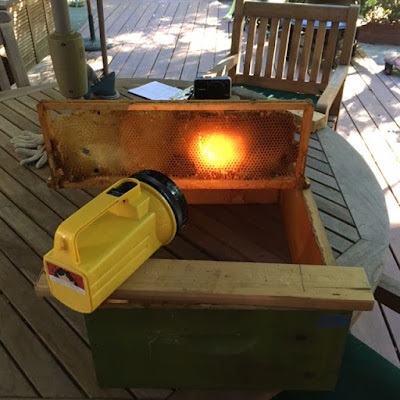
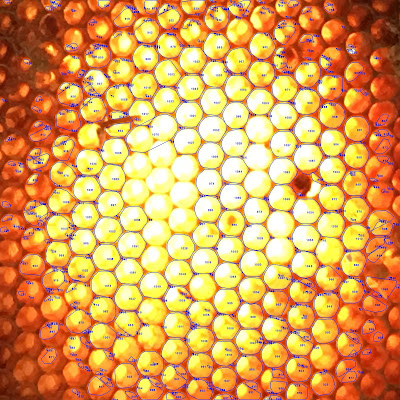
Michael Bush has written on the subject of natural cell size and focused on measuring brood comb. I'm going to start my measurements with cells used for honey storage. Honey comb is not darkened. So, I'm able to light the cells from either the camera side or from behind the cells - I've decided to start with placing my light source behind the cells. This honey comb was drawn without foundation. I'm using Medium Foundationless Frames from Kelly Beekeeping - select frame style F.
Here are a few photos of my setup and SimpleCV results so far.


Tuesday, May 7, 2013
Foundationless Frames by Walter T Kelly

I discovered a conversation to reduce the current center-to-center frame spacing from 1 3/8" to 1 1/4" in the brood chamber. Although narrow frames are not commercially available, the commercial medium sized Foundationless Frames caught my attention - I ordered the foundationless frames and assembled them using the glue on day1 and nail on day2 strategy.

I wanted to add a thin layer of beeswax to the center guide, but advice on the Internet seemed either messy or complicated. I filled an empty food can with beeswax - after removing the can from the boiling water bath, the wax remains liquid for many minutes - long enough for me to dab wax onto the center guide using a piece of cardboard. My application method needs more work - imagine a brushing style and not Jackson Pollock dripping paint. I placed a large cardboard sheet on top of the working counter top - a few wax drips landed in the wrong place, but the cleanup was easy.
Subscribe to:
Posts (Atom)