Showing posts with label combcapper. Show all posts

Sunday, June 13, 2021

crush and strain 2021

beekeeping,bee,slow cooker,crush and strain,honey,combcapper,escape,wax,

beekeeping,bee,slow cooker,crush and strain,honey,combcapper,escape,wax,

beekeeping,bee,slow cooker,crush and strain,honey,combcapper,escape,wax,

Here's my crush and strain experience so far this year:

bee yard activities:

  • inserted a triangular bee escape beneath a deep box and next day removed 8 fat deep frames 
  • halfway (8 steps) between hive and Storage Tote brushed small number of bees from the frame
  • one deep frame donated to "May 10th" swarm and remaining frames taken indoors
 kitchen activities:
  • attached (with blue painter's tape) brown paper on floor and cabinets
  • placed food safe 5 gallon bucket on brown paper and attached combcapper
  • plugged frame into combcapper and cut capped comb from frames with paring knife
  • crushed comb with 2 inch Plastic Joint Knife attached to a pole
  • filtered crushed comb with small mesh fabric strainer and bottler stack - yielded 3.4 gallons (12.9 liters) of honey 
  • in 3 cycles, I used 1 cup of water, coarse cotton fabric and a 5qt round slow cooker set on high for 1.75 hours to catch wax impurities which resulted in 1.54 lbs (700 gm) of wax

Thursday, March 12, 2020

salvage (rescue) honey


bee, beekeeping, combcapper, crush and strain, harvesting, winter,
  bee, beekeeping, combcapper, crush and strain, harvesting, winter,
bee, beekeeping, combcapper, crush and strain, harvesting, winter,
Cathy's bees did not pull through winter.  Capped frames were off-season honey harvested.  The right angle end of hive tool makes quick work scrapping capped comb from plastic foundation.   The combcapper confidently locks to frame and 5 gal bucket.   (A stainless steel nail ships with the combcapper, but I threw that component in the trash.)

Wednesday, July 31, 2019

crush and strain 2019


bee, beekeeping, combcapper, crush and strain, escape, foundationless. walter t kelly, harvesting, honey, slow shutter, Strainer and Bottler, wax,
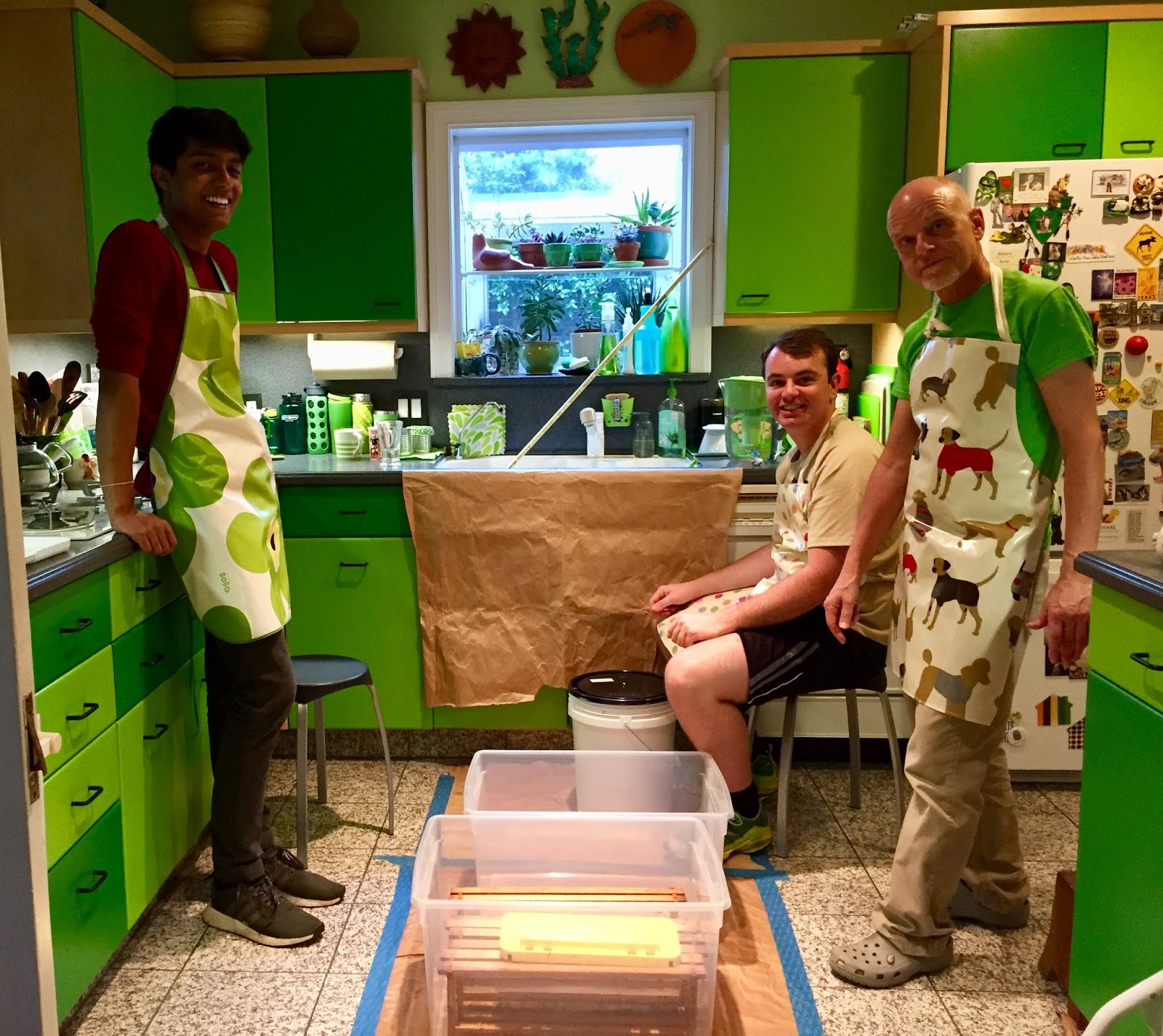
We worked in the middle of the kitchen floor to contain the sticky clean-up.  Imagine a compact vertical stack - from the bottom up: 
Sagar and Quin (co-workers) cut comb with a paring knife from foundationless frames. Comb was crushed in the bucket using a 2 inch Plastic Joint Knife attached to a pole.

Crushed comb was poured into the strainer bottler and left to sit for a few days so that foam (tiny air bubbles) can rise before bottling.

After cutting away honey comb, frames are returned to the Storage Tote. Over-night, honey dripped into the Tote and were captured too. Sticky frames were stacked outside in a location away from the hives.  Bees assisted with the final honey clean-up of sticky frames - a circle of life scene which reminds me of sky burial.

In the 3rd photo, I used a slow shutter iPhone app.  Crawling bee behavior looks like white dots while flying behavior looks like brown lines (classic multiple exposure).

Wednesday, June 13, 2018

crush and strain simplified

bee, beekeeping, combcapper, crush and strain, escape, foundationless. walter t kelly, Strainer and Bottler, brushy mountain, escape, harvesting, honey, wax,
It's called crush and strain, but there are surrounding steps to this simple slogan.  My honey harvest starts with the bee escape and ends with bottling.  So that foam can rise before bottling, strained honey is left to sit for a few days. With just one 5 gallon bottler, lots of honey and a busy day job, I had to modify my sequential honey harvest process.

Lucky for me, Home Depot sells food safe 5 gallon buckets - I bought two buckets to store crushed comb (wax and honey).  When the bottler becomes available, then I pour crushed comb into the strainer bottler

I'm trying to avoid making a large horizontal sticky mess in the kitchen.   So, I work in the middle of the kitchen floor.  Imagine a compact vertical stack - from the bottom up: brown paper, 5 gallon bucket, combcapper and medium foundationless frame of capped honey. In under an hour, Melissa and Dillon help cut comb from 14 frames with a paring knife.  Comb is crushed in the bucket using 2 inch Plastic Joint Knife attached to a pole.

Friday, June 8, 2018

crush and strain with Combcapper

bee, beekeeping, combcapper, crush and strain, foundationless. walter t kelly, honey, wax,
Combcapper gadget simplified my crush and strain process.  I'm not using the supplied nail and cut the medium foundationless frame down in thirds, guiding each 1/3 piece by hand into the 5 gallon bucket.  The combcapper holds the frame securely - an essential element when using a sharp paring knife. Michael Willis, coworker and beekeeper, helped me in the kitchen extracting 12 frames which yielded 4 gallons of strained honey.