Showing posts with label bee cozy. Show all posts

Saturday, October 25, 2025

hive preparation for winter


beekeeping,bee,winter,bee cozy,bee space,bee nest,winter cluster,air flow,

Refer to Derek’s 2024 paper in the Journal of Thermal Biology, Are man-made hives valid thermal surrogates for natural honey bee nests? Derek reports that “bee space above combs increases heat loss by up to ∼70%; hives, compared to tree nests, require at least 150% the density of honey bees to arrest convection across the brood area.”

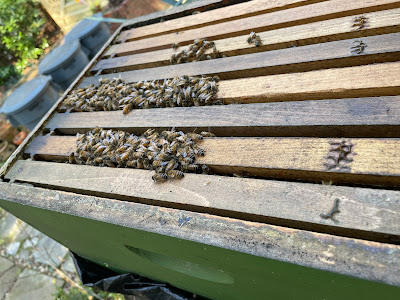
In a hive, brood heat typically circulates by (1) rising between frames, (2) striking the inner cover, (3) spreading sideways, and (4) descending through the cold bee space.

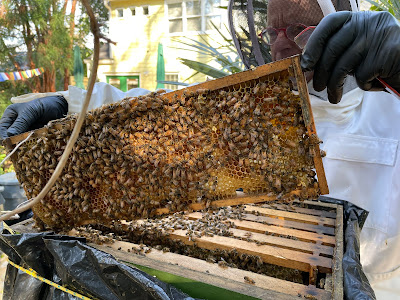
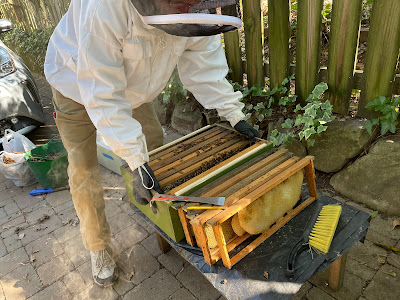
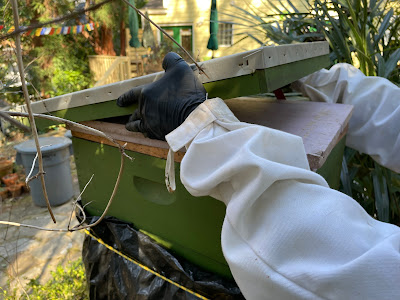
To improve insulation, I added an external Bee Cozy (R-value 8) and took internal measures to limit brood heat circulation by blocking the bee space above the combs. I used letter-sized plastic sheets (the type made for overhead projectors), placing one spliced and trimmed sheet directly on the top bars beneath each hive’s inner cover.

Wednesday, December 25, 2024

learning from natural honey bee nests

beekeeping,bee,winter,bee cozy,winter cluster,bee nest,bee space,air flow,ventilation,
It’s winter and I’m thinking about my bees in these recent cool temperatures; my curiosity turned to Google Scholar and searching for the beekeeper and engineer - Derek Mitchell. Here I found Derek’s 2024 paper in the Journal of Thermal Biology - Are man-made hives valid thermal surrogates for natural honey bee nests.  This is a highly technical read with an exotic mix of scientific units, but I found take-home nuggets useful to my hobby beekeeping. My goal is not to keep bees in a tree, but to modify my wintering of bees in a thin-walled wood box by learning what bees have, on their own, achieved living in tree cavities.
Man-made hive Tree nest
Top ventilation Beekeeper’s  choice None 
Wall properties Thin low R-value Thick high R-value
Comb to wall surface Continuous bee space separation Comb attached to the wall with a few small gaps
Comb to roof surface Continuous bee space separation Comb maximally attached to tree cavity roof
Comb to bottom surface Continuous bee space separation made more complex with multiple boxes One continuous separation
Vertical comb length Single frame height whether using one or multiple boxes  Continuous
Made with HTML Tables

Using 16 variables adjusted to experimental observation, Derek used computational fluid dynamics (CFD) modeling and compared the convective air flow and metabolic impact to bees in a standard British National Hive (one box of 35 Liters) versus a synthetic tree nest (45 liters).

Derek writes, “bee space above combs increases heat loss by up to ∼70%; hives, compared to tree nests, require at least 150% the density of honey bees to arrest convection across the brood area.”

Derek recommends blocking the bee space above the combs in a man-made hive, which I interpreted as adding a clear plastic sheet resting directly on the top bar frame. I have a box of letter-sized plastic sheets designed for overhead projector presentations - it seems perfect for the task. Stay tuned for how this works out for me as I am over-wintering two hives with a different number of boxes. One hive has two medium boxes, and the other hive has one deep box. I spliced sheets together with tape and trimmed the extended sheet to fit inside my eight-frame box. Each hive received one trimmed plastic sheet beneath its inner cover resting directly on the top bar frame. No doubt the bees will glue the plastic to the top bar frame and this will require some vigorous spring cleanup effort. 🤣

Perhaps you want to give this small modification a try and use different materials (e.g., wood, thick acrylic, or coroplast).

Monday, February 19, 2024

does the cluster provide insulation?

I discovered 2 interesting articles by Derek Mitchell (PhD Candidate in Mechanical Engineering at the University of Leeds), one is intended for a general honey bee audience, the other a hard-core engineering-science article.  This blog post contains 2 images from those articles.

 Facts about bees wintering in thin-wall wood hives:

  • bees move from the hive edges towards the center of the hive to form a cluster
  • as temperatures fall, the cluster shrinks - see the image from Derek's article
  • the cluster core is hot compared to the cluster periphery.  
  • bees in the core consume honey and keep bees in the periphery warm.
  • in extreme winter temperatures, bees on the periphery risk death by hypothermia
  • the cluster periphery is denser than the core

beekeeping,bee,winter,winter cluster,bee cozy,

Derek writes, "Since the early twentieth century, the outer layer (mantle) of honeybees (Apis mellifera) in the winter cluster has been said to insulate the cluster core."  

A shrinking cluster increases density, reduces porosity, and increases heat loss. Here I'm using porosity to describe the amount of empty (air) space, or porosity = empty space ÷ total space.  Typically a thermal insulator reduces heat loss by trapping air and is therefore low in density.  The higher density cluster periphery is not a thermal insulator - has never been a insulator.  Beekeepers need not stress bees in extremely cold temperatures when insulation is readily available. 

  • take a quick look in beekeeping catalogs and you'll discover flexible hive wraps - flexible wraps roll-up for easy storage and reusable next winter
  • solid foam board insulation for home improvement is available for purchase or free as building waste
Bees have evolved to live in trees (a nest with extremely thick wood walls) that provide real insulation - see the image from Derek's article. To those protecting popular opinion, to the skeptic, to the frugal beekeeper, consider winter insulation using a side-by-side test.

beekeeping,bee,winter,winter cluster,bee cozy,

Saturday, February 10, 2024

Winter Top Ventilation

If you turn to page 116 of Seeley's book The Lives of Bees, you'll find a reference to Derek Mitchell a PhD Candidate in Mechanical Engineering at the University of Leeds.   With web-based searching, I discovered Derek's 2017 article in the American Bee Journal (Vol. 157 No. 8) Honey Bee Engineering: Top Ventilation And Top Entrances.   The article illustrates that adding top ventilation significantly reduces humidity and the depth of the heat pool when compared to an uninsulated hive.  Why?  Warmer air is more buoyant and flows faster through the top vent.

Providing hive insulation in winter reduces bee-generated heat loss and this increases the temperature of the heat pool found at the top of the hive - see the image from Derek's article.  I'm using the word heat pool as temperatures measured relative to the top of the hive -- I recognize, pool is commonly used with liquids that fill upwards from the bottom of containers. I currently use insulated hive wraps in winter and plan to close my top vent moving forward.

beekeeping,bee,ventilation,winter,bee cozy,
In email conversation, Derek recommends adding more hive insulation above the hive compared to the hive sides to discourage condensation from raining down on the bees.

Derek has simulated the heat flow of a winter bee cluster in a thin-walled wooden hive and compared those results with measurements collected by other researchers.  I plan to discuss this article in an upcoming blog post.

Saturday, February 12, 2022

nectar management - checkerboarding

beekeeping,bee,Small Hive Beetle,checkerboarding,winter,nectar,bee cozy,hive tool,

beekeeping,bee,Small Hive Beetle,checkerboarding,winter,nectar,bee cozy,hive tool,

beekeeping,bee,Small Hive Beetle,checkerboarding,winter,nectar,bee cozy,hive tool,

beekeeping,bee,Small Hive Beetle,checkerboarding,winter,nectar,bee cozy,hive tool,

In the previous post using external measurements and observations, I postulated bees consumed honey and raised late-winter brood.   February 12th was my first 2022 hive inspection and I took action, well some actions!

  • an 8 frame medium box with drawn comb was set aside from the hive - drawn comb is a luxury that I rarely have at hand as a crush-and-strain beekeeper
  • the bees had corralled small hive beetles above the inner cover - I crushed these beetles using the short edge of the standard hive tool or my finger
  • every other frame in the hive's top medium box was exchanged with every other frame of the set aside 8 frame medium box
  • the top medium box contained 7 frames of nectar and 1 frame of capped honey
  • the set aside medium box was placed onto the hive completing my 8-frame version of checkerboarding
  • as more winter temperatures are expected, I returned the hard foam insulation above the inner cover and overlapped two hive cozys to cover the new medium box

honey consumption and late winter brood rearing

bee,beekeeping,ventilation,temperature,hive weight,bee cozy,winter,brood,foraging,

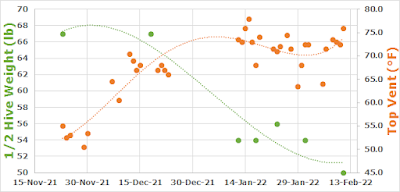
My 8-frame hive is wrapped in a hive cozy. On warm afternoons in December and January, bees flew vigorously and performed orientation flight. These 2021-2022 measurements show that bees are most likely consuming their honey stores and raising late winter brood.  

  • Temperature measurements are taken at dawn at the top vent using an inexpensive RadioShack Waterproof Pocket IR Thermometer. The orange trend line is most likely an increase in total bee metabolism/respiration (bees covering late winter brood). Peak temperature top vent measurement of 78°F (25.6ºC) is not the expected 89.6-96.8°F (32-36ºC) brood nest temperature, so why? Cold air flows into the hive entrance and screened bottom board and mixes with warm moist bee respiration and exits the top vent - usually I discover the warm moist air condensed to the outside of the hive cover.
  • Less frequently, I weigh the hive using an inexpensive luggage scale. The green trend line is most likely winter consumption of honey stores. I would prefer to connect densely sampled weight measurements (points) with a spline instead of the polynomial trend line.  However, extra hive weight measurements are not possible with my travel schedule. 
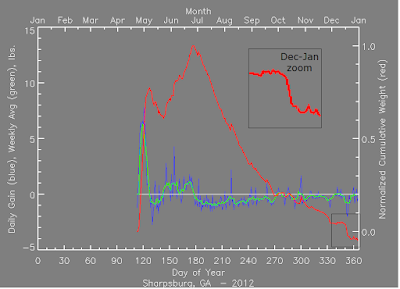
  • Also shown are HoneyBeeNet 2012 hive weight measurements from Cowetta GA (40 miles from Atlanta). HoneyBeeNet is a NASA hive and climate citizen science project. The zoom into these end of year weight measurements show a similar sharp drop in hive weight. 

Tuesday, February 9, 2021

mahonia Feb '21

beekeeping,mahonia,bee,foraging,beeline,winter,bee cozy,

Both backyard hives have NOD Bee Cozy R8 insulated hive wraps and do not fly during cold gray winter days.  During a week of decidedly sunny days, bees fly vigorously and are found foraging on mahonia. Standing by the mahonia, I looked in direction of the hives for the beeline bearing.  A straight 38 ft (11.6 m) line connects hives and mahonia, but the straight line nicks the corner of the chicken coop which is 7 ft (2.1 m) tall. Some bees are seen flying over the coop while other bees fly around the coop. These mahonia foraging bees are of the same mind regarding where and what to forage, but not how to get there.

Sunday, January 10, 2021

R value of soft wood

beekeeping,bee,hive wrap,condensation,winter,bee cozy,climate,darwinian beekeeping,cloake board,
In cold 30℉ weather, condensation is seen at the top vent and cloake board entrance. Warm moist air exiting from these locations are 11℉ warmer than the outside air and this resulted in a large drops of condensation and a wet cloake board landing area.  Foam board insulation above the inner cover and R8 Bee Cozy hive wrap enhances condensation outside of the hive - not inside the hive. Compared to home building codes, R8 insulation does not seem large, but this hive wrap is a wind break and equivalent to 6 inches (15cm) of soft wood. This equivalent hive wall thickness is more like a natural tree cavity wall thickness.

Friday, December 25, 2020

insulated hive wrap and cloake board stack


beekeeping,bee,hive wrap,condensation,winter,bee cozy,respiration,climate,arctic oscillation,cloake board,

beekeeping,bee,hive wrap,condensation,winter,bee cozy,respiration,climate,arctic oscillation,cloake board,

In Atlanta, cold 20°F temperatures arrived on Christmas Day and the ensemble of 11 arctic oscillation forecast a large negative downturn. I used these metrics as significant evidence that winter temperatures are here to stay.  Since 2010, I have reused my NOD Bee Cozy R8 insulated hive wraps  and believe hive wraps improved the chance of overwintered bee hive survival. As a lazy (aka stubborn) beekeeper and despite warm winter fluctuations, I'll leave the Bee Cozy on till spring 2021.

Photo shows joined hives - overwintered hive below and a March 23rd spring swarm capture above an open Cloake Board. The bee cozy is designed for 10-frame equipment, so it easily slipped over the Bloake Board without removing 8-frame boxes. 

I'm encouraged to see warm moist air (bee respiration) condense outside the hive at the top vent and Cloake Board Entrance. 

Here are current the hive elements:

Thursday, March 12, 2020

Sixth warmest winter on record for contiguous U.S.


bee, beekeeping, climate, dandelion, checkerboarding, winter, bee cozy
In "Assessing the U.S. Climate in February 2020", NOAA writes,
  • December through February was much warmer than normal across the contiguous United States, while precipitation remained above-average. 
  • Georgia ranked second wettest, while Alabama and North Carolina ranked third wettest.
  • Alabama and Georgia had their wettest winter on record, while South Carolina saw its second wettest.
NOAA's summary match my Atlanta weather experience and is consistent with the early arrival of flowering trees and plants.  I don't commonly see bees on dandelion flowers (many neighbors use lawn herbicides).   Wikipedia lists the  pollen color of  dandelion as "red yellow, orange" and typically flowering in  Apr-May.

Today, I removed the bee cozy hive wrap and checker-boarded the honey cap of my hives. From the top box, I swapped half of my drawn frames with no-comb foundationless frames.   The removed drawn frames are added to a new top box where half of the frames are no-comb foundationless.  I first learned about this beekeeping practice in 2015 where Steve Page spoke at Georgia Beekeepers Association.

Sunday, November 24, 2019

2019 Bee Cozy


Ants create tunnels and nest in the extruded polystyrene foam boards in warmer weather, so I postponed insulating the hives until now. In Atlanta, first frost arrived on November 12th which is just on the early side of historical average.  November 12 also marked the first subtle Arctic Oscillation downturn this winter.

Here are current the hive elements:
arctic oscillation, bee, bee cozy, beekeeping, hive wrap, respiration, temperature, ventilation, winter,

Sunday, March 31, 2019

hive weight - fall 2018 to spring 2019

I'm using an inexpensive luggage scale to weigh 4 box tall hives.  I attached the ends of a length of parachute cord to the front legs of my hive stand, then I pass the central part of the cord beneath the hive and towards the back of the hive.  This forms a V shape of cord beneath the hive.  I slowly pull on the cord with the luggage scale until the back edge of the bottom board slightly rises above the hive stand.

Scale readings are converted to total hive weight using a factor of 1.825 which I estimated using an unoccupied stack of 4 boxes with a similar total hive weight.

In the graph note:
  • Hives loose weight between 30-Sep-2018 and 22-Dec-2018.  Hive #1 looses more weight than hive #2.
  • No measurements during winter.
  • On 24-Mar-2019 hive #1 gains more weight than hive #2.
Fall weight loss is greater for hive #1 which is most likely attributed to its larger population compared to hive #2.  Said another way, hive #1 consume their honey stores more rapidly due to a larger population.

During the winter, these hives are insulated with Bee Cozy hive wraps and I don't disturb the bees with hive weight measurements.

In a similar explanation, greater spring weight gain for hive #1 is most likely attributed to hive #1 having a larger population compared to hive #2.

bee, bee cozy, bee keeping, hive weight, luggage scale, winter,

bee, bee cozy, bee keeping, hive weight, luggage scale, winter,

Friday, March 15, 2019

bee respiration with and without Bee Cozy

bee, bee cozy, beekeeping, hive wrap, respiration, temperature, ventilation, winter,

Here I'll compare winter bee respiration with and without the Bee Cozy hive wrap for two hives.  On the graph, think of the horizontal axis as outdoor temperature and vertical axis as the bee respiration temperature.  See previous posts for the measurement method.  All graph points have top vent temperatures greater than paver temperatures which is consistent with an active and alive hive. Red circles without fill are measurements with no Bee Cozy.

In the graph notice:
  • all points are consistently closer to the upper left corner with the Bee Cozy
  • hive #1 has top vent temperatures as large as 80 ℉ and consistently warmer than hive #2
  • the last measurement (blue circle with fill) is consistently closer to the upper left corner than other graph points.  
Hive #1 has more flight activity than hive #2 and the last measurement (blue circle with fill) is most likely attributed to a larger bee population in response to spring forage and warmer spring temperatures.

Monday, February 25, 2019

2019 spring bloom markers

This Atlanta spring has been like no other year, nor have we ever experienced an average spring.    Yet, I want a rough guide to plan my spring beeyard tasks.   At the moment, hives are in a winter configuration with bee cozy hive wraps and bradford pear and redbud trees blooming.
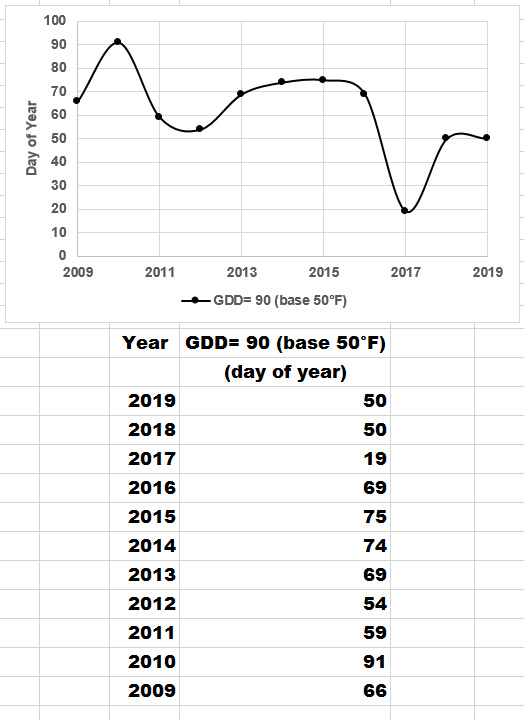
On February 21st, Atlanta pollen count exceeded 1000 which coincided with a Growing Degree Days (GDD) of 90. I'll use GDD equal to 90 and compare this spring with previous years. I calculated GDD using data from the University of Georgia Automated Weather Network.  I'll also use Julian Day  which converts a MMM-DD-YYYY date format which spans 4 months (January to April) into a seamless day of year format.

In the graph notice:
  • similar Day of Year values between this year and 2018
  • warm 2017 outlier which reached a GDD equal to 90 on January 19
bee, bee cozy, beekeeping, bloom, Bradford Pear, climate, growing degree days, pollen count, redbud tree,

bee, bee cozy, beekeeping, bloom, Bradford Pear, climate, growing degree days, pollen count, redbud tree,

Saturday, February 2, 2019

slow shutter iPhone app

bee, bee cozy, beekeeping, iPhone, pollen, slow shutter,
Reddit had a great bee yard photo using a slow shutter iPhone app.  After deleting some awful first tries, I was able to make the app work for me. At 63℉, the bees are active and returning with pollen.  Crawling bee behavior looks like white lines while flying behavior looks like classic multiple exposure.  Look closely and you'll find the bottom edge of the bee cozy at the top of the image.

Saturday, January 26, 2019

winter forage

bee, bee cozy, beekeeping, collecting water, foraging, winter, mahonia, pollen,
It's decidedly sunny this afternoon and both hives fly vigorously. I left a small amount of water and twigs in the dog bowl to protect bees from becoming chilled in this 40 °F weather. Some bees return to the hive with yellow pollen - most likely mahonia.

Sunny weather is a real treat. Both hives have bee cozy insulators and have not flown much during the past cold, gray winter days. 

Monday, July 16, 2018

with and without Bee Cozy hive wrap

bee, beekeeping, temperature, ventilation, winter, cloake board, respiration, bee cozy, hive wrap,
There's no ideal way to compare winter bee respiration with and without the Bee Cozy, but I'll do my best here.

IR temperature measurements started on 12-Nov-2017 without the Bee Cozy.  See a previous post, bee respiration, for measurement method.  On 2-Jan-2018, the 17.0°F outdoor temperature convinced me to add the Bee Cozy to two vertically stacked hives.  Only the queen excluder portion of a cloake board separate these hives.  1 Bee Cozy is added to the bottom hive (4 boxes) and 2 overlapping Bee Cozys are added to the top hive (5 boxes). The Bee Cozy is designed for 10 frame equipment.  So, the Bee Cozy easily slips over my 8 frame boxes and cloake board with no effort.  This 2-Jan-2018 measurement point appears as a blue dot in the lower left corner of dots - Paver temperature equals 17.0°F and Top Vent temperature equals 31.0°F.  On the graph, think of the horizontal axis as outdoor temperature and vertical axis as the bee respiration temperature.

All graph points lie above the green line (x= y) which is consistent with an active and alive hive. Blue dots are measurements without the Bee Cozy and trend beneath orange dots which are measurements with the Bee Cozy.  Excluding a few points, the Bee Cozy consistently increases bee respiration (Top Vent) temperature.

Wondering why I went into winter with such a tall stack of boxes which requires step ladder beekeeping - there's no good reason other than lazy beekeeping.

Tuesday, January 2, 2018

bomb cyclone

bee, bee cozy, beekeeping, climate, cloake board, condensation, respiration, telescoping cover, ventilation, winter,
Winter storm Grayson brought cold temperatures to Atlanta, but no snow.  Use this link to see NOAA's satellite image.

Here's a photo of the upside down telescoping cover.  Warm moist bee respiration which left the inner cover notch, condenses on the cold telescoping cover and froze as a white ring.  Click the image for more detail.

17 °F temperatures encouraged me to add the bee cozy hive wrap now.    The hive wrap is designed for 10 frame equipment, so easily slips over my 8 frame boxes and cloake board.   I'm overwintering a tall vertical double stack of hives.   The stack contains a cloake board, where I removed the cloake board's sliding floor leaving its queen excluder to separate the two hives.  I added two overlapping cozys on the upper large stack of boxes and one cozy to cover the smaller lower stack of boxes.

From the bottom up, here are the hive elements at this time.
  • screen bottom board with counting board insert removed
  • 1 bee cozy hive wrap surrounding 1 deep box and 3 medium boxes 
  • cloake board with integrated queen excluder and sliding floor removed
  • 2 overlapping bee cozy hive wraps surrounding 2 deep boxes and 3 medium boxes
  • inner cover with top notch ventilation
  • two sheets of 3/4 inch XPS insulation 
  • telescoping cover
  • white corrugated plastic sheet overhang
  • concrete pavers on top

Tuesday, February 14, 2017

chilled drone brood

bee, bee cozy, beekeeping, chilled brood, temperature, ventilation, winter,
This morning, the low temperature was 35 °F and I found chilled drone brood at one of the hives.   On the landing board, you can see a range of drone development by way of eye color...no color, pink, purple then black.   On the top edge of the photo you can see that the bee cozy insulator is still on.  

The hive with chilled brood has a temperature measured at the inner cover notch of 84.5 °F.    It's sad that this hive became out of sync with the number of adult bees and are not able to keep the periphery of the brood chamber warm.  The next hive over measured 77.5 °F at the inner cover notch and is found without chilled brood.

Wednesday, January 4, 2017

Arctic Oscillation Jan '17

arctic oscillation, bee, bee cozy, beekeeping, climate, hive wrap, winter,
Here's my go-to metric, Arctic Oscillation, for anticipating history making low winter temperatures in Atlanta.  I can hold-off no longer, today I added the bee cozy for the first time this winter.

Listed from the bottom upwards, here are the hive elements at this time.
  • screen bottom board with no counting board insert
  • bee cozy hive wrap surrounding the late August hive re-sizing
  • inner cover with top notch ventilation
  • two 3/4 inch sheets of XPS insulation
  • telescoping cover
  • white over-hanging corrugated plastic sheet
  • concrete pavers