Showing posts with label growing degree days. Show all posts

Sunday, March 9, 2025

Growing Degree Days and swarm collection

bee,beekeeping,swarm,growing degree days,Kim Flottum,

bee,beekeeping,swarm,growing degree days,Kim Flottum,
In Better Beekeeping, Kim Flottum described Growing Degree Days (GDD) and how this measure of heat accumulation predicts plant blooming. A growing degree day is a formula that reflects temperatures above 50°F which is the most common base temperature.

For example, red maples (Acer rubrum) begin to bloom when they reach a GDD threshold of 30–50 GDD (base 50°F). I started thinking that there was a relationship between GDD and swarms. I returned to Kim’s GDD page over several years struggling to relate GDD and collecting swarms - my favorite aspect of beekeeping.

At first glance, GDD calculator rules and heat accumulation bookkeeping results might look abstract - you are not alone.

Atlanta, GA Atlanta, GA
First Swarm Date - Growing Degree Days 
Date from David Marshall(GDD BASE 50 °F) data from NOAA GDD calculator
2-Mar-22173
25-Feb-23312
1-Mar-24176

Explanation of the Atlanta first swarm date versus Atlanta GDD table

Thanks to MABA’s swarm commander, David Marshall, I have three years of swarm collection data and combined these three first swarm dates with NOAA’s GDD plot. GDD measured on the first swarm day shows that 2023 GDD has a surprisingly large value compared to 2022 and 2024. In the table, two of these 3 data points (2022 and 2024) are extremely similar, but I nevertheless connected all points with a straight line. Wow, a relationship between GDD and swarm collection seems within reach!

Explanation of the Accumulated GDD graph
  • Smooth brown line is an average of several decades of Atlanta’s GDD calculations
  • Blue line is Atlanta’s historically highest GDD calculation (2017)
  • Red line is Atlanta’s historically lowest GDD calculation (1915)
Black line passes through Atlanta’s first swarm dates of 2022, 2023, and 2024. For simplicity, Atlanta’s GDD curves for these three years are not shown, but those curves lie between the blue and brown curves. I hypothesize that years with GDD curves closer to the blue curve also have their first swarm date earlier in the year - as much as eight days earlier in the Atlanta area compared to an “average” year.

Explanation of NOAA’s historical last freeze day

Georgia includes a wide range of historically average last freeze dates, which implies that your local bee club GDD curves do not match my experience in Atlanta. Please do not hesitate to share your club’s swarm collection dates with me - I promise to treat your data with respect and acknowledgment.
In summary, it’s not too early to make a plan to find your swarm traps (bait hives) in winter storage and spruce up that trap (paint, frames, and lure) before the start of the 2025 swarm season. Keep an eye on your local GDD curve. In hindsight, Atlanta’s 2023 higher-than-average GDD trend was detectable in late January.

Saturday, January 23, 2021

pollen color and winter 2020-2021

beekeeping,bee,pollen,growing degree days,foraging,winter,climate,

Here I'm using Growing Degree Days (GDD) to compare this Atlanta winter with previous winters. I calculated GDD using a web based calculator.  As seen in the table, this winter's GDD are much smaller than last year, with the nearest similar winter GDD found in 2013-2014. 

beekeeping,bee,pollen,growing degree days,foraging,winter,climate,

beekeeping,bee,pollen,growing degree days,foraging,winter,climate,
The back yard bees currently return with bright orange pollen and infrequently return with grey pollen - click on the image to enlarge. I'm using a wiki page of pollen colors of plants in hardiness zone 5, while Atlanta is found in plant hardiness zone 7 which presents challenges when comparing:

  • plant flowering dates
  • matching pollen color with a limited number of trees and plants

Other than color, I'm not able to analyze the bright orange pollen, but it's most likely sourced from winter-flowering ornamental cherry trees blooming in the neighborhood and attracting honey bees.

Using binoculars, I see that red maple trees are not yet flowering.  With evidence from previous years, I'll guesstimate that rosemary is the source of the grey pollen.

Monday, February 25, 2019

2019 spring bloom markers

This Atlanta spring has been like no other year, nor have we ever experienced an average spring.    Yet, I want a rough guide to plan my spring beeyard tasks.   At the moment, hives are in a winter configuration with bee cozy hive wraps and bradford pear and redbud trees blooming.

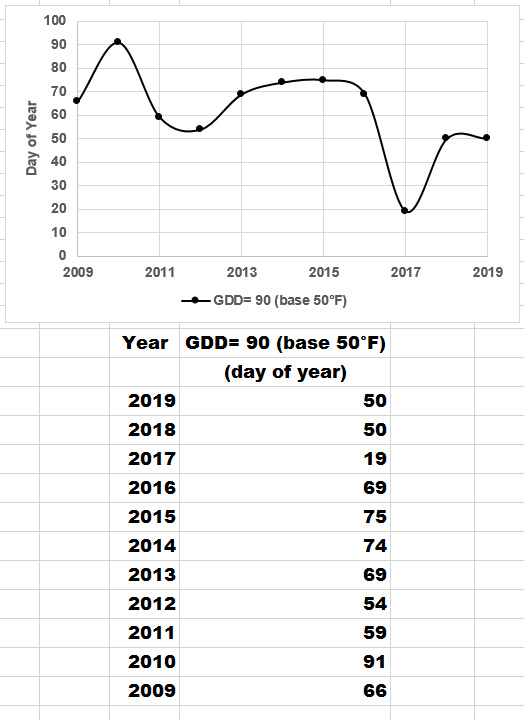
On February 21st, Atlanta pollen count exceeded 1000 which coincided with a Growing Degree Days (GDD) of 90. I'll use GDD equal to 90 and compare this spring with previous years. I calculated GDD using data from the University of Georgia Automated Weather Network.  I'll also use Julian Day  which converts a MMM-DD-YYYY date format which spans 4 months (January to April) into a seamless day of year format.

In the graph notice:
  • similar Day of Year values between this year and 2018
  • warm 2017 outlier which reached a GDD equal to 90 on January 19
bee, bee cozy, beekeeping, bloom, Bradford Pear, climate, growing degree days, pollen count, redbud tree,

bee, bee cozy, beekeeping, bloom, Bradford Pear, climate, growing degree days, pollen count, redbud tree,

Sunday, March 25, 2018

2018 spring bloom markers


Acer palmatum, bee, beekeeping, bloom, Bradford Pear, Carolina Cherry Laurel, Carpenter Bees, climate, growing degree days, pollen count,
I was hoping to simplify my tracking of spring bloom markers, but instead I added another marker, Growing Degree Days (GDD), which is easy to calculate using free web-based tools.  Julian Day allows me to convert MM-DD-YYYY date format which spans 3 months (February to April) into a seamless day of the year format. GDD is a major convenience, I can tap into a database of daily temperature minimum and maximum instead of recording my own observations.  Focusing on the last two graph points, the accumulated warming this year is roughly 25 days delayed compared to last year (84 versus 59).
Acer palmatum, bee, beekeeping, bloom, Bradford Pear, Carolina Cherry Laurel, Carpenter Bees, climate, growing degree days, pollen count,
Here I compare additional observations with GDD, 1) Acer leaf-out in my backyard and 2) first day that the pollen count exceeds 1000.  Notice how well these markers follow similar graph trends.
Acer palmatum, bee, beekeeping, bloom, Bradford Pear, Carolina Cherry Laurel, Carpenter Bees, climate, growing degree days, pollen count,
Here I show a free web-based tool by AgroClimate which compares this year's GDD to the previous year.  Reading from left-to-right, notice where the curves depart - last year's accumulated warming began in mid January, approximately 30 days earlier than this year.  If the daily high does not exceed 50°F, then the daily contribution to accumulated GDD is zero - the curve does not grow in height. I love this graph layout, but I can't use this tool to go back further in history. This tool can draw the average GDD (not shown), but we all know that no such thing exists in the wild - we have never experienced an average year of weather.
Acer palmatum, bee, beekeeping, bloom, Bradford Pear, Carolina Cherry Laurel, Carpenter Bees, climate, growing degree days, pollen count,
Here I show a free web-based tool by Weather Underground which I used to calculate GDD beyond the previous year in history.  In previous years, I kept the starting point equal to January 1, and I change the ending point in a trial and error manner to achieve a GDD value close to 296.  Why 296 - this is the GDD value where the Atlanta pollen count exceeds 1000 this year.

                     2009 2010 2011 2016 2017 2018 
                      day  day  day  day  day  day
Bradford Pear          65   79   60        56   53
Carpenter Bees         68   87   72        63   77
Acer palmatum leaf out 73   92   77        64   76
Carolina Cherry Laurel 73   97   83        57   76
Pollen Count over 1000                76   51   84
GDD=296 (base 50°F)    92  104   93   84   59   84
Here I show other values that do not appear in the graphs.