Showing posts with label crush and strain. Show all posts

Saturday, September 2, 2023

clean wax with slow cooker 2023

beekeeping,bee,slow cooker,crush and strain,ChatGPT,wax,

beekeeping,bee,slow cooker,crush and strain,ChatGPT,wax,

beekeeping,bee,slow cooker,crush and strain,ChatGPT,wax,
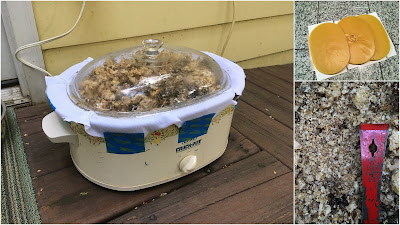
I switched to a round slow cooker (crock pot) to clean the crushed honeycomb and this led me to simplify my crushed comb cleaning steps using a colander.
  • crushed honeycomb - link for bee yard and kitchen activities
  • after several days of straining, I rinsed the crushed comb in warm water
  • selected a colander of the same diameter as the round slow cooker lid
  • line colander with cotton fabric and I mounded with rinsed crushed comb 
  • added lid and joined cotton fabric edges with 2 bull clips
  • removed the colander and added 1 cup of water and lid to the slow cooker
  • be safe and melt the wax outdoors
  • set slow cooker on high for 1 3/4 hours
  • turned off the slow cooker and let it cool undisturbed to room temperature with the lid on

ChatGPT generated haiku 

Crush, strain, honey's flow,
Slow cooker's gentle embrace,
Clean comb's sweet glow.


Sunday, June 13, 2021

crush and strain 2021

beekeeping,bee,slow cooker,crush and strain,honey,combcapper,escape,wax,

beekeeping,bee,slow cooker,crush and strain,honey,combcapper,escape,wax,

beekeeping,bee,slow cooker,crush and strain,honey,combcapper,escape,wax,

Here's my crush and strain experience so far this year:

bee yard activities:

  • inserted a triangular bee escape beneath a deep box and next day removed 8 fat deep frames 
  • halfway (8 steps) between hive and Storage Tote brushed small number of bees from the frame
  • one deep frame donated to "May 10th" swarm and remaining frames taken indoors
 kitchen activities:
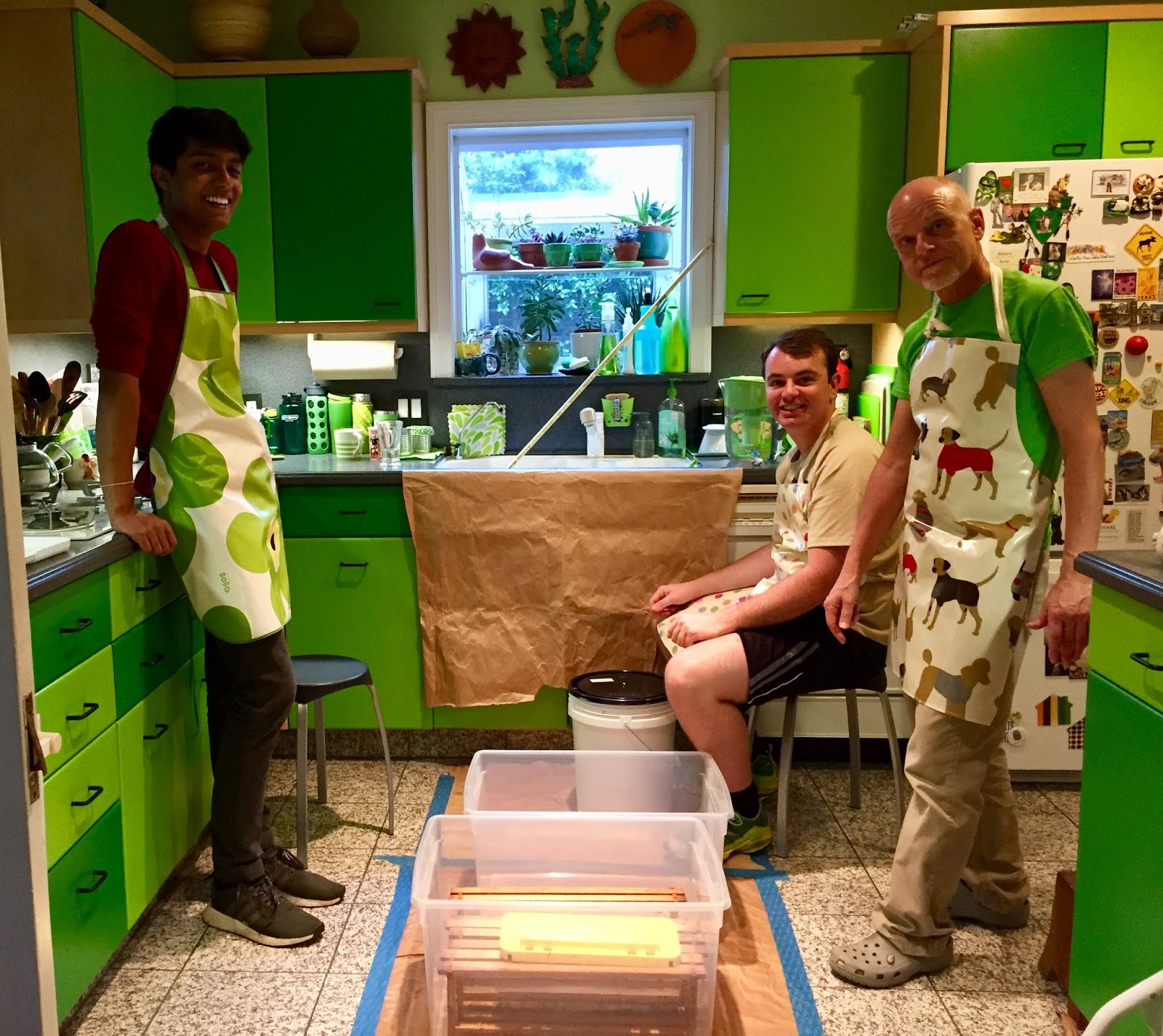
  • attached (with blue painter's tape) brown paper on floor and cabinets
  • placed food safe 5 gallon bucket on brown paper and attached combcapper
  • plugged frame into combcapper and cut capped comb from frames with paring knife
  • crushed comb with 2 inch Plastic Joint Knife attached to a pole
  • filtered crushed comb with small mesh fabric strainer and bottler stack - yielded 3.4 gallons (12.9 liters) of honey 
  • in 3 cycles, I used 1 cup of water, coarse cotton fabric and a 5qt round slow cooker set on high for 1.75 hours to catch wax impurities which resulted in 1.54 lbs (700 gm) of wax

Sunday, September 6, 2020

harvest 2020


beekeeping,foundationless walter t kelly,bee,harvesting,crush and strain,honey,escape,wax,

beekeeping,foundationless walter t kelly,bee,harvesting,crush and strain,honey,escape,wax,

beekeeping,foundationless walter t kelly,bee,harvesting,crush and strain,honey,escape,wax,
Notice the thin stripe above the 3rd box (count from the bottom), it's the triangular bee escape. 24 hours prior, I added the escape so that I can harvest frames above the escape without disturbing the vast majority of bees. I found more bees than expected during harvest and the reason can be seen in the third photo, a frame of brood.

I brushed off bees from harvested frames halfway between the hive and the plastic tub (2nd photo) - which is twenty steps away from the hive. 

I've not shown the crush and strain harvest of 5 fat frames which yielded 1.4 gallons of honey.

Sunday, July 19, 2020

bottling salvage (rescue) honey

bee, beekeeping, crush and strain, squeeze bottle, ergonomic,

bee, beekeeping, crush and strain, squeeze bottle, ergonomic,
This is life in the global pandemic. Masked and socially distanced, we bottled Cathy's 2 1/2 gallons of dark salvage (rescue) honey while she watched on zoom. Victoria managed the most difficult work of ergonomic bottling table setup and cleanup.

Thursday, March 12, 2020

salvage (rescue) honey


bee, beekeeping, combcapper, crush and strain, harvesting, winter,
  bee, beekeeping, combcapper, crush and strain, harvesting, winter,
bee, beekeeping, combcapper, crush and strain, harvesting, winter,
Cathy's bees did not pull through winter.  Capped frames were off-season honey harvested.  The right angle end of hive tool makes quick work scrapping capped comb from plastic foundation.   The combcapper confidently locks to frame and 5 gal bucket.   (A stainless steel nail ships with the combcapper, but I threw that component in the trash.)

Friday, August 16, 2019

wax blocks 2019


beekeeping,bee,slow cooker,crush and strain,wax,

After crush and strain, I rinsed the wax with warm water. Crushed wax was melted outdoors in a large thrift store slow cooker. I used one cup of water and cotton fabric to catch wax impurities. I set the cooker on high for nearly 2 hours and left everything to cool for another 4 hours. I repeated this cycle 3 times. Click on the photo and have a look at the tidy elliptical wax blocks.

Wednesday, July 31, 2019

crush and strain 2019


bee, beekeeping, combcapper, crush and strain, escape, foundationless. walter t kelly, harvesting, honey, slow shutter, Strainer and Bottler, wax,
We worked in the middle of the kitchen floor to contain the sticky clean-up.  Imagine a compact vertical stack - from the bottom up: 
Sagar and Quin (co-workers) cut comb with a paring knife from foundationless frames. Comb was crushed in the bucket using a 2 inch Plastic Joint Knife attached to a pole.

Crushed comb was poured into the strainer bottler and left to sit for a few days so that foam (tiny air bubbles) can rise before bottling.

After cutting away honey comb, frames are returned to the Storage Tote. Over-night, honey dripped into the Tote and were captured too. Sticky frames were stacked outside in a location away from the hives.  Bees assisted with the final honey clean-up of sticky frames - a circle of life scene which reminds me of sky burial.

In the 3rd photo, I used a slow shutter iPhone app.  Crawling bee behavior looks like white dots while flying behavior looks like brown lines (classic multiple exposure).

Sunday, August 26, 2018

Atlanta Community Food Bank

bee, beekeeping, climate, Atlanta community food bank, honey, spring, crush and strain, flowers
A long term goal met - an Atlanta Community Food Bank donation of 21 lbs of honey.   In 2017 there was no surplus honey.   This year, the favorable spring climate helped the flowers and honey bees produce lots of surplus honey - enough for friends, neighbors and the Food Bank.  Thank you to all my friends who helped with the crush and strain harvesting.

Please visit the Food Bank. Today's Food Bank is more sophisticated than a warehouse and distribution center for macaroni and cheese boxes or canned goods.   

Wednesday, June 13, 2018

crush and strain simplified

bee, beekeeping, combcapper, crush and strain, escape, foundationless. walter t kelly, Strainer and Bottler, brushy mountain, escape, harvesting, honey, wax,
It's called crush and strain, but there are surrounding steps to this simple slogan.  My honey harvest starts with the bee escape and ends with bottling.  So that foam can rise before bottling, strained honey is left to sit for a few days. With just one 5 gallon bottler, lots of honey and a busy day job, I had to modify my sequential honey harvest process.

Lucky for me, Home Depot sells food safe 5 gallon buckets - I bought two buckets to store crushed comb (wax and honey).  When the bottler becomes available, then I pour crushed comb into the strainer bottler

I'm trying to avoid making a large horizontal sticky mess in the kitchen.   So, I work in the middle of the kitchen floor.  Imagine a compact vertical stack - from the bottom up: brown paper, 5 gallon bucket, combcapper and medium foundationless frame of capped honey. In under an hour, Melissa and Dillon help cut comb from 14 frames with a paring knife.  Comb is crushed in the bucket using 2 inch Plastic Joint Knife attached to a pole.

Friday, June 8, 2018

crush and strain with Combcapper

bee, beekeeping, combcapper, crush and strain, foundationless. walter t kelly, honey, wax,
Combcapper gadget simplified my crush and strain process.  I'm not using the supplied nail and cut the medium foundationless frame down in thirds, guiding each 1/3 piece by hand into the 5 gallon bucket.  The combcapper holds the frame securely - an essential element when using a sharp paring knife. Michael Willis, coworker and beekeeper, helped me in the kitchen extracting 12 frames which yielded 4 gallons of strained honey.

Sunday, August 14, 2016

third hand tool - wood shims

bee, beekeeping, crush and strain, hive tool, Strainer and Bottler, third hand tool, wax, wood shim,
This year, I asked for help in the beeyard - a neighborhood beekeeper (aka He who must not be taken seriously) helped brush bees off capped honey frames and then place those frames into a covered storage tote.   Later the same day, friends Lauren and Todd helped in the kitchen, cut-out comb, then crush and strain the honey crop.   These are wonderful examples of an extra pair of hands.

Now imagine working solo in the beeyard - pry a gap beneath the top box with a standard hive tool and insert wood shims as a third hand tool.  Move to the opposite side of the box and repeat the process.   Now it's easier to lift the top box without fighting sticky propolis re-gluing the gap.  As wood shims are hard to recover against a leaf litter background - I add a piece of blue tape to the thick end of shim.

Tuesday, July 5, 2016

clean wax with slow cooker

bee, beekeeping, crush and strain, slow cooker, solar wax melter, wax,

bee, beekeeping, crush and strain, slow cooker, solar wax melter, wax,
I retired my solar wax melter and use a slow cooker exclusively to clean wax.  For safety, I operate the slow cooker outdoors and place concrete pavers beneath the hot appliance and wood table top. After crush and strain honey extraction, wax from thirteen frames are rinsed in warm water and cleaned in two slow cooker batches.   I added half the wax and two cups of water to the large oval slow cooker. Shown is cotton fabric and blue tape which suspend the wax above the water bath.  After two to three hours on the high setting, I turn off the slow cooker and leave all components (lid, cotton fabric and wax impurities) undisturbed until the slow cooker has completely cooled.

Sunday, June 5, 2016

bottle without white foam - pail perch

bee, beekeeping, crush and strain, honey, pail perch, Strainer and Bottler, white foam,
I was able to eke out a few more bottles of honey without white foam by tilting the pail. This homemade pail perch requires an extra pail lid, 2x4 scraps, fender washers and wood screws. For stability, a string connects the pail handle and pail perch.  To counterweight the tilted pail, I borrowed a heavy canned good from the pantry.

Before tilting the pail, I left a generous amount of time for bubbles to rise then I bottled honey to a point just above the honey gate.  After tilting the pail, I let the bubbles rise again before bottling the remaining honey.   

Wednesday, July 1, 2015

sky burial - stack of sticky frames after crush-and-strain

bee, beekeeping, brushy mountain, crush and strain, honey, Strainer and Bottler, wax,
I'm complaining about a good problem, too many frames of capped honey.  I credit the success mostly to honey bees from over-wintered hives and favorable Atlanta spring weather.  

I purchased a Sterilite® ClearView™ Storage Tote - Transparent with White Lid 66Qt. from Target.  The 12.25 " H x 16.25 " W x 23.5 " L dimensions are ideal for the storage of 15 medium frames of capped honey - the maximum processing capacity of the 2 (5-gallon) bucket strainer and bottler.

I'm using a a third 5-gallon bucket and a plastic scraper attached to a pole to thoroughly crush the honey comb.   I'm not a solo act - Ram, Melissa and Dillon volunteered to help - not counting the kitchen clean-up and hanging brown paper, the crush-and-strain process takes about 30 minutes.

After cutting away the honey comb, the frames are returned to the Storage Tote.  Over-night, a considerable amount of honey drips into the Tote and I captured these honey dripping too.  As seen in the photo, I stacked the sticky frames outside and in a location away from the hives.   The bees assist with the final honey clean-up of the sticky frames - a circle of life scene which reminds me of sky burial.

Saturday, June 2, 2012

crush and strain 2012

bee, beekeeping, brushy mountain, crush and strain, honey, solar wax melter, Strainer and Bottler, wax,
The day before the crush and strain, I removed eight deep frames of capped honey from the freezer and left the frames to thaw inside their plastic bag.  I cut away the honey comb and nearly filled a five gallon bucket - probably the limit of my strainer

Including preparation and clean-up, the entire crush portion took just one hour - a new record.  Here's my best effort with a material balance.
  • 48.0lb of honey + 8 deep frames + wax
  • 42.6lb of honey + wax
  • 37.0lb of honey
After two days of straining, stirring and settling, I filled 73 x 8oz bottles of honey.
bee, beekeeping, brushy mountain, crush and strain, honey, solar wax melter, Strainer and Bottler, wax,
I rinsed the wax pieces in warm water and dried those pieces on the sunny driveway.  Next, I placed the pieces in bags which are stored in the freezer until I was ready to use the solar melter.  Sounds extreme, but a few years ago wax moths made a complete mess of unprocessed wax which I left  indoors.
bee, beekeeping, brushy mountain, crush and strain, honey, solar wax melter, Strainer and Bottler, wax,
Coincidentally, I started the solar melting during Atlanta's all-time record of 106°F.   The block of wax smells great and has a beautiful deep yellow color - I'm blown away.

Wednesday, August 3, 2011

crush and strain honey


Each deep frame of capped honey comb was wrapped in a large plastic bag and put in the freezer a few weeks ago.  Freezing allowed me to postpone the crush and strain and kill any trace of small hive beetle larva.  The day before the crush and strain, frames were removed from the freezer and left to thaw inside their plastic bag. 

Comb was cut away from the frame in 3 parts and dropped into a 5 gallon bucket.  Nearly 6 deep frames of capped honey comb filled the bucket to the top.  Last year, instead of using a complete sheet of wax foundation, each frame was started with a narrow strip of  wax foundation.   What a pleasure that none of frames were wired.  So, I did not have to hassle with cutting away wire.   

I reused the cardboard and packing paper from Brushy Mountain before sending both to recycling.   The cardboard was reused twice, first to catch glue and paint drops (from assembly of deep hive body) and then to cover the kitchen floor during crush and strain.  Packing paper was used to cover the cabinet doors which sped up the kitchen clean-up too.  Including preparation and clean-up, the entire crush portion took just two hours--seems a lot easier than last year.

After straining and settling, nearly 6 deep frames of capped honey fills 40 x 8oz bottles of honey.

Tuesday, December 7, 2010

crush and strain


In the past, crushing honey comb using a hand scrapper on the kitchen counter top required lots of sticky clean-up.  Backwards Beekeepers inspired me to change the crush portion of my honey harvesting process.  I purchased a 2 inch plastic knife ($.98), a 5 gallon bucket ($3.98) and lid ($.98).  The plastic knife was attached to 1/2 inch CPVC pipe using stainless steel machine screws and stainless steel nylon lock nuts.  A plug added to the end of the CPVC pipe prevents the honey from entering the CPVC pipe.  I am not concerned with puncturing the bucket as the knife moves very slowly through the viscous honey comb mash.  This 8-frame medium super contains 30lb of honey comb or 24lb of honey (43 8oz bottles).

Saturday, November 1, 2008

Brushy Mountain Strainer and Bottler


5 deep frames of capped honey were removed from the freezer and the comb was crushed using a stainless steel scraper and a plastic cutting board. How much crushing is enough--stop when the voice of reason, "my spouse," says to stop. Next, the crushed comb was placed into a 5 gallon pale containing a nylon strainer which sits on top of yet another 5 gallon pale used for collection and bottling. The honey filled 30 8 oz. bottles and there was wax too. Residual honey was washed from the wax using the nylon straining bag. I am extremely pleased with this low tech extraction scheme. The only moving part is the honey gate and the only surprise was that I thought the draining was going to complete over-night. However, to complete the straining properly required 3 days of periodically stirring the crushed comb . See the picture of the straining/bottling gadget purchased from Brushy Mountain.