- graph 1 - dramatic 2019 fall hive weight gain
- graph 2 - flat to decreasing 2018 fall hive weight
- water balance calculator table - 2019 shows a slightly positive fall water balance compared to past years, while 2018 shows a dramatically wet fall water balance
Showing posts with label bloom. Show all posts
Saturday, November 23, 2019
2019 - fall hive weight and water balance calculator
Labels:
aster,
bee,
beekeeping,
bloom,
climate,
foraging,
goldenrod,
hive weight,
water balance calculator
Thursday, June 20, 2019
flowering trees - June '19
Mostly bumble bees, but a few honey bees are attracted to a flowering sourwood tree. Not shown, flowering mimosa tree which attract pollinators this time of year too. Mimosa have invasive tendencies.
Sunday, April 28, 2019
flowering plants - native or exotic pest
My favorite native flowering plant, spiderwort, attracts a honey bee. Last week, I noticed the unpleasant smell - now I've discovered the privet flowers. Also shown is a bee on a invasive flowering privet .
Another important bee forage are native tulip poplar flowers (not shown) - at this time of year, tulip poplar flower windfalls commonly attract sweet food seeking ants.
Monday, February 25, 2019
2019 spring bloom markers
This Atlanta spring has been like no other year, nor have we ever experienced an average spring. Yet, I want a rough guide to plan my spring beeyard tasks. At the moment, hives are in a winter configuration with bee cozy hive wraps and bradford pear and redbud trees blooming.
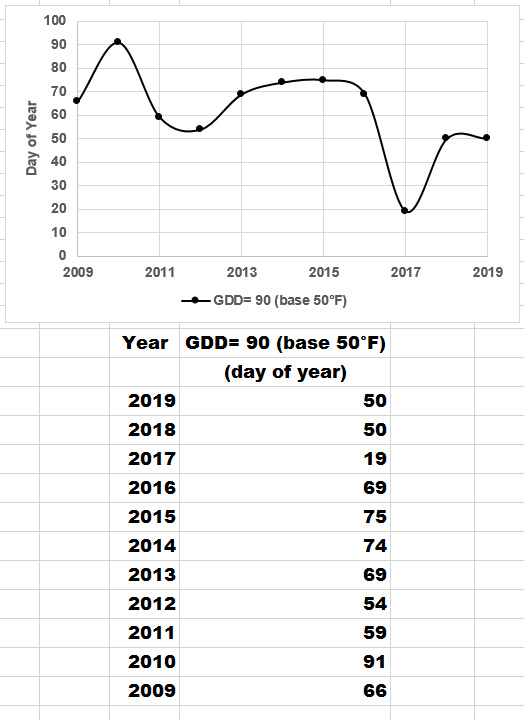
On February 21st, Atlanta pollen count exceeded 1000 which coincided with a Growing Degree Days (GDD) of 90. I'll use GDD equal to 90 and compare this spring with previous years. I calculated GDD using data from the University of Georgia Automated Weather Network. I'll also use Julian Day which converts a MMM-DD-YYYY date format which spans 4 months (January to April) into a seamless day of year format.
In the graph notice:
On February 21st, Atlanta pollen count exceeded 1000 which coincided with a Growing Degree Days (GDD) of 90. I'll use GDD equal to 90 and compare this spring with previous years. I calculated GDD using data from the University of Georgia Automated Weather Network. I'll also use Julian Day which converts a MMM-DD-YYYY date format which spans 4 months (January to April) into a seamless day of year format.
In the graph notice:
- similar Day of Year values between this year and 2018
- warm 2017 outlier which reached a GDD equal to 90 on January 19
Labels:
bee,
bee cozy,
beekeeping,
bloom,
Bradford Pear,
climate,
growing degree days,
pollen count,
redbud tree
Sunday, March 25, 2018
2018 spring bloom markers
I was hoping to simplify my tracking of spring bloom markers, but instead I added another marker, Growing Degree Days (GDD), which is easy to calculate using free web-based tools. Julian Day allows me to convert MM-DD-YYYY date format which spans 3 months (February to April) into a seamless day of the year format. GDD is a major convenience, I can tap into a database of daily temperature minimum and maximum instead of recording my own observations. Focusing on the last two graph points, the accumulated warming this year is roughly 25 days delayed compared to last year (84 versus 59).
Here I compare additional observations with GDD, 1) Acer leaf-out in my backyard and 2) first day that the pollen count exceeds 1000. Notice how well these markers follow similar graph trends.
Here I show a free web-based tool by AgroClimate which compares this year's GDD to the previous year. Reading from left-to-right, notice where the curves depart - last year's accumulated warming began in mid January, approximately 30 days earlier than this year. If the daily high does not exceed 50°F, then the daily contribution to accumulated GDD is zero - the curve does not grow in height. I love this graph layout, but I can't use this tool to go back further in history. This tool can draw the average GDD (not shown), but we all know that no such thing exists in the wild - we have never experienced an average year of weather.
Here I show a free web-based tool by Weather Underground which I used to calculate GDD beyond the previous year in history. In previous years, I kept the starting point equal to January 1, and I change the ending point in a trial and error manner to achieve a GDD value close to 296. Why 296 - this is the GDD value where the Atlanta pollen count exceeds 1000 this year.
2009 2010 2011 2016 2017 2018
day day day day day day
Bradford Pear 65 79 60 56 53Carpenter Bees 68 87 72 63 77
Acer palmatum leaf out 73 92 77 64 76
Carolina Cherry Laurel 73 97 83 57 76
Pollen Count over 1000 76 51 84
GDD=296 (base 50°F) 92 104 93 84 59 84
Here I show other values that do not appear in the graphs.
Sunday, November 5, 2017
tradescantia pallida - three petals and six yellow anthers
While waiting for the light to change on a busy Atlanta street, I saw lots of bees on a patch of tradescantia pallida, also known as purple-heart or purple secretia. These plants are growing from east facing gaps of a sidewalk wall.
The bee weight folds the filament at right angle. Click on the image, it's hard to distinguish between bee's pollen load and the three anthers in her grasp. Does the recent warm November rain make the filament more flexible? Perhaps these are extra long filaments, I don't know. In the process of counting petals and anthers I discovered on Wikipedia that this New World plant is part of same genus as my bee friendly plant favorite, spiderwort.
Saturday, April 15, 2017
2017 nectar flow
Bee cooperative weather is supporting a strong nectar flow of holly bushes, white clover, spiderwort and tulip poplar. Native mining bees and carpenter bees are extremely active too.
This year, I started to checkerboard the honey cap of over-wintered hives on March 6th. Since then, I check the honey cap every three weeks. My version of checkerboarding uses foundation-less frames with no drawn comb. Yesterday, I added another medium box to each hive. I don't know how long this nectar flow will last, but I have monstrously tall hives.
My swarm capture is drawing comb and growing in size too, but at a much slower pace than over-wintered hives.
Sunday, March 12, 2017
2017 spring markers & honey cap
2009 2010 2011 2016 2017
day day day day day
Bradford Pear 65 79 60 56
Carpenter Bees 68 87 72 63
Acer palmatum leaf out 73 92 77 64
Carolina Cherry Laurel 73 97 83 57
Pollen Count over 1000 76 51
The point of tracking these day-of-year values is to synchronize my beekeeping practices with spring weather. The first step/acknowledgement is to admit that there is no such thing as an average year- we have never experienced an average year of weather. My journal contains spring marker dates which sometimes appear in different months. So, dates are converted to day-of-year to make the comparison between years easier. I'm experimenting with comparing first pollen count over 1000. Pollen count is easy to acquire, loosely correlates with temperature and maybe more objective than my journal notes.
I first saw Steve Page speak at Georgia Beekeepers Association in 2015 on the topic of Sustainable Beekeeping. Do you want to learn more, sign-up for "It's Time To..." the free email mentoring of Coweta Sustainable Beekeeping. As Steve is influenced by other beekeepers - so, I'm influenced by Steve and have adapted my beekeeping management which uses Kelly foundationless (F Style) frames. Last Monday (day 65), I removed the bee cozy and checker-boarded the honey cap of my hives.
Sunday, June 9, 2013
white dutch clover
As ever, this year is like no other year in Atlanta - Lake Lanier is 1.5 feet above full pool. Atlanta has received lots of rain and many un-sprayed lawns are full of white dutch clover. It took me many attempts to capture this (cropped) iPhone shot of a honey bee visiting clover.
Had a quick look in my two hives and they seem to be healthy and with small SHB populations - one hive had one SHB above the inner cover and the other hive had zero - lots of earwigs. Knock on wood, things look on track for a July harvest and split(s).
Sunday, May 12, 2013
three purple petals and six yellow anthers
On the morning walk I discovered honey bees visiting this plant - check out the crisp iPhone photo. We purchased this flowering perennial too, but I lost track of its name. I eventually found the plant on an Internet search - spiderwort. My garden books were not helpful - perhaps Walter Reeves will consider a Georgia book for beekeepers?
The neighborhood stinks of flowering Privet which started to bloom a few days ago. A few front yards (without herbicides) contain tons of white clover. Has my big honey crop year hit a bump? - is the bee population in or out of sync with the weather and flowering plants? - four inches of rain in three days was ridiculous! - these are the uncertainties of the honey harvest.
Sunday, March 27, 2011
bloom calendar / spring markers
2009 2010 2011
Day of Year Day of Year Day of Year
Bradford Pear 65 79 60
Carpenter Bees 68 87 72
Acer palmatum leaf out 73 92 77
Flowering Dogwood 80 93 80
Asian Wisteria 83 96 81
Carolina Cherry Laurel 73 97 83
In Atlanta, the arrival of the 2011 spring markers are remarkably similar to 2009. So, as not to color my 2011 observations, I have intentionally not reviewed my old journal notes......too much. Picking "the date" for these spring markers requires more patience and discipline than I am always prepared to apply. Naturally, I want to escape winter and embrace spring.....ticking-off the entire spring marker list during one warm day. My journal contains spring marker dates which sometimes appear in different months. So, the dates are converted to day-of-year to make the comparison between years easier.
I speculate that this year, enthusiastic yard clean-up has made it less obvious to spot the arrival of the invasive Asian Wisteria bloom near "my local" coffee shop. My wood deck is a dependable habitat for those territorial wood nibblers (a.k.a. carpenter bees) who emerge/return to same piece of lumber each year. For example, the carpenter bee arrival are observations only recorded in my backyard....another self imposed rule to my scheme.
Day of Year Day of Year Day of Year
Bradford Pear 65 79 60
Carpenter Bees 68 87 72
Acer palmatum leaf out 73 92 77
Flowering Dogwood 80 93 80
Asian Wisteria 83 96 81
Carolina Cherry Laurel 73 97 83
In Atlanta, the arrival of the 2011 spring markers are remarkably similar to 2009. So, as not to color my 2011 observations, I have intentionally not reviewed my old journal notes......too much. Picking "the date" for these spring markers requires more patience and discipline than I am always prepared to apply. Naturally, I want to escape winter and embrace spring.....ticking-off the entire spring marker list during one warm day. My journal contains spring marker dates which sometimes appear in different months. So, the dates are converted to day-of-year to make the comparison between years easier.
I speculate that this year, enthusiastic yard clean-up has made it less obvious to spot the arrival of the invasive Asian Wisteria bloom near "my local" coffee shop. My wood deck is a dependable habitat for those territorial wood nibblers (a.k.a. carpenter bees) who emerge/return to same piece of lumber each year. For example, the carpenter bee arrival are observations only recorded in my backyard....another self imposed rule to my scheme.
Thursday, April 8, 2010
cold duration
I tapped into the climate records from the University of Georgia cold duration calculator. So, it's not just my imagination, but this past winter has been a particularly prolonged cold winter. This winter our purple heart plant died, but this plant survived the past 5 winters outdoors.
Has prolonged cold temperatures altered when trees bloom or the arrival of other spring markers? My backyard record keeping could be better, but it looks like a ~19 day delay of spring markers when comparing 2010 with 2009.
Bradford Pear 20-MAR-2010 15-FEB-2009 33 day delay
Carpenter Bees 28-MAR-2010 09-MAR-2009 19 day delay
Acer palmatum leaf out 02-APR-2010 14-MAR-2009 19 day delay
Flowering Dogwood 03-APR-2010 21-MAR-2009 13 day delay
Asian Wisteria 06-APR-2010 24-MAR-2009 13 day delay
Carolina Cherry Laurel 07-APR-2010 14-MAR-2009 24 day delay
Subscribe to:
Posts (Atom)