Showing posts with label checkerboarding. Show all posts

Saturday, February 12, 2022

nectar management - checkerboarding

beekeeping,bee,Small Hive Beetle,checkerboarding,winter,nectar,bee cozy,hive tool,

beekeeping,bee,Small Hive Beetle,checkerboarding,winter,nectar,bee cozy,hive tool,

beekeeping,bee,Small Hive Beetle,checkerboarding,winter,nectar,bee cozy,hive tool,

beekeeping,bee,Small Hive Beetle,checkerboarding,winter,nectar,bee cozy,hive tool,

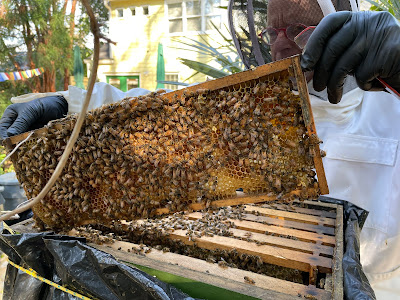
In the previous post using external measurements and observations, I postulated bees consumed honey and raised late-winter brood.   February 12th was my first 2022 hive inspection and I took action, well some actions!

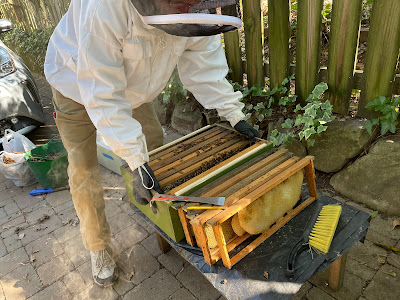
  • an 8 frame medium box with drawn comb was set aside from the hive - drawn comb is a luxury that I rarely have at hand as a crush-and-strain beekeeper
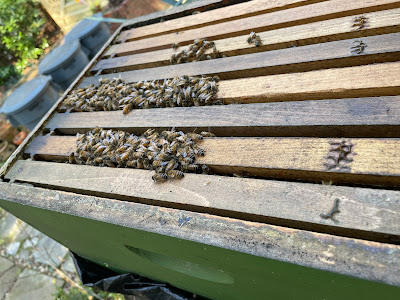
  • the bees had corralled small hive beetles above the inner cover - I crushed these beetles using the short edge of the standard hive tool or my finger
  • every other frame in the hive's top medium box was exchanged with every other frame of the set aside 8 frame medium box
  • the top medium box contained 7 frames of nectar and 1 frame of capped honey
  • the set aside medium box was placed onto the hive completing my 8-frame version of checkerboarding
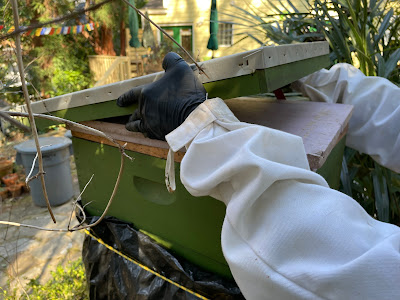
  • as more winter temperatures are expected, I returned the hard foam insulation above the inner cover and overlapped two hive cozys to cover the new medium box

Friday, March 27, 2020

2020 nectar flow

bee, beekeeping, checkerboarding, frame cleaner tool, honey comb, nectar, hive tool,
bee, beekeeping, checkerboarding, frame cleaner tool, hive tool, honey comb, nectar,
15 days ago, I checkerboarded and added a medium box.  Today I repeated that process to keep up with the nectar flow.   My version of checkerboarding uses foundation-less frames with no drawn comb. New comb is drawn in a typical pattern of merging teardrop curves. 
bee, beekeeping, checkerboarding, frame cleaner tool, hive tool, honey comb, nectar,
I used the right angle end of the (traditional spring steel) hive tool to increase the space between frame top bars. Next I lifted the top bar end with a Frame Cleaner tool - that yellow handle tool in my right hand.  I've forgotten how I discovered this indispensable off-label use of the Frame Cleaner tool.

Thursday, March 12, 2020

Sixth warmest winter on record for contiguous U.S.


bee, beekeeping, climate, dandelion, checkerboarding, winter, bee cozy
In "Assessing the U.S. Climate in February 2020", NOAA writes,
  • December through February was much warmer than normal across the contiguous United States, while precipitation remained above-average. 
  • Georgia ranked second wettest, while Alabama and North Carolina ranked third wettest.
  • Alabama and Georgia had their wettest winter on record, while South Carolina saw its second wettest.
NOAA's summary match my Atlanta weather experience and is consistent with the early arrival of flowering trees and plants.  I don't commonly see bees on dandelion flowers (many neighbors use lawn herbicides).   Wikipedia lists the  pollen color of  dandelion as "red yellow, orange" and typically flowering in  Apr-May.

Today, I removed the bee cozy hive wrap and checker-boarded the honey cap of my hives. From the top box, I swapped half of my drawn frames with no-comb foundationless frames.   The removed drawn frames are added to a new top box where half of the frames are no-comb foundationless.  I first learned about this beekeeping practice in 2015 where Steve Page spoke at Georgia Beekeepers Association.

Thursday, April 11, 2019

2019 tulip popular

amur honeysuckle, bee, beekeeping, checkerboarding, clover, foundationless. invasive plant, nectar, swarm trap, tulip poplar,


amur honeysuckle, bee, beekeeping, checkerboarding, clover, foundationless. invasive plant, nectar, swarm trap, tulip poplar, spiderwort,
I discovered my first 2019 windfall of the tulip popular flower kind.  Also shown is an invasive shrub which attracts pollinators, amur honeysuckle.  Other nectar sources at this time (not shown) include white clover and spiderwort.

Last weekend, I entered the hives for the first time this year.   The honey cap of one hive was checkerboard using foundation-less frames with no drawn comb.  The other hive was left in its winter configuration.

Weeks ago, I set tree hanging 8-frame swarm traps, but yet to see any scout bees.

Thursday, April 5, 2018

tulip popular flower windfall

bee, beekeeping, checkerboarding, foundationless. walter t kelly, honey cap, nectar, Small Hive Beetle, tulip poplar, sustainable, swarm, swarm lure, swarm trap,
Today I discovered the first 2018 windfall of the tulip popular flower kind.  Tulip poplar flowers could be a valuable nectar flow for the bees if the weather cooperates - no hard rainfall please.

In late February for one hive and mid-March for the other hive, I checkerboard the honey cap using foundation-less frames with no drawn comb. Both overwintered hives are flying with nearly equal vigor and have an amazing low number of small hive beetles during hive inspections, but are not drawing comb as I expected.

On March 29th I hung 8-frame deep swarm traps from crepe myrtle trees and now wait for the first scout bees - apparently I'm waiting impatiently.

Saturday, April 15, 2017

2017 nectar flow

bee, beekeeping, bloom, Carpenter Bees, checkerboarding, climate, clover, foraging, foundationless. walter t kelly, holly, honey cap, native solitary bee, nectar, spiderwort, tulip poplar,

bee, beekeeping, bloom, Carpenter Bees, checkerboarding, climate, clover, foraging, foundationless. walter t kelly, holly, honey cap, native solitary bee, nectar, spiderwort, tulip poplar,
Bee cooperative weather is supporting a strong nectar flow of holly bushes, white clover, spiderwort and tulip poplar. Native mining bees and carpenter bees are extremely active too.

This year, I started to checkerboard the honey cap of over-wintered hives on March 6th. Since then, I check the honey cap every three weeks. My version of checkerboarding uses foundation-less frames with no drawn comb. Yesterday, I added another medium box to each hive. I don't know how long this nectar flow will last, but I have monstrously tall hives.

My swarm capture is drawing comb and growing in size too, but at a much slower pace than over-wintered hives.  

Sunday, March 12, 2017

2017 spring markers & honey cap


Acer palmatum, Atlanta, bee, beekeeping, bloom, Bradford Pear, Carolina Cherry Laurel, Carpenter Bees, checkerboarding, climate, foundationless. walter t kelly, honey cap,
What feels odd about the first photo?  Maybe it's the expectation that the flowers are larger than bees - not in this case of this holly bush. Here's another prolific flowering tree in the neighborhood - Carolina Cherry Laurel appears in the second photo.

                     2009 2010 2011 2016 2017
                      day  day  day  day  day
Bradford Pear          65   79   60        56
Carpenter Bees         68   87   72        63
Acer palmatum leaf out 73   92   77        64
Carolina Cherry Laurel 73   97   83        57
Pollen Count over 1000                76   51

The point of tracking these day-of-year values is to synchronize my beekeeping practices with spring weather.  The first step/acknowledgement is to admit that there is no such thing as an average year- we have never experienced an average year of weather.  My journal contains spring marker dates which sometimes appear in different months.  So, dates are converted to day-of-year to make the comparison between years easier.  I'm experimenting with comparing first pollen count over 1000.  Pollen count is easy to acquire, loosely correlates with temperature and maybe more objective than my journal notes.

I first saw Steve Page speak at Georgia Beekeepers Association in 2015 on the topic of Sustainable Beekeeping.   Do you want to learn more, sign-up for "It's Time To..." the free email mentoring of Coweta Sustainable Beekeeping.  As Steve is influenced by other beekeepers - so, I'm influenced by Steve and have adapted my beekeeping management which uses Kelly foundationless (F Style) frames.  Last Monday (day 65), I removed the bee cozy and checker-boarded the honey cap of my hives.  

Saturday, March 17, 2012

making spring splits

bee, beekeeping, checkerboarding, division board feeder, feeder, pollen, split, swarm control,
I split all (two) of my hives this spring (March 17th).  I chose four adjacent frames from the bottom box of each parent hive which contained eggs, worker brood or pollen.  Next, I added three adjacent frames with wax strips.  Last, I added a 3 quart division board feeder as insurance.  In the parent hive, I checker-boarded the missing four frames with frames with wax strips.  Each split was placed on top of their parent hive and in the same orientation as the parent hive.  From the hive defensiveness, I presume that there is no major nectar flow.

On day fourteen (March 30th), I quickly checked beneath the inner cover of both splits.  The dawn temperature was 59 °F and some reassuring warm moist escaped from beneath the inner cover.  Both splits have a nice cluster of bees over several frames.  One split consumed one cup of syrup and the other split consumed two quarts of syrup.  So far, all seems well.

Saturday, March 6, 2010

IPM counting board debris

I'm interested in whether the debris on the IPM counting board correlates with the winter cluster location.  I'm using "debris" to describe everything that falls through the screened bottom board--not just varroa mites.  Is there a correlation between the winter cluster location and the debris--how can I use this information? 
bee, beekeeping, checkerboarding, counting board, debris, hive, ipm, open the brood nest, swarm, swarm control, varroa, winter cluster,
In the image above, counting board debris marks the bee space between frames and the absence of debris marks the location of the eight frames.  As the IPM grids does not line-up with the frames, I'll flip-over my counting board so that the white un-marked side faces up. I'm tired of ignoring the counting board grid lines and using my finger to count the frames.
bee, beekeeping, checkerboarding, counting board, debris, hive, ipm, open the brood nest, swarm, swarm control, varroa, winter cluster,

In the image above, the bees on the frames mark the top of the winter cluster (3D sphere)in the first deep hive body.   The counting board debris and winter cluster locations seems to line-up.  To make the debris more obvious, I'm scraping and washing the counting board surface clean after every inspection.

During spring swarm control, a quick look at the counting board debris may help plan which honey frames to remove for "checkboarding" in the second deep hive body or which frames get starter strips to "open the brood nest" in the first deep hive body.