Showing posts with label swarm control. Show all posts

Saturday, January 12, 2013

spring 2013 weather outlook

NOAA announced that "2012 was warmest and second most extreme year on record for the contiguous U.S."   Looking forward, NOAA forecasts the Atlanta spring 2013 with above normal temperatures and normal rainfall.  
bee, bee cozy, beekeeping, climate, foraging, mahonia, rosemary, split, swarm control,
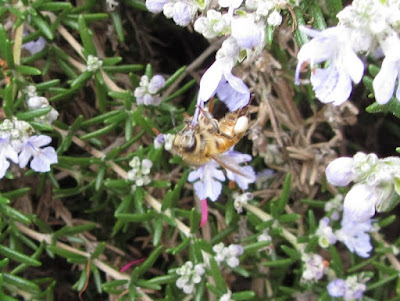
On warm days, I see bees foraging for water, mahonia, rosemary and winter blooming cherry (too difficult to catch on camera)The bee cozies are still on, but not for too much longerI am lucky, all three hives are still alive - I plan to spring split the strongest hives in an attempt to control swarming and create another hive.

Tuesday, May 1, 2012

one of two splits achieves a mated queen

From the parent hives I removed eggs, capped worker brood, pollen and bees and one of two splits achieves a mated queen.  Not bad for a new-bee, but I have to credit the favorable spring weather and drones from local hives.   Here's a summary of what went on with the two splits.
bee, beekeeping, division board feeder, feeder, pail feeder, pollen, split, swarm control,
April 6th (day 20) with help from a visiting friend, Ray Karsch, we move the splits which have been sitting on top of their parent hive with the same entrance orientation.  Without a cinch strap we gently stack both splits onto the same hive stand.  Each split has their own deep division board feeder and the bottom split has a counting board to keep them warm.  The top split is taking syrup while the bottom split is not.  April 12th (day 26), bees return to the top split with pollen, while no pollen is found on the counting board of the bottom split.  April 6th (day 30), I simply combine splits into a two deep box configuration.  I'm convinced that one split contains a mated queen based on pollen foraging and syrup consumption.
 
April 23rd, I discover all the bees in the lower box, so I squeeze the resources into one deep box with a division board feeder.  May 1st, I remove the deep division board feeder.  Next I add a medium box with one frame of capped honey (bait frame from parent hive) and seven medium frames with wax strips.  Above the inner cover I invert a one gallon pail and remove the counting board.
bee, beekeeping, division board feeder, feeder, pail feeder, pollen, split, swarm control,

Saturday, March 17, 2012

making spring splits

bee, beekeeping, checkerboarding, division board feeder, feeder, pollen, split, swarm control,
I split all (two) of my hives this spring (March 17th).  I chose four adjacent frames from the bottom box of each parent hive which contained eggs, worker brood or pollen.  Next, I added three adjacent frames with wax strips.  Last, I added a 3 quart division board feeder as insurance.  In the parent hive, I checker-boarded the missing four frames with frames with wax strips.  Each split was placed on top of their parent hive and in the same orientation as the parent hive.  From the hive defensiveness, I presume that there is no major nectar flow.

On day fourteen (March 30th), I quickly checked beneath the inner cover of both splits.  The dawn temperature was 59 °F and some reassuring warm moist escaped from beneath the inner cover.  Both splits have a nice cluster of bees over several frames.  One split consumed one cup of syrup and the other split consumed two quarts of syrup.  So far, all seems well.

Saturday, March 6, 2010

IPM counting board debris

I'm interested in whether the debris on the IPM counting board correlates with the winter cluster location.  I'm using "debris" to describe everything that falls through the screened bottom board--not just varroa mites.  Is there a correlation between the winter cluster location and the debris--how can I use this information? 
bee, beekeeping, checkerboarding, counting board, debris, hive, ipm, open the brood nest, swarm, swarm control, varroa, winter cluster,
In the image above, counting board debris marks the bee space between frames and the absence of debris marks the location of the eight frames.  As the IPM grids does not line-up with the frames, I'll flip-over my counting board so that the white un-marked side faces up. I'm tired of ignoring the counting board grid lines and using my finger to count the frames.
bee, beekeeping, checkerboarding, counting board, debris, hive, ipm, open the brood nest, swarm, swarm control, varroa, winter cluster,

In the image above, the bees on the frames mark the top of the winter cluster (3D sphere)in the first deep hive body.   The counting board debris and winter cluster locations seems to line-up.  To make the debris more obvious, I'm scraping and washing the counting board surface clean after every inspection.

During spring swarm control, a quick look at the counting board debris may help plan which honey frames to remove for "checkboarding" in the second deep hive body or which frames get starter strips to "open the brood nest" in the first deep hive body.