Showing posts with label hive. Show all posts

Tuesday, August 2, 2016

clean mold with non-toxic hydrogen peroxide

bee, beekeeping, clean, hive, hydrogen peroxide, mold, non-toxic cleaner,
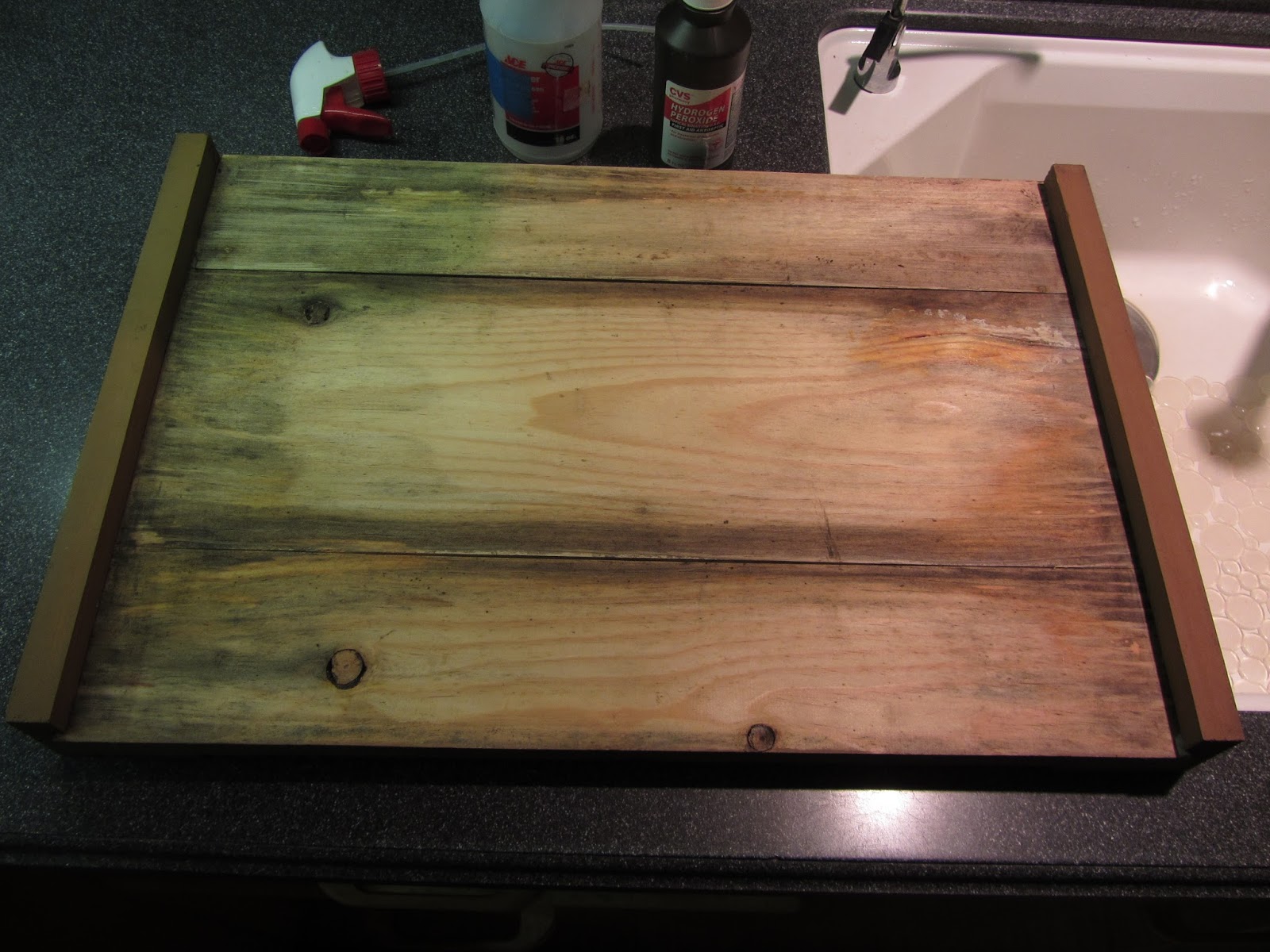
After hanging in a tree through winter, my 8 frame swarm trap required a serious cleanup.

I used the curved end of a Standard Hive Tool to scrape off most of the black mold. This was followed by spraying 3% concentration hydrogen peroxide, waiting 10 minutes, then wiping off the mold with a cotton rag. Shown is the migratory cover after cleanup, ACE hardware spray bottle and CVS hydrogen peroxide. I found the cleanup steps on THE MAIDS BLOG.

I wore rubber kitchen gloves and safety glasses for the hydrogen peroxide portion of the cleanup. 

Saturday, March 6, 2010

IPM counting board debris

I'm interested in whether the debris on the IPM counting board correlates with the winter cluster location.  I'm using "debris" to describe everything that falls through the screened bottom board--not just varroa mites.  Is there a correlation between the winter cluster location and the debris--how can I use this information? 
bee, beekeeping, checkerboarding, counting board, debris, hive, ipm, open the brood nest, swarm, swarm control, varroa, winter cluster,
In the image above, counting board debris marks the bee space between frames and the absence of debris marks the location of the eight frames.  As the IPM grids does not line-up with the frames, I'll flip-over my counting board so that the white un-marked side faces up. I'm tired of ignoring the counting board grid lines and using my finger to count the frames.
bee, beekeeping, checkerboarding, counting board, debris, hive, ipm, open the brood nest, swarm, swarm control, varroa, winter cluster,

In the image above, the bees on the frames mark the top of the winter cluster (3D sphere)in the first deep hive body.   The counting board debris and winter cluster locations seems to line-up.  To make the debris more obvious, I'm scraping and washing the counting board surface clean after every inspection.

During spring swarm control, a quick look at the counting board debris may help plan which honey frames to remove for "checkboarding" in the second deep hive body or which frames get starter strips to "open the brood nest" in the first deep hive body.

Sunday, November 22, 2009

condensation: outside versus inside the hive

air, bee, beekeeping, brushy mountain, condensation, hive, moist, Styrofoam, telescoping cover, ventilation, warm,
This fall, water was discovered between the telescoping cover and inner cover.  The dawn temperature of  45 °F, thin plywood construction of the telescoping cover and warm moist hive air is a recipe for condensation.  In the morning, I also discovered condensation on the landing board near the reduce hive entrance.

Using 2 pieces of Styrofoam Block 18"x12"x1" from Micheals, a 1" slab of Styrofoam is fitted to the inside of the telescoping cover.  The small bee escape notch on the top side of the brushy mountain inner cover permits some warm moist air to leak from the hive.  See the photo--Now, the warm moist air leaking from the hive is seen appropriately condensing on the outside of the telescoping cover.   Problem solved, I no longer find water between the telescoping cover and inner cover.

Wednesday, October 28, 2009

small hive beetle sizes

AJ Beetle Eaters contents are logged for several weeks in side-by-side hives.   After emptying the AJ Beetle Eaters on to white paper, a log is kept of 1) the number of adult beetles and 2) length of each adult beetle (nearest millimeter). Sounds easy, eh?  It's messy, oily, and the clubbed beetle antennae can complicate the length measurement.

Do the adult small hive beetle populations change over time?
  • Probably in response to cooler fall weather, less adult small hive beetles are captured over time
  • I'm surprised--the hives maintain their unique small hive beetle size profile over time
How do the hives differ?
  • Hive A is weaker (less flight activity) than hive B
  • Hive A is younger (swarm capture) and hive B is older (early spring nucleus hive)
  • Hive A has larger beetles than hive B.   Perhaps weaker (less flight activity) hives offer more small hive beetle treats (nutrition).
Unanswered questions:
When does the small hive beetle population peak?  Had I started the log sooner, then I could have captured the small hive beetle population peak.  Oh well, something for next year.  I'll wait for a further decline of the small hive beetle numbers before offering tasty (to small hive beetles) dry MegaBee pollen substitute to the bees.

Monday, July 27, 2009

bee bearding


"Bearding," what's next? Why does one hive, Kent, have a greater tendency to beard? Kent is followed for three weeks, where 1) bearding (or lack of), 2) outdoor temperature and 3) outdoor relative humidity are logged at 7AM. In contrast to a normally warm July, a cold front creates record low temperatures, extending the range of measured temperatures for analysis. The compact three week data collection period help exclude other annual population/reproduction cycles that Kent may experience. Lastly, the 7AM (approximately dawn--temperature nadir) measurement time is characterized by slowly varying temperature and an absence of sun light striking Kent.

Web: A quick look on the Internet shows that the beekeeping community speculates that the bearding bees implies:
  • lack of ventilation
  • high temperature
  • high humidity
  • crowding--preparation to swarm
Bearding Score: Sometimes I made entries in the log, other times my spouse (voice of reason) made those entries. As seen below, this is the relaxed language found in the log. The bearding is a somewhat binary phenomena, so traditional area units seemed to strict for the log.

  • 0= none(zero)
  • 1= tiny(very little)
  • 2= small(some)
  • 3= small (some) to medium
  • 4= medium
  • 5= medium to lots
  • 6= lots
Bearding versus Temperature: At Kent, bearding begins at ~61 °F and bearding increases with increasing temperature. A few points are not in agreement with the linear fit. For example, a zero bearding point is seen with a temperature of 70 °F. This point follows a day with a 5 inch rainfall.

Bearding versus Humidity: Surprisingly, no relationship between bearding and humidity is found. In other words, along the humidity axis, there is no bearding (bubble size) trend.

Bearding versus other theories:Lastly, Kent has not swarmed--so far. All hives have the same screened bottom board and the same inner cover to outer cover gap. In other words, Kent likes to beard for reasons I do not completely understand.

Thursday, June 25, 2009

clean the AJ Beetle Eater

AJ's Beetle Eater, bee, beekeeping, clean, hive, propolis, reuse, Small Hive Beetle,


Yikes, after a few weeks, the AJ Beetle Eater is covered with propolis. I frequently rotate spare Beetle Eaters into the easily accessible top boxes, but I also want to clean and reuse the Beetle Eaters . FYI, I use two Beetle Eaters per box. Early attempts at cleaning the Beetle Eaters with soap and water were a disaster. Now, I use a cleaning scheme that works with a minimal amount of effort:
  • drain used AJ Beetle Eater components at room temperature
  • clean components with paper towel (no water)
  • freeze all the AJ Beetle Eater components
  • one component at a time, remove from freezer and chip away the propolis with a paint scrapper and dab up the vegetable oil with paper towel (no water)
So, the results are 95% clean as new Beetle Eaters and ready for re-use. The paint scraper is appropriately less sharp than a hive tool for chipping away the frozen propolis.

Wednesday, May 13, 2009

baggie feeder

baggie feeder, bee, beekeeping, feeder, hive, Honey B Healthy, lemongrass, oil, spearmint,


baggie feeder, bee, beekeeping, feeder, hive, Honey B Healthy, lemongrass, oil, spearmint,
After a number of stings (on the hand), I began to search for something other than a boardman style feeder. I started using a one gallon baggie, but I had to solve some questions:
  • transporting filled baggies without creating leaks
  • checking for leaky baggies
  • where to puncture the baggie
  • how much syrup to place in the baggie
Using a plastic bucket (with handle), several baggies can be filled and safely transported. Baggie leaks can be discovered by checking the bucket. I use a permanent marker to highlight where to puncture the baggie. I make two small punctures followed by one central one inch slit. If the baggie is sealed with lots of air, then this reduces the likelihood of puncturing the bottom side of the baggie. Usually, I fill the baggie with a 1/2 gallon of syrup, but I have also successfully filled the baggie with 3/4 gallons of syrup. This year, I am adding Honey B Healthy to the syrup, so the hive smells of lemongrass and spearmint. Entering the top of the hive may require a veil, but I have not been stung on the hand.

Monday, May 11, 2009

free bees - swarm capture

baited, bee, beekeeping, brushy mountain, free bees, hive, swarm, swarm capture, swarm trap, baited, bee, beekeeping, brushy mountain, free bees, hive, swarm, swarm capture, swarm trap,


baited, bee, beekeeping, brushy mountain, free bees, hive, swarm, swarm capture, swarm trap,


baited, bee, beekeeping, brushy mountain, free bees, hive, swarm, swarm capture, swarm trap,


The swarm trap (+ lure) was being visited by a large number of scouts, and by dusk I was convinced that the swarm trap was occupied. At dawn of the next day, the swarm trap (+ lure) was placed on top of the desired hive. After 24 hours, the bees are shaken or bumped into the hive. Some bees remain attached to the trap and are left to crawl into the hive at their own pace. The small quantity of drawn comb is not placed into the hive.

AJ Beetle Eater


In the beginning, I spilled vegetable oil on myself trying to fill the AJ Beetle Eater. Now, I use a use a squeeze bottle ($3) with vegetable oil to fill the AJ Beetle Eater reservoir. Snap on the AJ Beetle Eater grill and suspended the ready to use AJ Beetle Eater on blue tape. The plastic pot is easy to transport to a hive inspection and between hive inspections, a plastic shower cap covers the oil filled AJ Beetle Eaters.


Thursday, April 2, 2009

hive marking - unique patterns (not colors)

In The Buzz about Bees, Jürgen Tautz describes how pattern (not color) is useful in assisting bees find their hive address. Inexpensive pre-painted patterns were purchased from a Michaels craft shop, sprayed with clear Krylon and attached to the hive body using Titebond water-resistant glue.

Sunday, February 15, 2009

Swarm Trap


How does the Brushy Mountain swarm trap dimensions and swarm lure compare with the nest-site preferences in Honeybee Ecology? The book suggests:


  • a volume between 15 and 80 liters
  • entrance faces south
  • entrance area less than 75 square cm
  • entrance positioned near the floor
  • located several meters above ground
  • located between 100 and 400 meters from the parent nest
  • comes equipped with beeswax combs
The Brushy Mountain swarm trap has a volume of 19 liters and a circular entrance area of 13 square cm. Depending on how one attaches the swarm trap to a tree (or whatever), the entrance is either located near the floor or between floor and ceiling. Does entrance at the bottom of the trap hedge my bets as to what direction the entrance faces? The back deck of the house is 5 foot tall, so in combination with a short 4 foot (manageable) ladder that puts the the trap a few meters above the ground. However, my small property makes it difficult to site the trap 100 to 400 meters from my hives--maybe I will attract swarms from other hives. The trap does not contain beeswax comb, but that's where the the smelly lure and other favorable conditions like smooth and dry interior may help--there are no guarantees to this scheme.

Sunday, November 30, 2008

2009 wish list

Where does reading get me? Reading about bees is very satisfying and builds my vocabulary, but how much is appropriate to the tiny Atlanta in-town apiary? I mostly rely on listening to my Metro Atlanta Beekeepers Association (MABA) friends, re-reading Keith Delaplaine's book "First Lessons in Beekeeping" and of course trying to learn from my mistakes. Here is my 2009 wish list:

  • Running two AJ Beetle Eaters (+vegetable oil) per box, not one per hive as in 2008
  • Purchasing nematodes (Southeast Insectary in Perry 877 967 6777) for spring SHB treatment
  • Replacing concrete blocks with new hive stands that lift the hives higher and let more light reach the ground
  • Painting a unique entrance for each hive as described in The Buzz about Bees by Jürgen Tautz
  • Trying a bucket syrup feeder and certainly repeating the baggie feeding
  • Purchasing more queen excluders and running a single deep brood chamber, not two as in 2008
  • Trying a queen marking kit and practicing on a few drones
  • Purchasing swarm traps (+lures), not the reactive ladder based swarm capturing as in 2008
  • Trying MegaBee served dry using a bird (meal worm) feeder--no protein served in 2008
  • Trying SuperBoost brood pheromone during the summer
  • Trying Honey B Healthy (+water) for front entrance boardman feeding--not letting the neighbor water my bees using their salt water system swimming pool as in 2008
Why am I changing so many variables--not very scientific? My goal in 2009 is to reduce the SHB population and cover the single deep brood chamber with lots of bees during the summer SHB strength.

2008 at-a-glance

2008 was filled with many bee experiences--some unexpected. Thoughts like "what have I got myself into" entered my mind more than a few times. Here are my 2008 beekeeping calendar highlights:

  • 20-March: Two nucleus hives from P.N. Williams sit next to deep 8-frame hive bodies
  • 8-April: Add second deep hive body to each hive, "Buda" and "Pest"
  • 2-May: Bees pour out of "Buda" like rushing water. Captured a very small swarm on the shaded ground and create a new third hive, Kent, using a deep hive body.
  • 12-May: Bees pour out of "Buda" again. Captured a medium sized swarm while standing on the neighbors roof. I have run-out of wooden ware, so I combine the new swarm with "Kent" which requires a week of using the queen exlcuder as a queen includer.
  • week of 9-June & 16-June: volunteer at Oakhurst Community Garden's Beekeeping Camp; Curtis Gentry helps me label the interesting summer bee behaviour as washboarding
  • 3-August: "Pest" is lost to small hive beetle (SHB) and robbing
  • 17-August: "Kent" is abandoned and covered with SHB slime
  • 15-September: "Buda" is abandoned and covered in-part with SHB slime