Showing posts with label nectar. Show all posts

Monday, November 7, 2022

urban and suburban pesticide risk

The Two Bees in a Podcast discussion of "Finding Pesticide Residue in Nectar and Pollen" led me to dig into that journal article topic.

Honey Bee (Apis mellifera) Exposure to Pesticide Residues in Nectar and Pollen in Urban and Suburban Environments from Four Regions of the United States concludes:

  • 27% of all nectar and pollen samples contained detectable pesticide residues
  • more pesticides were detected in pollen than in nectar
  • no seasonal or spatial pesticide trends
  • 17 pesticides were detected in nectar samples and 60 in pollen samples. Where honey bee oral pesticide toxicity was known, those samples were entered into the EPA BeeREX risk assessment software and 4 pesticides showed a potential acute risk (survival) to honey bees - see table
 method and materials:
  • 768 nectar and 862 pollen samples collected monthly over 2 years
  • 8 locations in medium to large cities in California, Florida, Michigan, and Texas

 other links:

Risk Quotient

bee,beekeeping,pesticide risk,nectar,pollen,urban,suburban,

As the RQ equation shows, a tiny "acute oral LD50" can create a large Risk Quotient for any sample containing a small "residue in nectar".  For this reason, the table below is sorted in LD50 order with Imidacloprid appearing in the first row.

Products containing Imidacloprid

bee,beekeeping,pesticide risk,nectar,pollen,urban,suburban,

PesticideOral Acute LD50 (ug/bee)IntroducedEPA banned Pollen Nectar
Imidacloprid0.00371991 
Deltamethrin0.07001974  
Chlorpyrifos0.150019652021
Esfenvalerate0.21001987 

Saturday, February 12, 2022

nectar management - checkerboarding

beekeeping,bee,Small Hive Beetle,checkerboarding,winter,nectar,bee cozy,hive tool,

beekeeping,bee,Small Hive Beetle,checkerboarding,winter,nectar,bee cozy,hive tool,

beekeeping,bee,Small Hive Beetle,checkerboarding,winter,nectar,bee cozy,hive tool,

beekeeping,bee,Small Hive Beetle,checkerboarding,winter,nectar,bee cozy,hive tool,

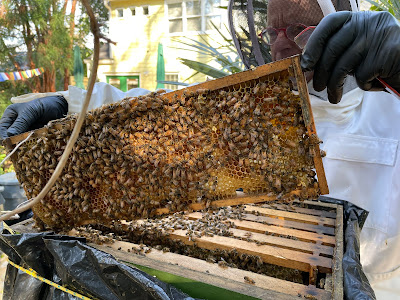
In the previous post using external measurements and observations, I postulated bees consumed honey and raised late-winter brood.   February 12th was my first 2022 hive inspection and I took action, well some actions!

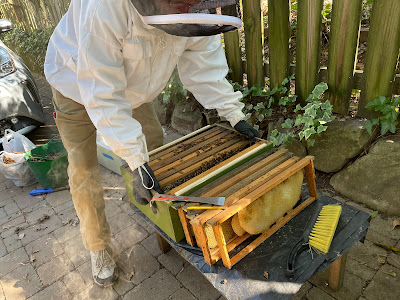
  • an 8 frame medium box with drawn comb was set aside from the hive - drawn comb is a luxury that I rarely have at hand as a crush-and-strain beekeeper
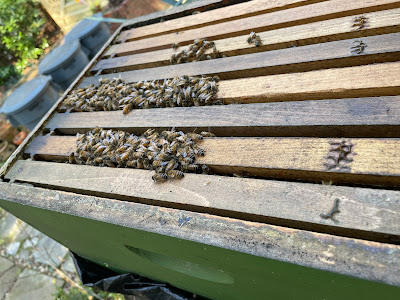
  • the bees had corralled small hive beetles above the inner cover - I crushed these beetles using the short edge of the standard hive tool or my finger
  • every other frame in the hive's top medium box was exchanged with every other frame of the set aside 8 frame medium box
  • the top medium box contained 7 frames of nectar and 1 frame of capped honey
  • the set aside medium box was placed onto the hive completing my 8-frame version of checkerboarding
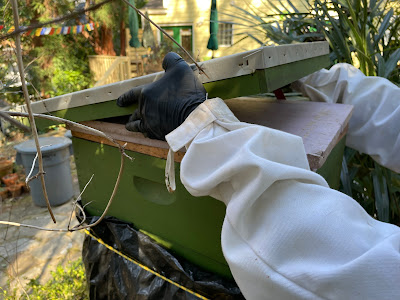
  • as more winter temperatures are expected, I returned the hard foam insulation above the inner cover and overlapped two hive cozys to cover the new medium box

Friday, March 27, 2020

2020 nectar flow

bee, beekeeping, checkerboarding, frame cleaner tool, honey comb, nectar, hive tool,
bee, beekeeping, checkerboarding, frame cleaner tool, hive tool, honey comb, nectar,
15 days ago, I checkerboarded and added a medium box.  Today I repeated that process to keep up with the nectar flow.   My version of checkerboarding uses foundation-less frames with no drawn comb. New comb is drawn in a typical pattern of merging teardrop curves. 
bee, beekeeping, checkerboarding, frame cleaner tool, hive tool, honey comb, nectar,
I used the right angle end of the (traditional spring steel) hive tool to increase the space between frame top bars. Next I lifted the top bar end with a Frame Cleaner tool - that yellow handle tool in my right hand.  I've forgotten how I discovered this indispensable off-label use of the Frame Cleaner tool.

Thursday, April 11, 2019

2019 tulip popular

amur honeysuckle, bee, beekeeping, checkerboarding, clover, foundationless. invasive plant, nectar, swarm trap, tulip poplar,


amur honeysuckle, bee, beekeeping, checkerboarding, clover, foundationless. invasive plant, nectar, swarm trap, tulip poplar, spiderwort,
I discovered my first 2019 windfall of the tulip popular flower kind.  Also shown is an invasive shrub which attracts pollinators, amur honeysuckle.  Other nectar sources at this time (not shown) include white clover and spiderwort.

Last weekend, I entered the hives for the first time this year.   The honey cap of one hive was checkerboard using foundation-less frames with no drawn comb.  The other hive was left in its winter configuration.

Weeks ago, I set tree hanging 8-frame swarm traps, but yet to see any scout bees.

Thursday, April 5, 2018

tulip popular flower windfall

bee, beekeeping, checkerboarding, foundationless. walter t kelly, honey cap, nectar, Small Hive Beetle, tulip poplar, sustainable, swarm, swarm lure, swarm trap,
Today I discovered the first 2018 windfall of the tulip popular flower kind.  Tulip poplar flowers could be a valuable nectar flow for the bees if the weather cooperates - no hard rainfall please.

In late February for one hive and mid-March for the other hive, I checkerboard the honey cap using foundation-less frames with no drawn comb. Both overwintered hives are flying with nearly equal vigor and have an amazing low number of small hive beetles during hive inspections, but are not drawing comb as I expected.

On March 29th I hung 8-frame deep swarm traps from crepe myrtle trees and now wait for the first scout bees - apparently I'm waiting impatiently.

Friday, March 23, 2018

bees forage without pollinating

bee, beekeeping, blueberry, Carpenter Bees, nectar, foraging,
For years I've visited my neighbor's blueberries, but all I ever see is foraging bumble bees.  Today the visitors include carpenter bees and honey bees. There's something odd about this photo, have you noticed?  Bees are not entering the flower. Carpenter bees have chewed holes and honey bees forage without pollinating the blossoms. See this link from Cornell University.

Saturday, April 15, 2017

2017 nectar flow

bee, beekeeping, bloom, Carpenter Bees, checkerboarding, climate, clover, foraging, foundationless. walter t kelly, holly, honey cap, native solitary bee, nectar, spiderwort, tulip poplar,

bee, beekeeping, bloom, Carpenter Bees, checkerboarding, climate, clover, foraging, foundationless. walter t kelly, holly, honey cap, native solitary bee, nectar, spiderwort, tulip poplar,
Bee cooperative weather is supporting a strong nectar flow of holly bushes, white clover, spiderwort and tulip poplar. Native mining bees and carpenter bees are extremely active too.

This year, I started to checkerboard the honey cap of over-wintered hives on March 6th. Since then, I check the honey cap every three weeks. My version of checkerboarding uses foundation-less frames with no drawn comb. Yesterday, I added another medium box to each hive. I don't know how long this nectar flow will last, but I have monstrously tall hives.

My swarm capture is drawing comb and growing in size too, but at a much slower pace than over-wintered hives.  

Tuesday, March 27, 2012

tulip poplar flower 2012

I discovered fully opened tulip poplar flowers in the backyard.    Previously I only found tulip poplar flower heads which were not fully opened.  The squirrels are very helpful in nibbling flower heads and then dropping them to the ground for my inspection.    This may be the big nectar flow that the bees have been waiting for.

Earlier, I may have made a blog error reporting that all my spring markers appeared before day 71.  Actually I now think that the invasive Asian Wisteria bloomed after day 71.

Sunday, July 17, 2011

bees on calamintha nepeta

bee, beekeeping, foraging, nectar,


A neighbor is attracting hundreds of pollinators.  The plant, or should I say perennial, sits in full sun with tiny flowers and a strong herbal fragrance.  But what is this fragrance?  My neighbor helped me out and said, "mint" - does not look like any mint with which I'm familiar.  With the help of Google Images, I'm fairly confident that the plant is calamintha nepeta.

Wednesday, April 27, 2011

holly bush bee forage


In my experience, it is a rare treat to discover bees foraging at eye level.  Presumably the bees are making flights to the tree canopy and our planted flowers and bushes are not the destination of their foraging.  This is an exciting exception, as the morning air warms up I have discovered bees foraging on the holly bush and later in the afternoon warmth I found bees foraging on the winter jasmine (not shown).

Sunday, April 10, 2011

tulip poplar flowering

On the 8th of April, I saw the first sign of a partially open tulip poplar flower on the ground.  Lately, the daytime temperatures have reached 85 °F and I am finding fully opened tulip poplar flowers on the the ground.  If the weather cooperates (unlike last year), then perhaps the tulip poplar flowers will provide a great nectar source for the bees.